
TAGS
ON CAMPUS
STUDENT LIFE
OFF CAMPUS
EDUCATION

GOVERNMENT
MONEY
COOL
VARSITY BLUES
UTSU
ADMINISTRATION
BIOLOGY
ART
MUSIC
FOOD & DRINK
ELECTIONS
IN THE LAB
FACULTY
TECHNOLOGY
HEALTH
FILM
PROFILE
NUMBERS
INTERVIEW
LITERATURE
PSYCH
BRIEFS
THEATRE
LOVE & SEX
DESIGN
GENDER
ENVIRONMENT
LONG FORM
POP CULTURE
THE VARSITY
SPACE
LAW
PRO SPORTS
SIMCOE HALL
TORONTO
HUMAN RIGHTS
MISSISSAUGA
UTSU DEFEDERATION
FROSH
SCARBOROUGH
PHOTOGRAPHY
INFOGRAPHICS
FAITH
BEST OF 2012
GUIDES
LGBTQ
FASHION
RACE
DRUGS
ALUMNI
EUREKA
EDITORIAL
DANCE
SGRT
RELIGION
JOURNALISM
INTRAMURALS
JOB MARKET
COMMUTE
INVESTIGATIVE
PODCAST
University of Toronto's Student Newspaper Since 1880

SGM approves online voting for upcoming election

Update: UTSU board of directors approves election procedure, no online voting

By Zane Schwartz
Published: 8:27 am, 13 February 2013
Modified: 3 pm, 11 May 2013
under
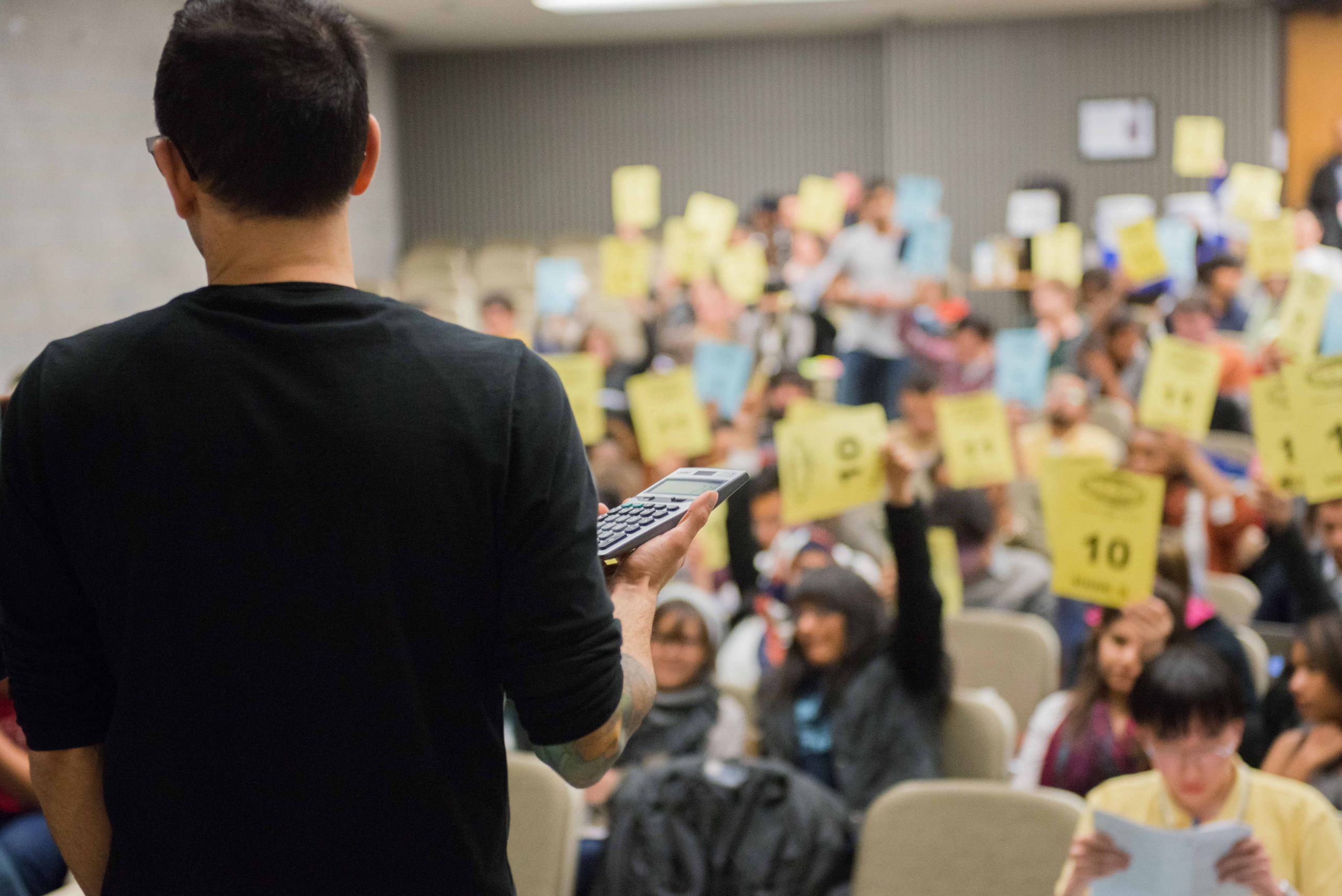
Meeting chair Ashkon Hashemi counts votes at the original UTSU SGM. Only one motion was voted on at Tuesday's continuation, with the meeting losing quorum shortly thereafter. BERNARDA GOSPIC/THE VARSITY
UPDATED

Update: The UTSU Board of Directors met Wednesday evening to approve electoral policy recommended by the Elections and Referenda Committee (ERC) for the upcoming executive and board of director elections. The policy, which passed with an overwhelming majority, does not include online voting, nor any of the other major provisions outlined in the Non-Partisan Declaration on UTSU Electoral Reform, which was voted on by students at the SGM on Tuesday.

UTSU vice-president, internal & services Corey Scott explained that it was not procedurally possible to include any revisions to the policy coming out of Tuesday’s SGM because “Saturday was the last day to consider amendments to the electoral code.” UTSU president Shaun Shepherd, who indicated on Tuesday that he would speak in favour of online voting at the board meeting, did not attend. 

Ashkon Hashemi, chair of both the board meeting and Tuesday’s SGM, explained that the only options the board had were to approve the recommendations of the ERC, or to send them back to change them. The union’s bylaws do not permit board members to alter the ERC’s recommendations in any way. The motion to implement online voting and consider the other parts of the Declaration was a directive-based, non-binding motion.

The union’s regulations require 72 hours notice to hold an emergency ERC meeting, and the union needed to finalize their rules by Wednesday night, in time for the nomination period for elections to open on Thursday. Several prominent opposition members had previously indicated to The Varsity that they would likely not pursue defederation referenda this year if online voting passed at the board meeting. Rishi Maharaj, president of the Engineering Society and Sam Greene, co-head of Trinity College, will meet with vice-provost, students Jill Matus on Thursday to discuss next steps.


A motion calling for online voting in UTSU elections was narrowly approved Tuesday night at the second part of the UTSU’s special general meeting (SGM), by a vote of 575–567.

UTSU president Shaun Shepherd said he was disappointed that repeated attempts to “offer the olive branch” to college heads had been ignored or rebuffed. Several colleges and faculties whose leaders backed the motion announced Sunday that they were considering severing ties with the union.

“I’m just so fed up with this school,” said Shepherd in the aftermath of the vote.

The motion called for online voting to be implemented in time for the upcoming UTSU election, and for the other recommendations of the Non-Partisan Declaration on Electoral Reform to be examined again.

An emergency meeting of the Elections & Referenda Committee (ERC) was held directly after the SGM. The Varsity was barred from attending that meeting.

Shepherd said the committee would make a formal recommendation to a regularly-scheduled meeting of the UTSU’s Board of Directors set for tomorrow.

“Irrespective of whether or not we agree with them, we have to honour them — that’s democracy,” said Shepherd, explaining that he planned to speak in favour of implementing online voting at Wednesday’s board meeting. Shepherd said his only concern was logistical: that the Office of Student Life would not be able to implement online voting in time.

Corey Scott, UTSU vice-president, internal & services and an ERC member, suggested during discussion of the motion that the university administration could not oversee the vote as it was a “conflict of interest,” since the university had an interest in the outcome of the election.

“The University has encouraged the use of online voting and has made available a secure process, UelecT, which many student groups currently use,” a university spokesperson said this weekend.

The union’s Elections & Referenda Committee has already made several changes to this year’s election process based on a recently-concluded legal review. The changes are limited to clarifications about times lines and appeals processes.

The motion calling for online voting is “directive-based,” and not a binding measure, unlike the bylaw amendments passed in prior meetings of the members.

Preparations for March’s election already appear to be underway, based on the minutes of the ERC. Chief returning officer Eric Luong is set to hire 45–50 poll clerks, and funds have already been set aside to book space for polling locations on campus. The Arts & Science and Graduate students’ unions have also been invited to select representatives for influential election appeal committees.

College leaders remained adamant. “If the union decides not to implement online voting and the recommendations passed at the SGM, they will be doing so in direct contradiction of the wishes of their members,” said Sam Greene, head of Trinity College and an early backer of the Declaration. “That would be egregious, both procedurally and morally.”

Nominations for UTSU elections open Thursday morning. Wednesday’s board meeting will determine whether and what, if any, changes to the electoral code will be made in time for this year’s elections.

The meeting was held simultaneously on two campuses, with students at the University of Toronto, Mississauga, using Skype to speak and vote. Chair Ashkon Hashemi said that the UTSU bylaws are “silent” on whether electronic participation is allowed, and permitted it on his own authority.

Following the vote on electoral reform, Hashemi ruled a motion calling for UTSU clubs’ membership to be comprised entirely of UTSU members out of order.

Quorum, the minimum number of people required to hold the meeting, was lost shortly thereafter, when a number of students left both the St. George-campus meeting room and the Skyped-in location in Mississauga abruptly. Remaining items, including GTA-wide transit passes and a mental health campaign, were not addressed. Union directors promised to raise both issues at tomorrow’s scheduled board meeting.

  • http://twitter.com/BenDionne Benjamin Dionne

    Irony: voting against online voting via skype.

  • http://www.facebook.com/samgreene11 Sam Greene

    “Irrespective of whether or not we agree with them, we have to honour them — that’s democracy,” said Shepherd

    It’s amazing that it’s taken 6 months and three General Meetings for someone from the UTSU to say this. We’ve had to drag the Union kicking and screaming towards even the most straightforward of changes that members clearly want. It should never have been this difficult. Last night was a victory, but it was a victory in a battle that we should never have had to wage in the first place.

    I’m genuinely confused by Mr. Shepherd’s claims of frustration about extending the “olive branch” to the Colleges and Faculties. If anything, we extended the olive branch to him and his team from the late summer onwards, and all we were given was vague, insubstantial promises that this year would be “different”, and delays, delays, delays. I met with Shaun every month from August to now, and nevertheless it took three General Meetings to get him to change his position. The Non-Partisan Declaration on UTSU Electoral Reform, which I wrote in the late-summer/early-fall, subsequently endorsed by 7 College and Faculty Councils, begins as follows:

    “No matter your politics, and no matter who you voted for in
    the last UTSU election, one thing is clear: it’s a problem that every year,
    elections end up being fights over the rules of the elections themselves and
    over competing allegations of misconduct. Nobody benefits, least of all
    students, from elections that focus on procedural fights, and not on an honest
    debate over how best to serve the student population.

    Those who have supported incumbents and those who have
    supported opposition candidates need to find common ground on at least one
    important issue: electoral reform. Let’s put these issues to bed once and for
    all, so that UofT students can have the elections they deserve.”

    If the UTSU Executive had simply taken that message to heart, we could have solved these issues in the fall, and right now we could be talking about how to unite the campus behind improving student life, student services, educational quality, and financial accessibility. But we needed leadership at the UTSU that was willing to embrace change. That didn’t happen – and that’s why we are where we are now.

  • MrSnowDay

    Irony, voting against carrying proxies…with proxies #hypocrite

    • Pierre Harfouche

      Go home. Respect the vote – it is done. No need for personal attacks.

    • http://www.facebook.com/aimee.quenneville Aimee Quenneville

      Hello troll with irrelevant name,
      I spoke in favour of reducing the number of proxies available for collection by each individual student, and on principle I have never utilized the absolute affront to democracy that is the proxy system. Are you aware of why that motion failed to carry?

      It’s because people like me, who support self-representation in fair and free elections, were holding up papers with a ’1′ on them, and 50 or so UTSU executives and their supporters were holding up papers with an ’11′.

      You know what irony is? Irony is losing a vote against an unfair proxy system because the system is run by a few people with a lot of proxies.

      • greg eisman

        maybe that’s what he meant

  • Hardy Weinberg

    When did your university get filled with so many Alanis Morisette Fans? http://www.youtube.com/watch?v=Jne9t8sHpUc

  • Pierre Harfouche

    It’s a shame I can’t declare I’m fed up with the UTSU and then have a democratic right to vote to leave the Union.

    4 months of crazy attempts by the UTSU’s allies to stifle debate, vote in favor of an AGM agenda that was empty and vote in favor of adjourning a meeting early – and FINALLY we get someone who is willing to stand up and say: “I guess we should respect our members”.

    I’m fed up:
    with the UTSU.
    with the dirty tricks, deception and lies.
    with meetings not being advertised to students.
    with the fact that other colleges have to advertise your AGM because you don’t. with the possibility of attending the SGM remotely not being promoted.
    with the fact that our EngSoc President, Trinity Heads [Insert name of college if applicable...] had to waste this much time and effort passing 1 motion.

    I can’t even begin to imagine the amount of time it will take us in future years to debate the merits and changes that need to be made to the new voting system.

    • SoFedUp

      And it is funny that Shaun did not even attend the Board meeting to speak on behalf of the democratic vote.

  • 95

    This is all Episkopon’s fault.

    • Pakenham Edward Stewart

      Man, I ain’t even do shit this time.

  • Ban Zai

    Shaun Shepard is a sore loser and a p***y.

  • Dennis from Utah

    Irony: women voting on men’s rights!

    • Anonymous

      Not entirely sure you know what irony means.

    • Actual Student at UofT

      This is completely irrelevant to this article just as the other misogynistic comments all of you AVfM supporters like to swamp The Varsity with are. Please go away and find something better to do with your time

    • http://twitter.com/BenDionne Benjamin Dionne

      GTFO

  • Alumnus

    On the logistical issues, speaking as a former CRO at the college level with knowledge of the relevant processes and technologies, it will be challenging to get things done for this election, given the timelines involved. But – if undertaken wholeheartedly – it should nevertheless get done on time. Failure to get it done would I think in these circumstances constitute either incompetence or wilful disregard for the opinions expressed by the student body.

    I wish the ERC and UTSU CRO the best of luck in rapidly implementing online voting. The student body is watching.

  • Shaishav Shah

    You know, when I am fed up with something, I usually quit. When I’m fed with someone, I quit, or at least, let the other person quit. I wonder what is stopping Mr. President from quitting, or at least allowing EngSoc and Trin from seceding.. Could it be money and power? Nawww..

    Now, I am no genius, but when the “democratically elected” President is fed up with a university that prefers democracy, I assume it is known as “irony of the highest order”..

  • http://www.facebook.com/samgreene11 Sam Greene

    I find this hilarious:

    “Ashkon Hashemi, chair of both the board meeting and Tuesday’s SGM, explained that the only options the board had were to approve the recommendations of the ERC, or to send them back to change them. The union’s bylaws do not permit board members to alter the ERC’s recommendations in any way.”

    First off, I think that this is complete nonsense given that these proposals could have been adopted long ago by the union, and it’s obvious that they intentionally delayed these discussions in order that they could claim to be bound not to change the rules. But secondly, I PROPOSED a BYLAW amendment this fall AND this spring to ALLOW the Board of Directors to debate and amend rulings of the ERC in order to increase transparency. The policy and procedures committee did not even allow it to go to a vote. So, the UTSU CREATED this situation by refusing to allow commonsense changes.

    • Pierre Harfouche

      LOL.
      “But secondly, I PROPOSED a BYLAW amendment this fall AND this spring to ALLOW the Board of Directors to debate and amend rulings of the ERC in order to increase transparency. The policy and procedures committee did not even allow it to go to a vote. ”

      So you mean to say that someone on the exec has been planning this since day 1? This is not news to me.

      But it’s ok, I think most people are familiar with “karma”.

    • Ryan Bradley

      While I am by no means apologizing for what appears to be some careful manipulation to avoid the implementation of online voting, I do understand the desire not to have the Board directly amend the recommendations of a sub-committee.

      I cannot speak directly for the UTSU, as I have never sat on a UTSU sub-committee. However, from my own experience as a student leader, a lot of time and discussion often goes into the decisions made at a sub-committee level. For the Board of Directors to make amendments to these recommendations, the same level of discussion should take place and amendments should not occur at the whim of the Board. I am a stronger proponent of refusing to accept the recommendations of the sub-committee and sending back suggestions for changes, with the recommendation that interested Board members take part in sub-committee meetings.

      That being said, I think it is egregious that the UTSU removed all power from the Board of Directors in this situation. By scheduling ratification of the ERC’s recommendations for the night before nominations open, the Board was being implicitly told to accept them at face value, as there were clearly no plans to even considering delaying the nomination period (and the rest of the election schedule).

  • Michael

    One wonders why the UTSU executive did not call an emergency ERC meeting for say Wednesday morning sometime (say last week) in anticipation that the electoral reform motion might pass. It doesn’t pass, you cancel the meeting; if it does pass, you look up the rules from a couple of years ago when the Elections Procedure Code did include provisions for online voting. It is really not that difficult…

    • Michael

      So I am apparently mistaken. Upon reading the actual article (and not just the bolded bit), apparently the ERC did meet with enough time to make requisite changes. Why they did not escapes me.

      “An emergency meeting of the Elections & Referenda Committee (ERC) was held directly after the SGM. The Varsity was barred from attending that meeting.”

  • Hardy Weinberg

    There is only one solution to this problem: DEFEDERATE NOW!

  • http://twitter.com/BenDionne Benjamin Dionne

    When you corner yourself, you can’t blame the wall for being in the way.

  • Anonymous

    See yah, VUSAC, TCM, EngSoc. If you love something, set it free!