
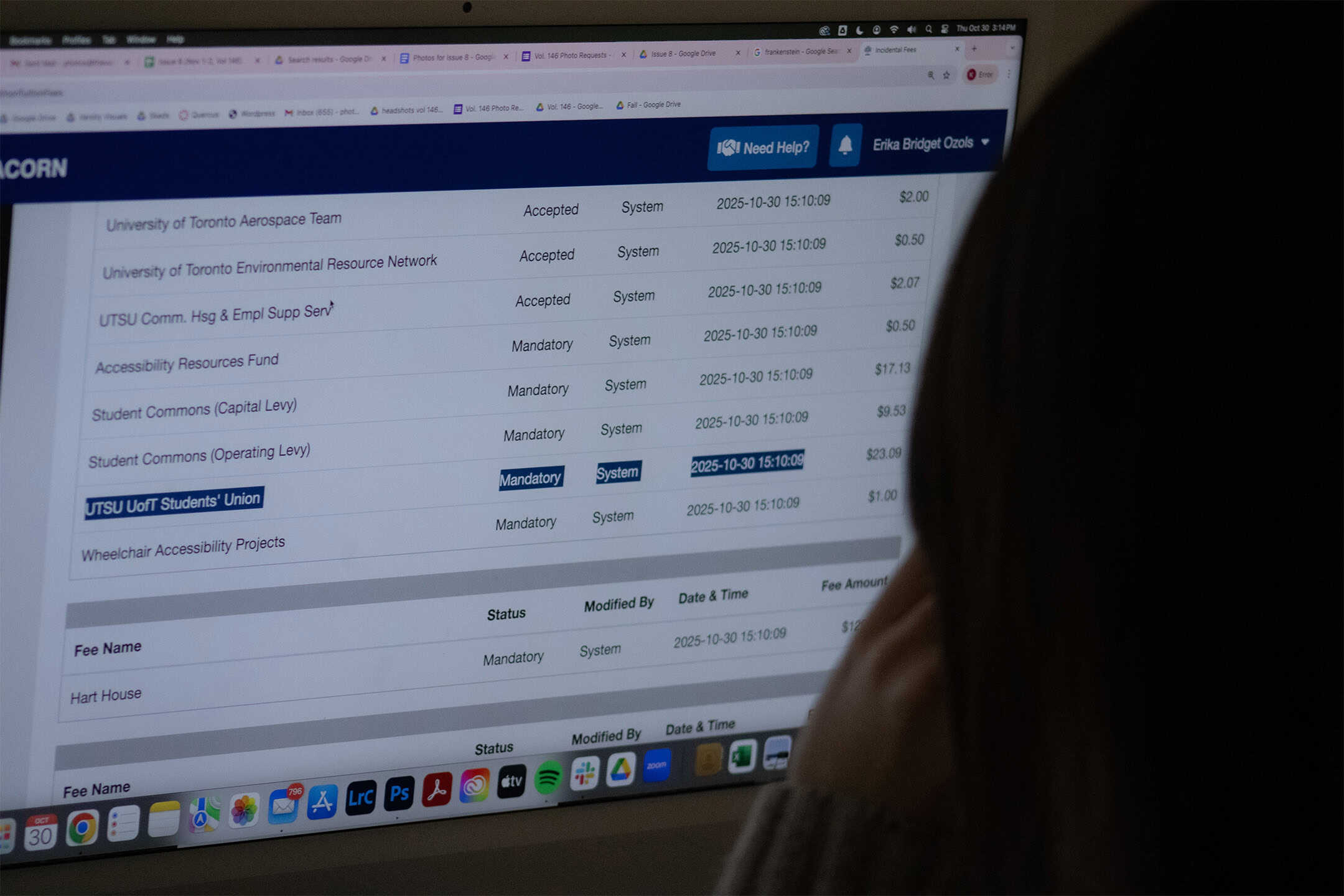
Every year, around mid-July, U of T releases invoices for the upcoming fall and winter sessions. Nestled among tuition charges, program fees, and residence costs are “ancillary fees” directed to the University of Toronto Students’ Union (UTSU), the primary body representing undergraduates at the St. George campus. Ancillary fees are mandatory charges that fund services, programs, and organizations beyond tuition, ranging from health insurance to campus events.
While the trivial amounts students pay may go unnoticed, collectively, it adds up to more than $25 million annually. In fact, the UTSU is one of the largest student-run organizations in Canada in terms of personnel.
The hidden scale of ancillary fees
The average full-time undergraduate pays approximately $350 in U of T ancillary fees each semester.
Instead of appearing as one large charge, these fees are scattered across the invoice in many smaller amounts. This year, for instance, UTSU fees included $142.41 for the health plan, which provides extended medical benefits in addition to basic coverage such as the Ontario Health Insurance Plan (OHIP) or University Health Insurance Plan (UHIP). Another $119.04 went toward the dental plan. Overall, health and dental coverage make up almost 75 per cent of UTSU fees.
Other UTSU fees include a general membership charge and a Student Commons charge. Together, these fees illustrate how each student contributes to sustaining the wide range of services and resources available at U of T.
How budgets are made
UTSU’s budgeting process mirrors that of larger institutions. Budgets are built around historical spending patterns and reviewed annually by the UTSU’s Board of Directors following recommendations from their Finance Committee. The committee oversees all of the union’s financial operations, including the budgeting process, before forwarding its guidance to the Board.
The Board itself is made up of 12 U of T students, mostly undergraduates, who, alongside essays and midterms, are also responsible for managing a multi-million dollar budget. For some, that might sound intimidating — the same people pulling all-nighters at Robarts are also deciding how your health plan is funded. For others, it is reassuring, a sign that the UTSU is genuinely run by students.
The UTSU strives to dedicate its funding to initiatives that help students. “The UTSU hosts a wide range of events throughout the year, including orientation sessions, social activities, and workshops, all of which are open to every student at no additional cost,” wrote Elizabeth Shechtman, Vice-President of Operations, in an email to The Varsity. Many programs are also designed to meet practical needs. “For example, we organize tax clinics, mental health and wellness workshops, and skill-building sessions to provide guidance and resources that directly benefit students.”
The health and dental plan is also funded through ancillary fees and provides healthcare coverage for tens of thousands of students, including medical and paramedical care. The UTSU also offers the Student Aid Program (SAP), a program designed to alleviate students’ financial burdens by providing direct aid to help with living and academic expenses, distributing more than $400,000 directly back into students’ pockets.
Additionally, clubs receive $250,000 in funding from UTSU to run events and have access to free space in the Student Commons. The union also runs the only food bank on campus and operates a subsidized café in the building.
Surpluses and reserves
UTSU financial statements show that the union often finishes the year with more revenue than expenses — in 2024, they had a surplus of $1.24 million, while in 2023, they had a surplus of $1.33 million.
These surpluses are not left idle, but are instead moved into reserve funds — savings accounts set aside for specific purposes. They allow the union to prepare for future costs, cover unexpected expenses, and ensure services can continue even if revenues fluctuate.
Currently, UTSU maintains three major reserves. The largest is the health and dental reserve, which holds about $5.7 million to protect against future increases in insurance premiums. The capital and operating reserve, worth $882,707, supports continuity of services. A third fund, the human resources reserve, was created in 2024 and currently holds $200,000 to help with staffing-related costs.
While these reserves may seem steep, Shechtman emphasized that “future financial stability and direct, immediate student service is a balance for any student association.”
When broken down into separate, smaller fees, UTSU fees may seem insignificant, but when added together, they sustain the programs and services that shape everyday student life.

No comments to display.