
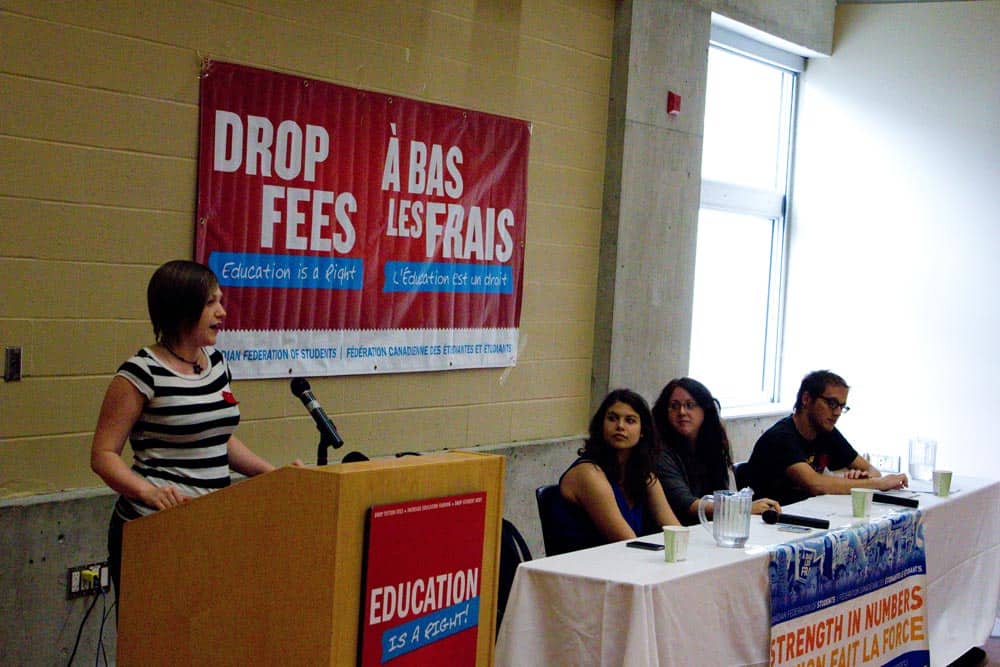
On July 19, at Ryerson University, student strikers from Quebec delivered “Lessons From Quebec” to a capacity crowd at the Campus Student Centre, the ninth of ten stops on a nine day, whistle-stop tour of Ontario sponsored by the Canadian Federation of Students-Ontario.
In her introduction Melissa Palermo, vice president-education of the Ryerson Students’ Union, warned that anyone who failed to exhibit “solidarity” would be asked to leave the presentation.
New CFS-O chair Sarah Jayne King speaking at Ryerson University. MOHAMED OMAR/THE EYEOPENER
After brief remarks from Sarah Jayne King, chair of the Canadian Federation of Students (Ontario), the first speech, by Marianne Breton Fontaine, editor of the Young Communist League’s magazine Jeunesse Militante, and candidate for Quebec Solidaire, began.
In her address, Fontaine situated the student strike in a larger context that included not only other decisions on education by the Charest government, but the Harper government’s controversial budget bill, the struggles of Chilean democracy activists, and the efforts of South African student organizations to combat apartheid in the 1990s. The student strike in Quebec, she argued, was not about numbers or tuition, but securing the future from “ignorance, death, and poverty.”
Fontaine was followed by Audrey Deveault, chair of the Dawson Students’ Union at CEGEP Dawson in Montreal. In her brief speech, Deveault recounted her experiences preparing for an ultimately unsuccessful strike vote at Dawson, including alleged interference by the administration.
Hugo Bonin, interim spokesman for La CLASSE, the most radical of the student organizations participating in the strike, concluded the evening with practical advice for students seeking to fight the “commodification of education.” Although the Quebec strikes were started by “about 50 people,” he said, they succeeded because it was a democratic movement. Bonin said a successful strike is achieved only with “blood, sweat, and tears” and picketing to prevent “scab” students from attending classes.
Ending on a note that had recurred throughout the previous speeches, Bonin assured the audience that the strike in Quebec was not just student activism. It was, he claimed, a social movement.
