
I sat boredly in my American history tutorial on the cloudy afternoon of September 10, trying to think of something smart to contribute to the class discussion. Suddenly, someone raised their hand and said, “I have some news. Charlie Kirk was just shot.”
On September 12, US federal and Utah law enforcement arrested a suspect, Tyler Robinson, in connection with the fatal shooting of Kirk at Utah Valley University. News articles, broadcast interviews, and social media comment sections have since turned all their attention to the political and social implications of Kirk’s death. In response to the video of Kirk’s shooting being circulated so widely, Utah Governor Spencer Cox said, “Social media is a cancer on our society right now.”
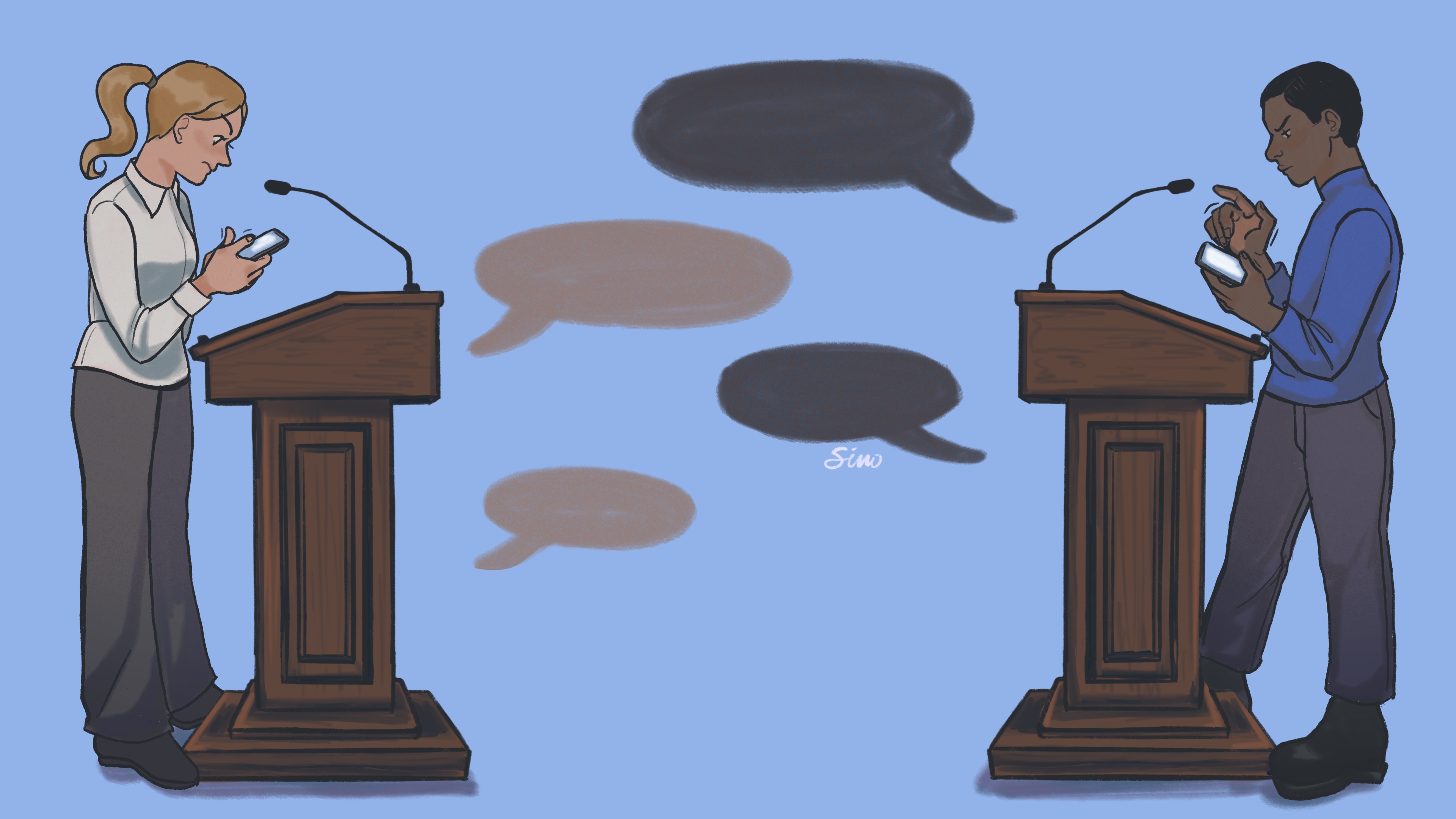
Cox’s statement reflects a widespread sentiment about debate culture — that social media has negatively and destructively influenced how we exercise free speech, especially surrounding political topics.
Social media is now a major source of how we receive our news, and has made the circulation of news faster than ever before. It is our responsibility to recognize the implications of social media as a means of information itself.
As Canadian scholar Marshall McLuhan said: “The medium is the message.” McLuhan reminds us that all technology is simply an extension of ourselves, and that constant innovation results in personal and social implications inseparable from the technology’s medium.
“Nobody wants to read a moderate tweet. They want to read a crazy tweet.”
A 2023 Statistics Canada report revealed that nearly half the Canadians surveyed received their news from social media accounts unaffiliated with news, government, or science organizations. Social media is dominating as a platform where people consume ‘news’ content. So, how does it shape our current political debate climate? How do we shape political debate through social media?
When asked by his parents after being brought into custody why he allegedly killed Charlie Kirk, Robinson said, “The guy spreads too much hate.”
Kirk’s shooting was widely condemned among US citizens, with many agreeing on social media that Kirk was guilty of spreading excessive hate. His digital footprint has made a significant contribution to social media debate culture, especially to debates about free speech, when it should be restricted, and how this contention is extremely politicized.
Kirk was notorious for videos where he debated college and university students. A college student in one of these debates asked Kirk, “Do you feel proud of yourself for debating college kids who are unprepared to speak in front of an audience?” This quote also highlights that much of his audience, as well as the individuals he chooses to debate, are younger and less experienced with debating than him.
In an interview with The Varsity, second-year international relations student Oscar Kraemer said, “There will be 14-year-old boys watching [Kirk’s appearances on] Jubilee’s videos, and they don’t know any better. They are very susceptible to all forms of [political] content [on social media].”
This is illustrative of the ease with which political ideas disseminate to youth via social media. In Kirk’s case, this is harmful, as much of his political rhetoric is discriminatory to marginalized groups. Kirk’s debate tactics of rapid-fire questioning and speaking over his opponents consequently incentivize his audience to repeat his rhetoric.
Gamal Mansour, a PhD student in political science, comparative politics, and international relations, similarly expressed how “in an unregulated mess such as social media right now, it is a free-for-all.” He explained that more than anyone, users of social media control its content because there is no [mediator]. “We’re stuck with a space where it’s all about angry responses.”
As Geoff Dancy, Associate Professor of political science at UTM, said in an interview with The Varsity, “Nobody wants to read a moderate tweet. They want to read a crazy tweet.”
“In the national or the global marketplace of ideas, the things that we’re seeing are the things that are pushing boundaries in promoting radicalism. And it’s because those get more eyeballs and they’re more titillating than moderate ideas.” He added that there is often a difference between how people are in person, and “their online selves,” and that there is “possibly a relationship between being very online and being drawn to extreme ideas.”
If social media is pushing the most ‘click-worthy’ content, users in turn exploit those algorithms, using tools like hot-topic keywords, shock-factor visuals, and hashtags to procure views and engagement.
But when we keep manipulating this algorithmic form of social media, doesn’t this incite us to abuse our free speech by being deliberately controversial just for clicks and likes?
Free speech policies at U of T
Walking through the UTSG campus, light poles and postering structures are littered with posters inviting passersby to debate various topics. Along this stretch of St. George Street, there are sometimes tables set up where students are invited to speak on various social, political, or even religious topics. It’s not uncommon to find someone handing you a flyer about communism on your way to class.
The freedom to engage in debate and conversation with each other is protected by U of T’s Statement on Freedom of Speech.
Part of the Statement reads: “All members of the University must have as a prerequisite freedom of speech and expression which means the right to examine, question, investigate, speculate, and comment on any issue without reference to prescribed doctrine, as well as the right to criticize the University and society at large. The purpose of the University also depends upon an environment of tolerance and mutual respect.”
While U of T appears to encourage a free speech culture on the tenets of tolerance, respect, and anti-discrimination, some students feel that in the classroom, their free speech is limited.
A May 2025 report by Randy Boyagoda, Provostial Advisor on Civil Discourse at U of T, found that students feared facing consequences for expressing their opinions in assignments or lecture halls, such as getting ‘cancelled,’ or receiving a bad grade from a professor who simply disagrees with them.
“Respondents reported that atmospheres where viewpoints were seen as highly polarized often served to shut down discussion. It was observed that in such environments, emotions are often heightened, leading to conflict, upset, and personal attacks.”
First-year cinema studies student Andrew Carragher attested to this, explaining that he feels ideas are often politicized in the classroom. He gives the example of how, in his English class, discussions of Critical Race Theory have elicited the question of “Whether or not we should give Indigenous people their land back.”
He argues that questions like these should be posited in neutral rather than opinionated ways. Otherwise, students lack “the freedom to make their own opinions and formulate their own ideas.” Carragher adds that “we should give people a platform to have their opinions, but we should also have the ability to fact-check their opinions.”
This Civil Discourse report seems to expose an incongruency between U of T’s formal statement on free speech, and students’ experiences expressing their views on campus. Social media’s exacerbation of things like political polarization and sensationalism has trickled down into classrooms, making students afraid to exercise the tenets of free speech that U of T promises them.
Mansour touched on free speech restriction, and explained that we “are policing freedom of speech on the other side [of the political spectrum] because it happens to disagree with our content because we think it’s dangerous.” He elaborated that as debate culture expands on social media, “the instantaneousness of our actions right now is killing the deliberative process, the deliberation, the time…We’re talking over one another’s heads. We’re no longer talking to each other.”
I agree with Mansour’s argument that we have come to forget the fundamental element of listening to each other’s sides in contemporary political debates — evidently facilitated by the algorithmic, fast-paced, and strategic use of social media.
“I miss the time when we used to have to think and pause before we took an action.”
Student stories
The social media sensationalization of Kirk’s death has evidently elicited questions about free speech on campus at U of T. Students that I interviewed discussed many perspectives on how they feel about expressing their views on campus, with attention to the role of social media in the conversation.
First-year humanities student Rennick Kosekela referenced a recent event at Toronto Metropolitan University (TMU) in our interview.
At TMU, a pro-Palestine demonstrator was shoved to the ground by a campus security guard. In a video posted on social media, the protester is heard allegedly saying, “Get off me. You’re hurting me. I can’t breathe.” The widespread circulation of this video is attributable to social media, and the video has elicited responses from students a few blocks west, at U of T.
Kosekela expressed how, in comparison to TMU, he feels that U of T’s “environment… is pretty open to say what you want without judgment,” and that he has “had no issue with the way professors are handling… harsh topics.”
Olivia Bello — second-year political science and peace, conflict, and justice student — disagrees. “When it comes to academic discussions [at U of T],” Bello said, “I think there is more to be done in terms of amplifying perspectives which may not have received as much attention as they should have in the past.”
“Within the classroom setting, there seems to be a tendency to avoid normativity when it comes to certain topics… For example, taking a neutral stance when it comes to the ongoing genocide in Palestine.”
In July 2024, U of T was granted an injunction to shut down a pro-Palestine encampment in King College Circle. “U of T’s response to the protest, the encampments, and support of the Palestinian cause was very repressive,” felt Bello, “ to the point where now there are very limited forms of action that students are allowed to take on campus… In that case, [free speech on campus] is being threatened.”
In October 2024, following the encampment, U of T updated its Policies on Protests with statements like “Constructing tents, encampments, fences, barriers, or other structures is not permitted,” and “U of T allows peaceful protest that does not interrupt University activities – including classes, meetings, or other University business.”
Yet many sources agree that disruption of the everyday is inherent to the very practice of protest, which seeks to interrupt people’s sense of normalcy to draw attention to a specific issue. U of T’s statement on free speech claims to entitle students to “the right to criticize the University and society at large,” but do its Policies on Protests truly align with this right?
Maintaining a healthy environment for debate and conversation on campus is especially important in today’s age, where social media is a prominent mechanism for political activities like organizing protests, spreading social movements, and even influencing our political ideologies. But misinformation and hate are easier than ever to disseminate, thanks to our frequent use of screens to engage in debates.
I believe that they can and should be addressed by meaningful conversations where we aim not to argue or retort, but to hear and understand.
What should we do? What can we do?
Mansour believes that social media is not the cause of people forgetting to listen to and deliberate with other people when engaging in political debates.“Social media is a reflection and an amplification of that forgetfulness,” he said. Social media is merely an extension of ourselves.
We shouldn’t be complicit in becoming susceptible to hateful and discriminatory rhetoric, amplified by social media algorithms. Instead, we can become a generation of people who are adept at recognizing and dismantling misinformation.
As members of one of the highest-ranking universities in the world, we are surrounded by tens of thousands of peers with different experiences and perspectives from our own. We know the importance of acknowledging and understanding different opinions, arguments, and ideas without jumping into states of hate or anger. We need to practise recognizing the way people use and manipulate social media algorithms to boost hate speech, and criticizing institutions like U of T, when we find that policies for free speech are inadequate and even harmful.
Only then will we be able to have productive conversations and debates when we disagree on issues, so that no one is left feeling ignored, unimportant, or further harmed by conversations.

No comments to display.