
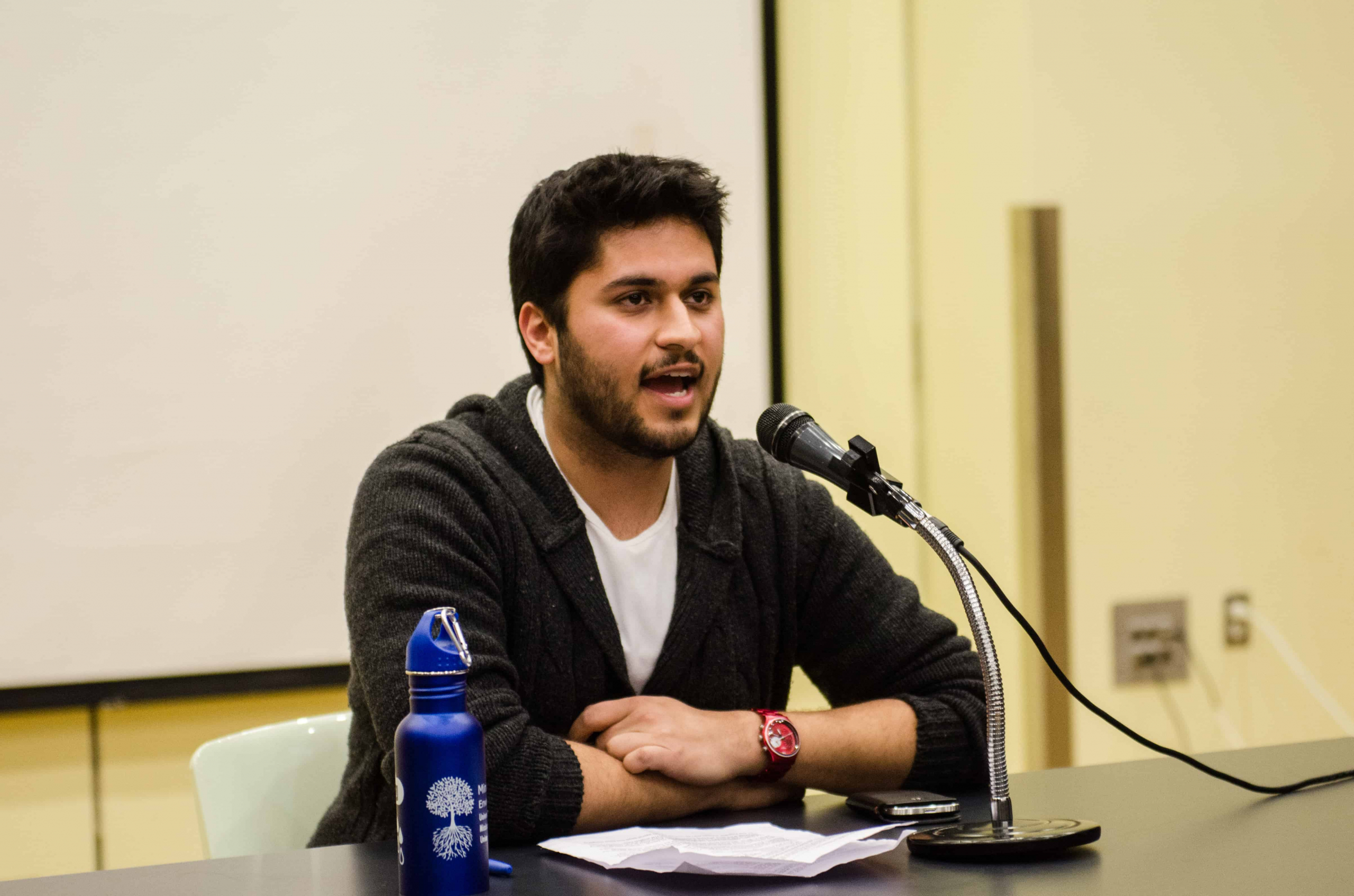
The five executive candidates from current vice president, university affairs Munib Sajjad’s Renew slate participated in a subdued all-candidates debate Wednesday afternoon. All five look set to be acclaimed to their positions next week.
The candidates emphasized the common themes that have shaped Renew’s campaign so far, including investigating and exposing illegal ancillary fees, improving the status of international students, and involving more people with the work of the union.
Sajjad, the presidential candidate for Renew, spoke passionately about the power of a united student body: “Across the world, we have seen students at the forefront of change. From toppling governments to bringing changes that affect students as a whole, students have been starting the conversation, leading the research and sparking mobilization everywhere,” he said. “This is the strength of the student movement.”
In a heated moment, Trinity College co-head Sam Greene noisily exited the debate after Sajjad declined to state whether he would consider legal action in a hypothetical scenario in which several divisions had voted and been approved to have their fees diverted.
“If a referendum were to be held at the UTSU, it is for all members to participate in, not specifically for one college or one small group,” said Sajjad.
Outgoing president Shaun Shepherd made a similar statement at a VUSAC meeting about fee diversion last week, saying that any vote about “defederation” or the re-routing of fees would need to be put to the entirety of the University of Toronto Students’ Union.
Sajjad did not address whether he would pursue legal action, instead saying that he hoped to meet with opposition leaders to discuss their concerns. Sajjad called for continued dialogue, as did several Renew vice-presidential candidates. Sajjad said he hopes to meet with the boards of directors of college councils, explain the work of the union, and convince them to stay.
Sajjad also said he believes that most students do not know what the Union actually does, and argued that if they did, they would likely be more supportive. He said too much time has been spent this year with “quarreling over minor and petty issues.”
The remainder of the two-hour debate was uneventful, with each vice-presidential candidate explaining their priorities for the upcoming year.
Vice-president, university affairs candidate Agnes So was unable to attend for personal reasons.
In a statement read by Sajjad on her behalf, So said her goals for next year include opposing illegal ancillary fees and flat fees. So also proposed instituting a drop credit policy that would allow students to select their lowest mark to exclude from CGPA calculations.
Yolen Bollo-Kamara, the candidate for vice-president, equity, focused on combating the “misogyny and sexism” of ‘men’s issues’ groups on campus, and continued support for the embattled Transitional Year Program.
Cameron Wathey, the candidate for vice-president, internal & services, said he plans to re-design the union’s website and expand the union’s photocopying services.
Vice-president, external candidate Sana Ali stressed the importance of unity, arguing that the union’s 47,000 members can accomplish more together than apart. Ali said she plans to maintain good relations with Queen’s Park, while lobbying to expand the eligibility criteria for the provincial government’s 30 per cent off tuition grant.
