
Content warning: This article mentions antisemitism and Nazism.
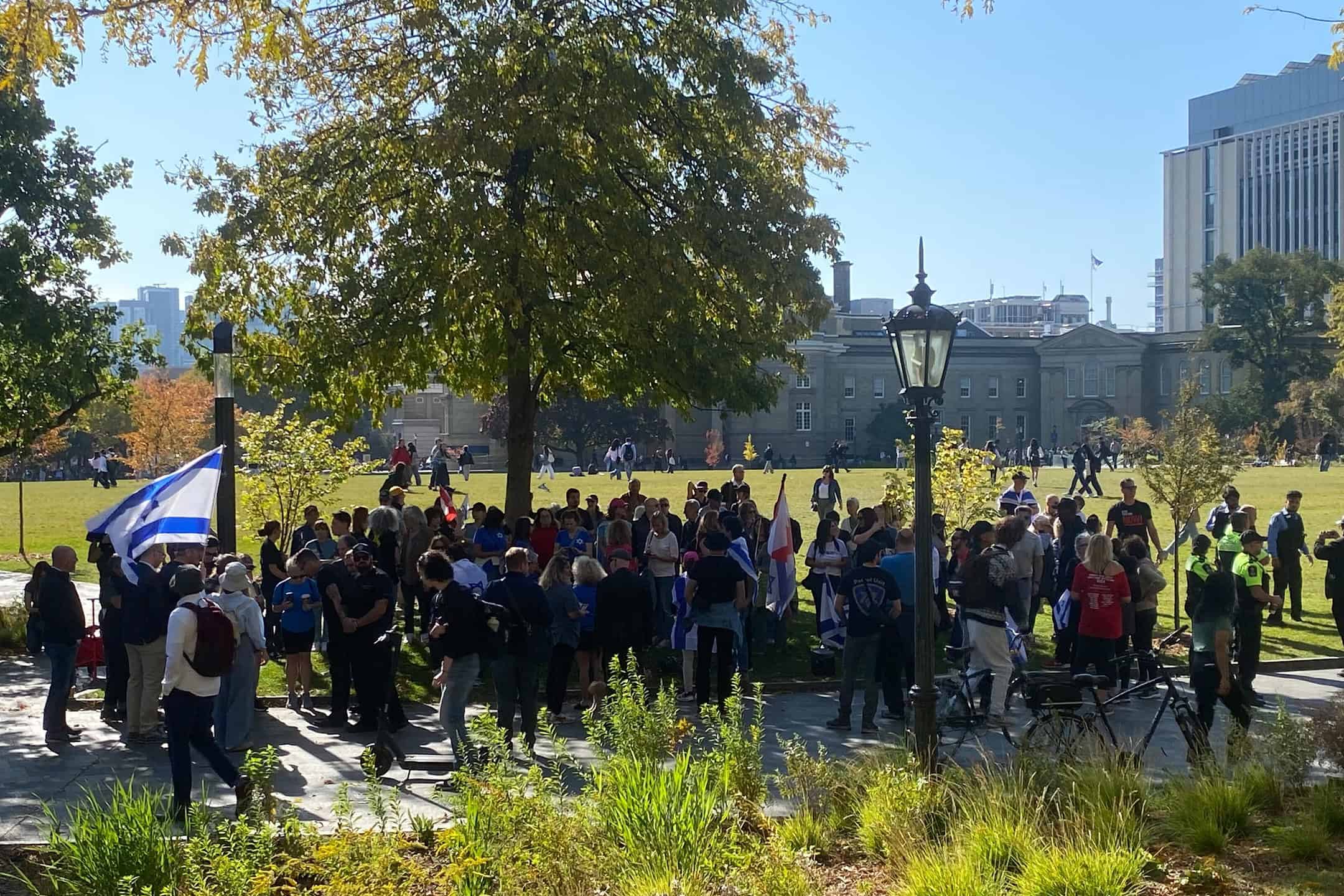
On October 21, a former assistant professor from Columbia University, Shai Davidai, held a rally at King’s College Circle protesting anti-Zionism and antisemitism at U of T. The rally marked the second day of his tour led by the Tafsik Organization — a group that rallies across Canadian universities to stand against antisemitism and anti-Zionism.
Davidai, who faces multiple allegations ranging from racism to doxxing, was suspended from Columbia University after reportedly harassing and intimidating university employees.
Davidai’s rally, O4P press conference
The student-led UofT Occupy for Palestine (O4P) group organized a press conference outside Simcoe Hall on October 21 at 11:30 am, immediately before the scheduled time for Davidai’s rally. The group condemned U of T for allowing Davidai on campus and disregarding concerns O4P raised about his presence.
“As Palestinian students and allies, we know from lived experiences that the University of Toronto’s administration is neither prepared nor willing to protect us… whether it was during the occupation of Simcoe Hall, at the encampment, or in our everyday campus life,” said Palestinian U of T student, Serene Paul, during the press conference.
Jewish community members also shared their perspectives on Davidai’s presence and the rally during the press conference.
“We [Jewish people] are not a monolith and… many pro-Israel counter-protesters have discredited the Jewish of myself and others by referring to us as ‘self-declared as well as self-hating Jews’… and have subjected us to threats of physical violence and doxxing. This erasure itself is deeply anti-semitic,” said Colin Pigeon Edwards, a Jewish PhD student in the Faculty of Music.
Sarit Cantor, a recent graduate of the masters of pastoral studies program at U of T — recently renamed to psychospiritual studies in September — and a member of the Jews Say No to Genocide Coalition, added, “Zionism has become a home for violence so vast, so destructive. The ways that Israel and its supporters stitch Judaism and Zionism together is a complete corruption of Jewish teachings.”
At noon, Davidai made his way to King’s College Circle and began the rally with a group of around 100 protesters. Among the protesters were the independent Zionist vigilante group Magen Herut Canada (Defender of Freedom Canada), who have been patrolling at U of T since the beginning of the semester, claiming they are protecting Jewish students.
Four Toronto Police Service officers were also present, along with U of T’s Campus Safety Special Constable Service and additional security presence.
As Davidai addressed the crowd, he shared the reasons why he had chosen to hold the rally at U of T, saying that “Hamas-supporting students and their professors” have made Canadian universities “uninhabitable for Jews.”
Allegations of harassing and doxxing students
Davidai and the protesters also repeatedly called on O4P members watching from the sidelines to remove their face coverings.
In an email to The Varsity, Sara Rasikh — an O4P spokesperson and second-year masters student studying social justice education — explained that Davidai’s “history of harassing and doxxing students” informed O4P’s decision not to counter-protest. As part of this decision-making, Rasikh highlighted U of T’s alleged instances of anti-Palestinian racism at the Simcoe Hall occupation, the encampment, and on-campus protests.
“Our restraint was intentional and grounded in a commitment to de-escalation. Time and again, we have witnessed UofT’s administration fail to create a genuinely safe environment for Palestinian and pro-Palestine students,” Rasikh wrote. “This consistent neglect has left us responsible for our own safety, which was a priority on that day.”
“Our aim was not only to ensure our community’s safety but also to uphold a stance that distinguishes free speech from hate speech—particularly speech that endangers students based on their views or identities.”
Speakers at the rally referred to students wearing keffiyehs as “Hamas sympathizers” and “jihadis.” While the word means ‘effort’ or ‘struggle’ in Arabic, “jihad” has been commonly interpreted as the ‘holy war’ and misused by the West to characterize Muslims as terrorists.
Rasikh argued that the harassment is “a direct attack on academic freedom and students’ rights, fostering a climate of fear and hostility.”
“The keffiyehs and symbols of Palestine solidarity are more than just attire or statements; they are expressions of identity and resistance that have frequently become targets,” she wrote.
During the press conference, Rasikh shared that she and other pro-Palestine students and faculty at U of T have recently been listed on Canary Mission’s website, which documents and publishes identifying information about pro-Palestine individuals and groups.
“Although the university has communicated to us that they understand the distress caused by being doxxed on Canary Mission, they allowed Davidai — someone who has shared the Canary Mission watchlist of UofT students, staff, and faculty on social media — to freely roam campus. This decision reflects a serious disregard for the safety and well-being of those targeted,” she wrote.
However, as of writing, The Varsity was only able to independently verify that Davidai had shared Canary Mission watchlists of U of T faculty on his social media.
U of T admin, faculty response
Davidai also made other inflammatory statements directed at the U of T administration, comparing them to the Nazi party.
He claimed that “the administration is our problem, just like the Nazis.”
In response to his comments, a spokesperson for U of T wrote to The Varsity, “The university has a high threshold for expression, and that can include speech and imagery that are uncomfortable and offensive to some.”
According to the spokesperson, “Professor Davidai’s visit to Toronto was organized by an external group, with no involvement by the University of Toronto. Members of the public are generally allowed in unrestricted areas of our campuses as long as they abide by the law and university policies.”
They added, “The University of Toronto continues to be responsive to the unique needs and concerns of our community and has posted resources and supports for Jewish and Israeli members and Palestinian, Arab and Muslim members, among others.”
Faculty for Palestine (F4P) UofT did not comment on Davidai’s appearance on U of T campus. In an email to The Varsity, the group explained that its position is to support students and faculty’s Palestine solidarity work in many forms.
“We endorse the Palestinian right to education under colonial occupation and apartheid, and support building ties with Palestinian academic institutions, colleagues, students, and staff,” they wrote, drawing on the F4P’s basis of unity. “We oppose the fallacious conflations of anti-Zionism with antisemitism, and of Zionism with Judaism, and we affirm the right to criticize any state, including the state of Israel.”
If you or someone you know has experienced antisemitism and is in distress, you can contact:
- Hillel Ontario at [email protected]
- Chai Lifeline Canada’s Crisis Intervention Team at 1 (800) 556-6238 or [email protected]
- Jewish Family and Child Services of Greater Toronto at 416 638-7800 x 6234
The Hamilton Jewish Family Services at [email protected]

No comments to display.