
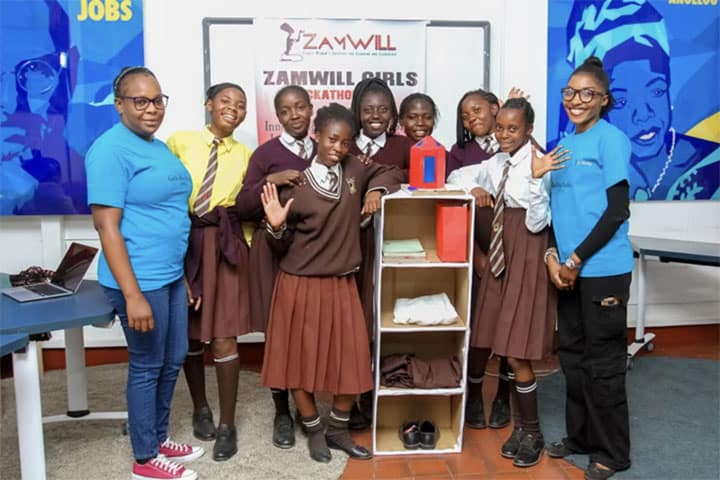
Zambia Women Institute of Leadership and Learning (ZAMWILL), a women-led NGO founded by Ontario Institute for Studies in Education (OISE) PhD candidate Racheal Kalaba and based in Zambia, offers comprehensive leadership and educational programs for young women to promote gender equality. Last August, the organization held a hackathon for 120 young girls in Zambia, an event where participants build a technological product in a short timeframe. Participants attended various developmental workshops and used their newly attained skills to present solutions addressing the United Nations’ Sustainable Development Goals (SDGs).
In an interview with The Varsity, Kalaba shared the inspiration behind the hackathon and the process of organizing this event.
The beginnings of the hackathon
“What inspired me to really think about [the hackathon] was [the question]: what would I want to see done better,” Kalaba explained. For her, the COVID-19 pandemic revealed many gaps in Zambia’s education system. “So many schools in [Zambia] couldn’t even have access to… the internet,” she said. That moment prompted her to consider what it would look like for young girls to have access to technology — and the many opportunities that come with it.
A belief that guided the development of the hackathon was the Southern African concept of Ubuntu — a philosophy of interconnectedness often translated as “I am because we are.” Ubuntu emphasizes that one’s humanity is tied to the success and well-being of others within the community. According to Kalaba, “when we empower one girl, we uplift an entire community. When we invest in STEM for girls, we create a ripple effect of innovation and change that touches everyone.”
More than just coding
While the hackathon originally intended for all 120 participants to code, resources were limited. “Initially, we tried to fundraise but couldn’t get the actual support to have each girl with a laptop to continue coding,” said Kalaba. Eventually, the participants were able to find alternative spaces that offered access to computers, and as Kalaba stated, “Training was well equipped.”
Given this, Kalaba explained that “[The hackathon] moved from technology to STEM.” The girls learnt coding, but they also developed problem-solving skills and explored how to apply technology, environment knowledge, and the SDGs to create innovative solutions. ZAMWILL ultimately focused on developing the girls’ innovation by “providing opportunities for them to think out of the box,” noted Kalaba.
Unlike typical hackathons — where participants code and then present their final products — ZAMWILL’s hackathon was presented in different phases. First, the girls attended various workshops to develop skills that would aid them in solving pressing issues in Zambia. These sessions trained the girls in coding, design thinking and leadership. They then applied their newly developed abilities to solve global and local issues, from reducing electricity blackouts to optimizing land for agricultural purposes.
From OISE to Zambia
ZAMWILL and the hackathon could not have been created without Kalaba’s academic pursuits. Her PhD studies focus on adult education and community development, with a specialization in women and gender studies as well as international and comparative education. “I’ve gotten to use these particular skill sets when implementing the ZAMWILL girls hackathon project.”
Moreover, Kalaba noted that working on the hackathon further motivated her PhD journey. The doubts she had about pursuing a PhD and making sense of her degree faded whenever she worked on ZAMWILL. “Going back home for me is a proud moment,” she said.
“It shows that [my] learning is just not for personal [goals], but it’s also for my community.”
With Kalaba stationed in Toronto, ZAMWILL’s operations wouldn’t have been possible without the support of her community members throughout the hackathon. Kalaba said, “I want to acknowledge a lot of people I’ve worked with on the board — like Brighton Kaoma, our strategist; Stacy Douglas, who has been behind the scenes; and the volunteers back home.” The hackathon also received support from Mweene Himwiinga, an adjunct lecturer at Copperbelt University in Zambia, who served as the chief judge.
What’s next?
Although the organization is based in Zambia, Kalaba hopes to expand ZAMWILL outreach internationally. “I would definitely want it to grow [globally], and also see how this could be translated in Canada for newcomers — [specifically] young girls who identify as Black and African — [so they] also have the opportunity to learn culturally responsive approaches that [encourage innovation].”
Kalaba is planning the second cohort of the hackathon and expanding the event’s scope through volunteers. “We want to have different volunteers in different [regions],” she explained. Additionally, the ZAMWILL hackathon currently works with 10 schools in the Copperbelt region of Zambia, and Kalaba hopes to increase this number to expand the event’s outreach across the whole country.
For future hackathons, Kalaba has considered including other genders. However, given the complexities of addressing gender disparity and inclusion in education, ZAMWILL is still exploring how to balance opportunity for all genders while maintaining its core mission to empower women’s education and leadership through the principles of Ubuntu.

No comments to display.