
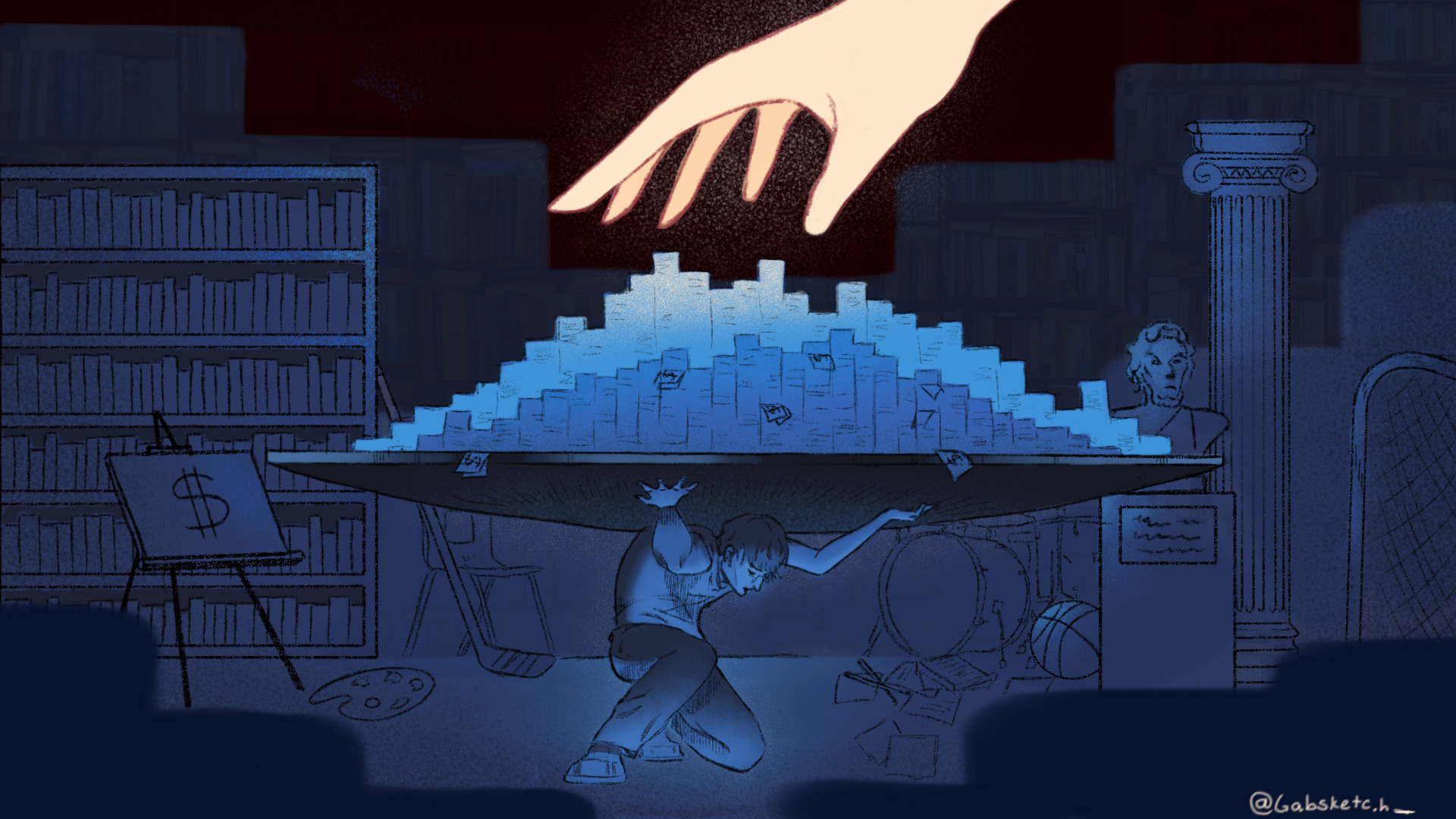
When students accept their university admission offers, they think they know what they’re getting into — at least for the most part.
“Going into university, I had already come to terms with the fact that I would need to incur debt to get through my undergraduate degree,” wrote first-year social sciences student Salaar Khan, in an email to The Varsity. “Those expectations have changed.”
When Khan was applying to universities last year, the balance between grants and loans offered through the Ontario Student Assistance Program (OSAP) felt manageable. He and other students could expect their funding to be allocated as a maximum of 85 per cent grants and a minimum of 15 per cent loans. Khan knew a post-secondary education was supposed to be an investment, but one “which felt manageable considering the ratio of grants to loans at the time.”
More than two-thirds of postsecondary students in Ontario rely on OSAP to afford tuition, rent, and basic living expenses. On February 12, however, the Government of Ontario announced that the non-repayable grants allocation of OSAP funding had been substantially reduced. Now, students can expect a maximum of 25 per cent non-repayable grants, and a minimum of 75 per cent loans.
For students like Khan who had already mapped out their next four years, this change may derail their plans for higher education. It lessens the ability for students to be able to use their discretion, instead leaving the decision to forces out of their control.
Who has a foot in the door?
For many high school students, a ‘dream school’ carries an invisible price tag long before tuition prices enter the equation. Competitive university programs in Ontario — like engineering sciences at U of T — may require a more substantial portfolio demonstrating their abilities, ambition, and experience, in addition to the applicant’s academic profile. Experiences like leadership roles, research positions, and community involvement all strengthen a prospective student’s application. But building a competitive application often requires resources, namely time and money.
The kinds of experiences necessary for a competitive application often require a means for transportation, equipment, and unpaid labour. High school students from financially stable households are more likely to be able to dedicate their free time to costly extracurriculars or their summers to unpaid volunteer positions. Alternatively, some students may not have the resources to finance such activities and must prioritize working to support themselves or their families.
A 2025 Statistics Canada study pulling data from 2001–2022 showed that there is a sizable gap in university enrolment between those in the top and bottom income groups. The study reports that in 2022, 75.2 per cent of 19-year-olds in the top income quintile were enrolled in university, compared with 43.2 per cent of those in the lower income quintile. Furthermore, a 2019 report from the Higher Education Quality Council of Ontario stated that “students from wealthier and better resourced families are more likely to enter academic streams, access universities and experience more rewarding occupational outcomes.”
A 2026 Statistics Canada report also found that first-generation students — those whose parents did not attend postsecondary schooling — attend postsecondary programs at lower rates than students whose parents did attend postsecondary schooling. As of 2023, first-generation enrolment in undergraduate degrees sat at 18 per cent, while non-first-generation enrolment in undergraduate degrees was at 32 per cent.
This further illustrates the intergenerational aspect of access to higher education. Approximately 75 per cent of first-generation student respondents to a 2022 University of British Columbia (UBC) survey said they “experienced difficulties paying their tuition (75%) and living expenses (74.11%).” The survey listed a series of factors that first-generation students may face, such as “financial insecurity, a lack of academic preparation, little knowledge about the college systems, aspirational burdens from families if the family has invested a lot in one’s education, limited class and school engagement, and a sense of alienation.”
The financial burden of university starts before paying for tuition and living expenses. In addition to the money that might go into cultivating a competitive application, the application process itself carries costs, and application fees accumulate quickly for students applying to multiple institutions or programs.
The base application fee when applying through the Ontario University Application Centre (OUAC) is $156, which increases if students want to apply to more than the three allotted schools covered by that payment. Just under 40 per cent of respondents to the UBC survey said they “struggled with paying the university application fee.”
U of T, like many other universities, often frames its admissions process as merit-based, reflecting students’ talent and hard work. Evidently, however, there are invisible barriers that create gaps in who is able to pursue a higher education.
Choosing security over passion — the cost of opportunity
For students who enrol in university, the financial pressures of funding an education only increase once they begin their studies.
In university, students are often told to pick a program that they find compelling, but that will also provide them with a successful future career. However, striking that balance is harder than it sounds when faced with the financial burdens of covering tuition with the new cuts to OSAP.
Even students who do not rely on OSAP to fund their studies experience this cost-benefit crisis. First-year engineering student April Huynh had the pressure of choosing a program that would provide financial security, rather than personal fulfillment. “When the choice came between pursuing art or STEM, I was consistently discouraged [from] pursu[ing] art,” she wrote.
This pressure for people to make choices based on what might provide financial stability, rather than pursue a path that inspires them, is even reinforced at a political level. Recently, Ontario Premier Doug Ford tried justifying his OSAP cuts by suggesting that federal spending on so-called “basket-weaving courses” is unreasonable.
Ford strongly believes that students should go after “jobs of the future,” which he defined as careers in healthcare, trades, and “STEM-related fields.” Remarks like these reinforce the idea that programs that do not streamline students into the job market are useless, ultimately dissuading students from pursuing them unless they want to become a “college-educated barista.” More specifically, Ford undermines the value of the humanities and social sciences by specifying STEM as a more productive field.
Julia Boyd, an assistant professor in the Department of English and Drama at UTM, said in an interview with The Varsity that she is “very concerned” that Ford’s statements “may deter students from taking courses… that teach them the practical, hands-on skills that are essential in any functioning workplace, no matter the sector.”
“Humanities degrees teach absolutely critical skills in research, in accuracy, in the ability to cut through information overload, misinformation, and disinformation, and [to] transform accurate information into compelling… arguments,” said Boyd. These skills are important across fields, from law to teaching.
“No matter what field you are in, the communication skills,” continued Boyd, the interpersonal, management, community-building, and critical thinking skills that humanities students are constantly required to exercise, “are all going to be not useful, not helpful add-ons, but essential.”
If students are influenced by sentiments like Ford’s, then they will not only be sacrificing personal interests in exchange for imagined financial security, but they may also pass on opportunities for a nuanced skillset.
As Boyd suggests, all students benefit from having skills across sectors. If lack of funding stops students from expanding their scope of education, then the next generation of jobholders will lack the versatile expertise that was once available to more students.
Education on hold
Once students complete their degrees, even though they have gained connections and knowledge, financial restrictions continue to be a burden for those attending or considering graduate school.
Third-year UTM molecular biology specialist Sofiya Salakhutdinova once imagined pursuing a master’s degree immediately after graduation. But that path now feels less certain for her.
Since she can’t rely on OSAP as much anymore, Salakhutdinova is considering postponing her studies to find a job that can pay for her next degree. However, Salakhutdinova is worried that a gap year might slow down her academic progress.
According to the Federal Budget Report, the Canada Graduate Research Scholarship increased from $17,500 to $27,000 per student in 2024; yet this amount is still below the low-income threshold for a single-person household. Funding structures for graduate-level education have not changed to accommodate the rising cost of living.
In cities like Toronto, where rent costs continue to climb at drastic rates, these funding programs usually fall short of covering the actual cost of pursuing a graduate degree, taking into account additional costs like rent, groceries, and transportation.
Funding access is also not evenly administered across programs and disciplines. Students in more prominent research fields may receive more financial support, while others must compete for smaller pools of funding. Furthermore, research and teaching assistant positions are limited, and funding packages vary depending on the discipline, program, and supervisors.
When academic advancement depends on the tolerance of financial risk, the level of opportunity narrows once again. For students like Salakhutdinova, pursuing graduate studies, therefore, means considering how much risk they are willing to take on financially.
Deconstructing the barriers
Higher education can serve as an equalizer by bringing diverse groups of people together and by providing students with an education and opportunities for them to more readily pursue future careers.
Universities often refer to enrolment demographics to measure their success in achieving equity. However, what the numbers don’t show is how hard those students worked to overcome the barriers necessary to get here.
Universities can try to mitigate those barriers, such as high application fees, extracurricular requirements, family income and education, and the prospect of debt. At the end of the day, however, most Ontario universities function like businesses, which means they want to make more money than they spend on resources that help students.
This profit-driven model seems incompatible with amending the main barriers to access, because most of them are financial. There needs to be systemic changes to the structure of higher education to force universities to prioritize education over money.
Programs like OSAP were created to mitigate those financial incentives from universities — to allow the universities to be well-funded while also protecting students’ access to them. With the context of Doug Ford’s OSAP cuts, it seems as if those intentions have been lost. Accessing higher education should not be a constant battle against financial restraints. It should be a place where students are allowed to explore passions, gain connections, and find security for their future pursuits without having to fight institutional barriers.
