
Low-income students and families who depend on the Ontario Student Assistance Program (OSAP) to pursue post-secondary education are facing a profound setback. The recent cuts introduced by Premier Doug Ford’s government represent a significant rollback of the principle that education should be accessible regardless of income.
Before these changes, OSAP allowed students to receive grants covering up to 85 per cent of tuition costs, with loans available to help cover the remainder. For many students from working-class families, these grants were the difference between attending university and abandoning the idea altogether.
However, the Ford government’s revisions reduce grant funding to a maximum of 25 per cent of total OSAP funding received by students, dramatically increasing the reliance on loans. This change follows the government’s decision to lift Ontario’s tuition freeze, placing further financial pressure on students.
Despite widespread criticism from students and community organizers, Ford has defended the policy, claiming that the previous system was “unsustainable.” At the same time, Ford suggested in a press conference, as reported by the CBC, that students pursue fields such as STEM, healthcare, trades, and technology, calling them “jobs of the future.” Ford has repeatedly dismissed other academic disciplines by referring to them as “basket-weaving courses.” These comments and their rhetoric reveal the ideological framework underlying these cuts.
Ford’s approach reflects a narrow understanding of education that treats universities primarily as engines of labour market production. In this framework, the value of education is determined by how efficiently it feeds workers into sectors deemed profitable or economically productive. Fields that do not fit neatly into this model, such as arts, humanities, and social sciences, are cast as frivolous.
Basket-weaving and colonial logic
The “basket-weaving” metaphor has long been used to mock academic disciplines perceived as impractical. Yet the phrase carries deeper historical baggage. Basket-weaving itself is a practice embedded in Indigenous cultures across Turtle Island for thousands of years. Indigenous women in particular have historically practiced intricate forms of weaving for ceremonies and childcare. These practices represent knowledge systems rooted in land and intergenerational teaching.
The denigration of such practices emerged through colonial ideology, which systematically devalued Indigenous knowledge in the effort of elevating European conceptions of labour and value. By dismissing academic study as “basket-weaving,” Ford inadvertently reproduces colonial logic that knowledge is only considered legitimate if it conforms to market-oriented and colonial standards.
The comment also carries gendered implications. Historically, many crafts and cultural labour practiced by women were dismissed as simple or unimportant precisely because they existed outside of formal wage labour. When political leaders invoke “basket-weaving” as a metaphor for uselessness, they draw on this long tradition of belittling both Indigenous knowledge systems and women’s labour.
Class consequences
At the same time, the structural consequences of OSAP cuts are deeply classist. Financial aid programs such as OSAP disproportionately benefit students from low-income households. Many of them are Black, Indigenous, and other racialized students who already face systemic barriers to accessing post-secondary education.
When grants are replaced with loans, the burden shifts directly onto these students. Wealthier families may be able to absorb rising tuition costs without hesitation, but working-class students must weigh the prospect of years of debt against uncertain career outcomes. The result is that many talented, intelligent students may simply choose not to attend university at all due to the additional financial burden.
This dynamic reveals how Ford’s rhetoric and policies reinforce one another. By portraying certain fields as economically useless, the government justifies cutting financial support that enables students to pursue them. In doing so, it reshapes higher education into a system that privileges those who can afford to take financial risks or who pursue ‘productive’ careers.
The role of universities
Although education has never been solely about economic return, universities play a critical role in producing knowledge that shapes public policy and social change. Sociologists, historians, artists, and researchers contribute to understanding inequality and addressing urgent societal challenges. Many of the ideas that shape democratic rights emerge from the disciplines that Ford’s rhetoric dismisses.
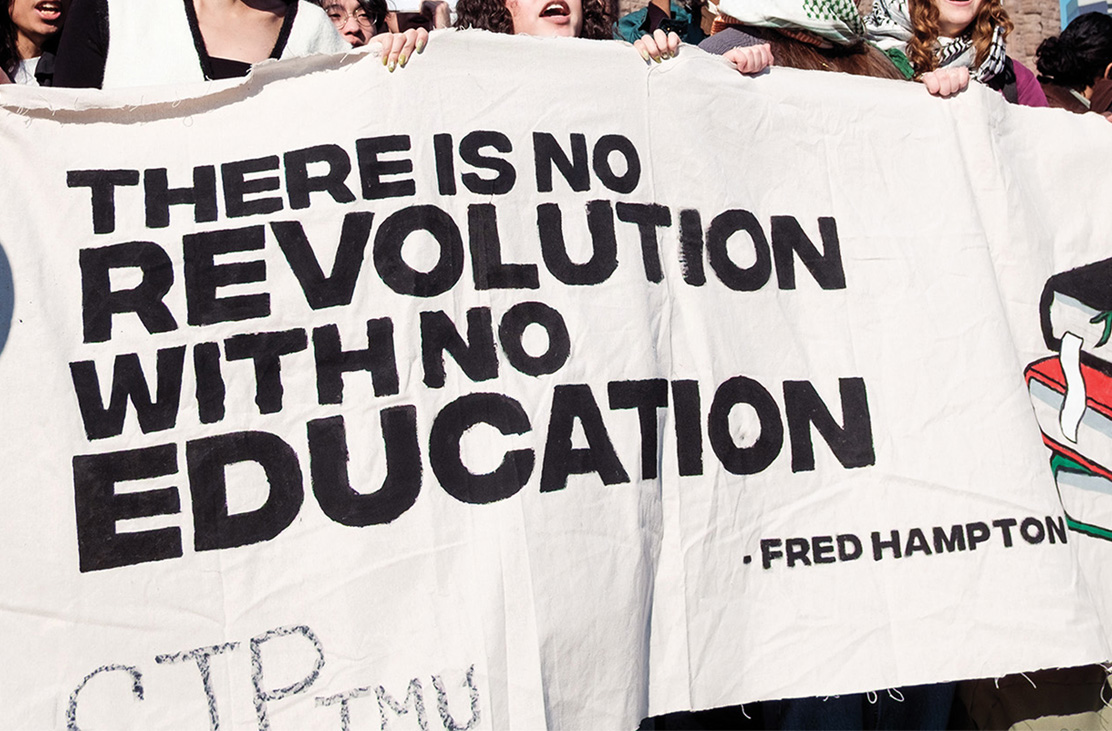
Reducing education to a pipeline for labour is ultimately harmful for both universities and society. The backlash to Ford’s policies demonstrates that students recognize what is at stake. On March 4, hundreds of students gathered at Queen’s Park for the “Hands Off Our Education” rally, raising a collective voice against the government’s cuts. The protest illustrated a growing frustration among students who see their educational opportunities being constrained by political decisions that prioritize economic thinking.
At its core, the debate surrounding OSAP cuts reflects two polarized views on education. One views education as a public good, where knowledge is pursued not just for economic benefit, but also for societal advancement. The other treats education primarily as a financial investment, valuable only when it generates measurable economic returns.
Ford’s “basket-weaving” comment makes clear which vision his government embraces. But Ontario students are making it equally clear that they reject it. Education should not be reserved for those who can afford it, nor should its value be dictated solely by market demand. A truly accessible education system recognizes that knowledge in all its forms has value, and that it is something no government should ever dismiss.
Landon Sanderson is a queer and Indigenous advocate, and a first-year undergraduate student studying critical equity studies, Indigenous studies, and education & society at U of T.
