
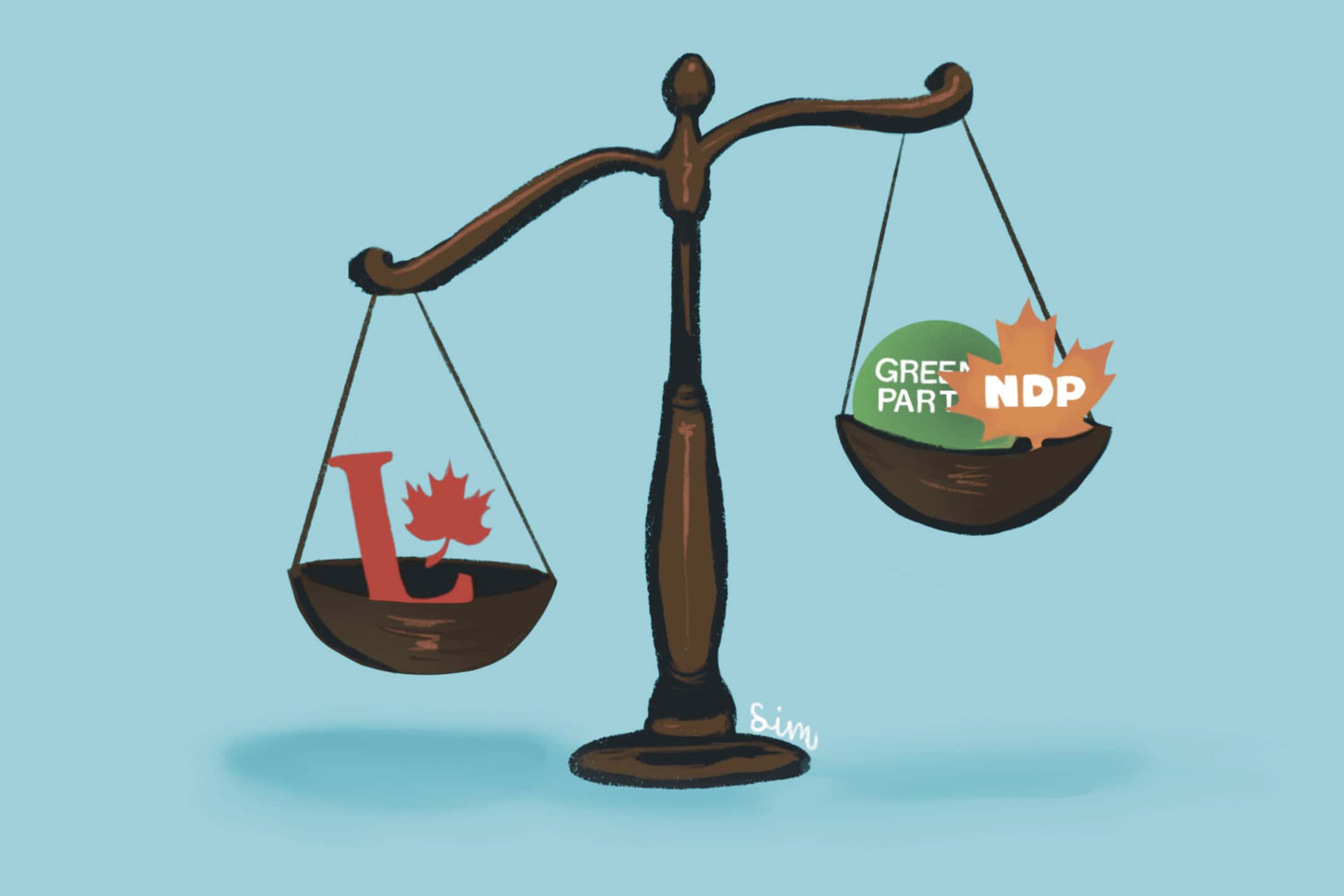
In the recent Canadian federal election, the aim of many left-wing voters of the Liberal Party of Canada (LPC) was to block the accession of the Conservative Party of Canada (CPC) to government. This accession was achieved in part due to the substitution of former party leader and Prime Minister Justin Trudeau with the current Prime Minister Mark Carney, and the emergence of Trump’s politics as a Canadian issue. However, I believe that the LPC’s ability to remain in power has come at the cost of progressive politics.
In an attempt to practice strategic voting by voting for the LPC, Canadians have elected a party that will struggle to create policies to differentiate itself from the CPC, and will fail to deliver on key issues domestically and abroad.
The LPC’s continued failure throughout its 10 years of governance since Trudeau’s election in 2015, foreshadows a resounding victory for the CPC in the next federal election. Therefore, I believe consolidating around and strategically voting for the LPC was a grave error on the part of Canadian progressives who wish to build a long-term alternative to right-wing politics in Canada.
The problem with strategic voting
Strategic voting played a prominent role in Canada’s recent federal election. Many New Democratic Party (NDP) and Green Party voters seemingly switched to the LPC candidate in their riding, evidenced by the huge decline in the proportion of votes for the NDP and Green Party compared to the huge swing for the LPC Party.
Cooperate for Canada, an organization that promotes strategic voting as a means of blocking a CPC victory, compiled a list of unity candidates — namely, MP-hopefuls from the LPC, NDP, Green Party, and Bloc Québécois — in select ridings where supporting a single progressive candidate was deemed necessary to defeat the CPC candidate. Cooperate for Canada encouraged Canadians to consolidate with these unity candidates in an attempt to defeat CPC candidates in swing ridings — ridings where the race is close and multiple parties ‘have a chance.’
However, after my own analysis of the unity candidates in Ontario and the election results, I noticed that the LPC candidates saw a surge in support, whether or not they were their riding’s unity candidate.
In the cases where an LPC candidate was indicated as the unity candidate, I found that NDP and Green candidates performed far worse than in previous elections, while the LPC candidate saw a surge in votes.
Where NDP and Green candidates were unity candidates, on the other hand, the results were discouraging. In Hamilton Centre, the incumbent NDP candidate Matthew Green was defeated by LPC candidate Aslam Rana. In Kitchener Centre, unity and incumbent candidate Mike Morrice of the Green Party lost due to the progressive vote split between Morrice and Brian Adeba of the LPC. I found similar circumstances in London-Fanshawe and Windsor West, where NDP incumbents lost to CPC candidates due to vote splitting among progressive parties.
In fact, every unity candidate in Ontario listed by Cooperate for Canada who was not representing the LPC ended up losing their seat. This shows an unwillingness of LPC voters to take strategic voting seriously, even when this results in victories for the CPC.
The results of the 2025 Canadian election lead me to believe that this election stands as a resounding defeat for Canadian progressives, with the NDP and Green Party sustaining heavy losses in favour of the LPC.
What will the Liberal Party deliver?
Even now that the LPC has formed government under a new leader, progressives should not expect any radical breaks from the previous decade of LPC policymaking.
In many ways, the LPC is gradually caving into many of the CPC’s policies. This has been demonstrated with Trudeau curtailing immigration to Canada as well as Carney axing the consumer carbon tax, both long-time talking points of CPC leader Pierre Poilievre. The Carney government is also separating the federal budget into the two categories of operating and capital, which may potentially carry the risk of reducing transparency, despite the LPC attesting that it will do the opposite.
Regarding Canada’s response to Israel’s invasion of the Gaza Strip — an issue that resulted in a 63-day occupation of King’s College Circle by pro-Palestinian U of T students last summer — there is no indication that Carney will significantly change the LPC’s Trudeau-era position. Trudeau suggested Canada would enforce International Criminal Court arrest warrants against Israeli Prime Minister Benjamin Netanyahu, but further commitments from the LPC in defence of Palestinian human rights are not clear, as the party attempts to appease all sides of this debate.
In their 2025 election guide, Canadians for Justice and Peace in the Middle East — a Canadian non-profit that advocates for Palestinian human rights — ranked the NDP and Green Party far above the LPC, which was ranked second last, above only the CPC, in their 2025 election guide outlining where each party ranked based on their commitment to Palestinian human rights.
However, the LPC’s ranking is still too high, as the LPC oversaw a record-breaking 43 per cent increase in arms exports to Israel in 2023. Despite the Canadian Lawyers for International Human Rights’ lawsuit against the Canadian government to block arms exports to Israel, it remains unclear whether the LPC will put this into effect, as a Canadian company received a contract in September 2024 to supply arms to the Israeli military. This was months after the government said they would no longer approve contracts. Moreover, Carney off-handedly confirmed that Canada continues to supply arms for the Iron Dome, making it clear that he has not taken a strong stance.
Although I believe that the LPC winning the election may have averted the crisis of a CPC victory, it should not be treated as a victory by progressives, who I believe have lost much in the election, notably the NDP’s party status.
With the CPC still making gains, specifically with their ability to flip some Liberal and NDP ridings, the LPC are unlikely to deliver on the issues that continue to animate Canadians, and I believe this will only further demoralize progressive voters, and increase the chances of a CPC victory in the next election.

No comments to display.