
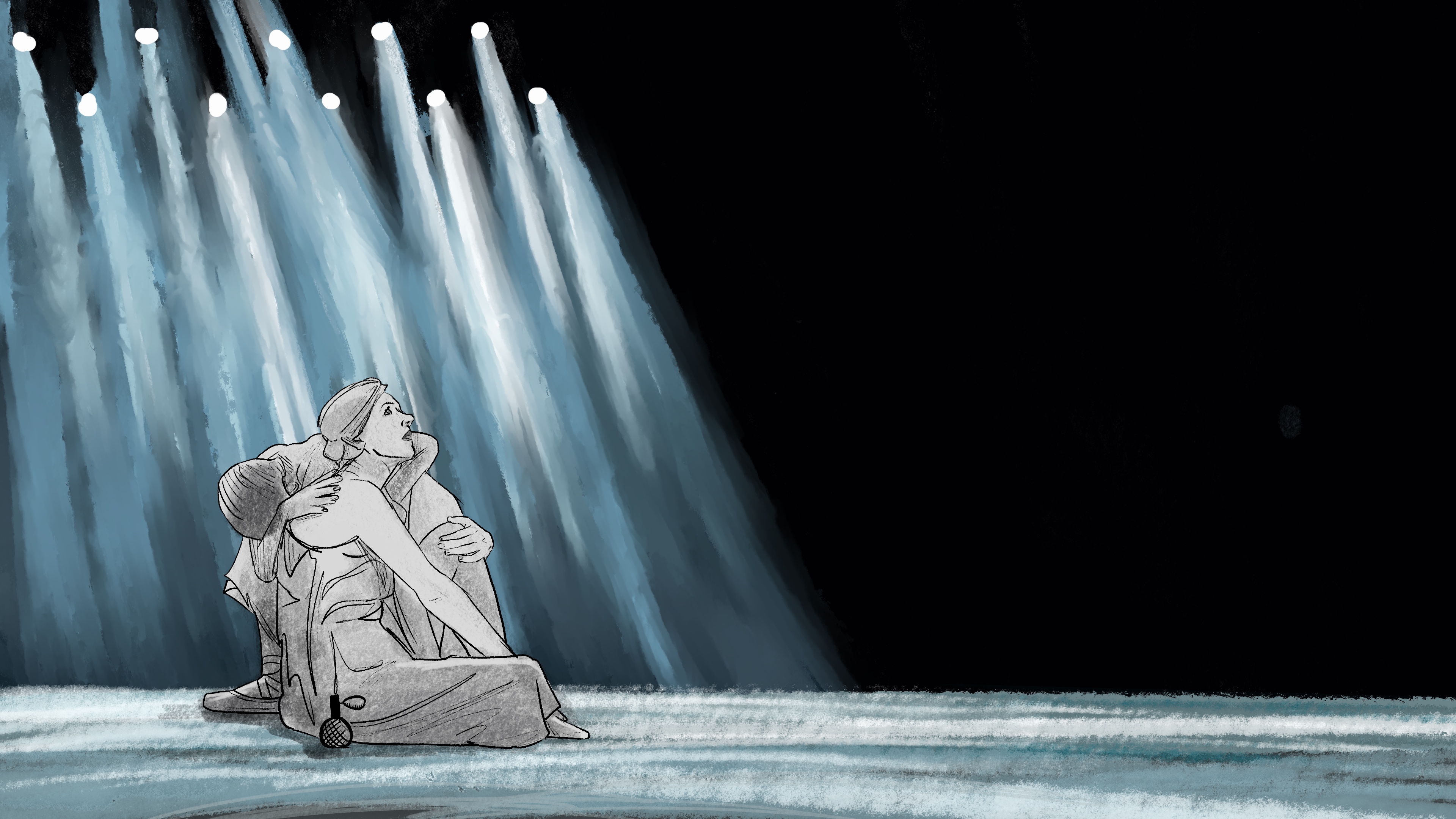
Have you seen Rainbow on Mars? I’m not sure that I have either — at least, I wouldn’t use those words. Rainbow on Mars is a play that challenges our assumption that vision must be our primary sense for watching a performance, even though it’s in the name of the act.
How are we to discuss experiences of theatre and dance without centring sight? At Ada Slaight Hall from August 14–20, playwright, performer, and Associate Professor of Disability Studies at Ontario Institute for Studies in Education (OISE), Devon Healey, asked us to try.
Developed over the last five years with co-directors Nate Bitton and Mitchell Cushman, Rainbow on Mars is a multidisciplinary work of theatre and ballet that calls on audiences, both blind and sighted, to question the primacy of vision in our world. Inspired by the way Healey’s writing caters to perception beyond sight alone, choreographer Robert Binet and apprentice dancers from the National Ballet of Canada create movement sequences with such emotional clarity that they can be — perhaps even best — appreciated without sight.
Immersive Descriptive Audio
The most revolutionary element of Rainbow on Mars is also that which makes it accessible to visually impaired audiences: Immersive Descriptive Audio (IDA). Conceived by Healey, IDA acts as so much more than an accessibility feature. It is a central character as ‘The Voice’ (Vanessa Smythe), and is the philosophical centre of the production.
Unlike described-video-esque audio description, which coldly narrates visuals as they appear on the surface, IDA captures the experience of seeing, in a way not even vision can truly rival. The IDA’s lush, poetic descriptions often felt more evocative than the visuals themselves, translating the external form of ballet into internal, embodied emotion. It proposes that to understand a dance, one must not just see it, but feel what it might be like to inhabit it.
This practice, developed with Binet, builds a parallel to the visual experience of dance, equally rich, making blindness not a deficit but a different, and often deeper, way of knowing.
As a dancer myself, the highlight of my experience was listening to how The Voice described the ballet sequences. It did not name steps or describe their appearance predictably or intuitively. Rather, Smythe described the experience of dancing: the tug of energy between bodies in the space, the texture and breath of the movement.
The Voice captured the feeling of choreography more effectively than my eyes could, as if I were dancing each phrase myself. And because these descriptions were evocative rather than prescriptive, I left with a sense that, should 100 random people be given this audio, they would imagine 100 vastly different variations of the same steps, unified not by accuracy but by a shared emotional resonance.
Rainbow on Mars: the premise
The narrative follows Iris (Healey), a young woman hurled out of her old life and into a disorienting new world upon being diagnosed with a mysterious and incurable ailment affecting her vision. The performance details Iris’s journey into blindness, the relationships she builds, and her internal battle between despair and hopeful curiosity.
The dancers externalize these conflicting emotional experiences by playing two groups of creatures in Iris’s new world: ‘The Sads,’ dressed in skin-tight red costumes covered in suffocating, weaving vines, and an unnamed group dressed in flowing white sheaths.
The narrative journey is a modern interpretation of Plato’s Allegory of the Cave, where Iris, like Plato’s cave-dwelling prisoners, is initially trapped in the world of the sighted, her worldview limited by her narrow experience. As a sighted audience member, I came to recognize that it is thanks to Iris’s blindness that she can ‘see’ the world in a larger and more embodied way.
Act 1
Plato’s Allegory of the Cave informs the opening scenes so intelligently. The first moment we see and receive a description of Iris, who is yet to be named, is as a ‘cave slug’ in an engulfing head-to-toe drape, embodying restriction and suffocation. The costume detail is so effective, it became one of the most haunting images of the night. In this scene, Iris still has her sight, and we are immediately informed through both the audio and visual design that this reality is limiting and hollow.
As a further nod to Plato’s Allegory, shadows dance across the walls thanks to the massive chandelier-like structure that hangs over the space. Equally chilling is the following doctor’s office scene, staged with cold exaggeration. Clinical voices and sterile gestures captured the disorienting mix of care and alienation that defines so many medical encounters for disabled people.
Other moments, however, felt less fully realized. The ensemble known as ‘The Sads’, meant to trap Iris in their winding, despairing choreography, did not achieve the weight they seemed to promise. Their fluid, classical phrasing created a sense of entanglement, but the dread never fully materialized.
I longed for a more contemporary vocabulary with more suspension, more collapse, more melting of time. I don’t believe that the classical ballet vocabulary used contains the full range to embody the lethargy and suffocation viscerally enough. By contrast, the dancers’ portrayal of blind joy in the flowing white slips was luminous and playful, offering an example of the efficacy that The Sads lacked.
Act 2
In the second act, a band of misfits called the ‘techies’ bring Iris a device that looks like a headset with a bulky, visor-like front. Iris pleads for the techies’ help as they promise this device will get her back to her old life.
The technology captures visual information from the world and converts it into audio, intending to ‘compensate for’ and even ‘fix’ Iris’s blindness. However, the auditory description from this device is cold, rigid, and limiting, reducing Iris’s sensory experience rather than expanding it.
This technology embodies a design philosophy that frames blindness as a deficit to be corrected, rather than a difference of perception. The contrast is stark: while the IDA used in the play opens new, embodied ways of knowing, the headphones impose on Iris a narrow, prescriptive method of perceiving the world.
This explicit critique underscores one of the production’s central messages: accessibility technologies risk reinforcing the very barriers they claim to break down if they fail to respect the unique modes of experience of the people they are meant to serve.
Ultimately, Rainbow on Mars is a landmark work. Healey challenges our preconceptions of disability, theatre, and dance by presenting a blind perspective not as a limitation to work around, but as a heightened state of awareness we can learn from.
