
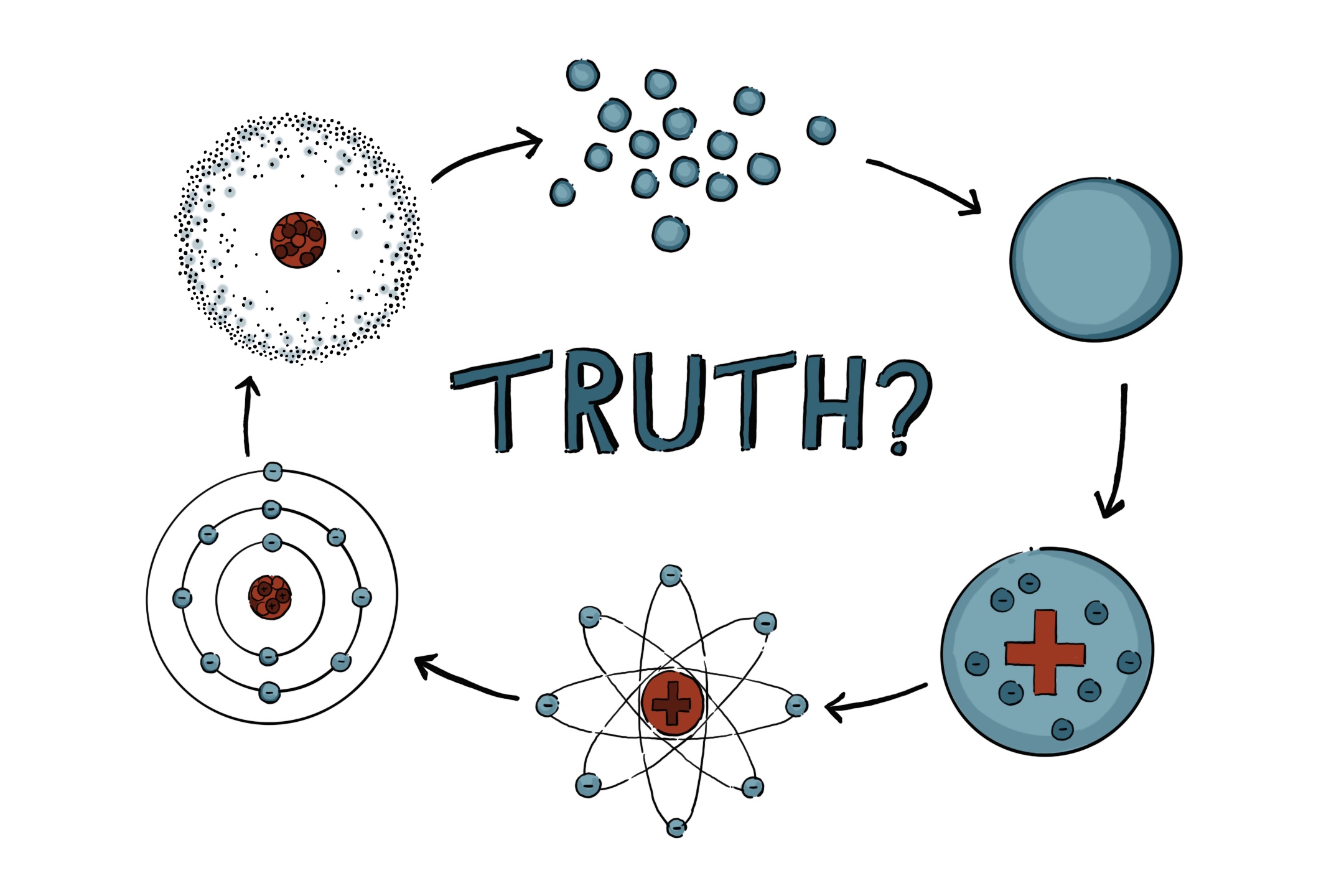
Consider this: science isn’t a perfect collection of true facts. Instead, science is closer to a game whose goal is to explain patterns, uncover mechanisms, and make reliable predictions about natural phenomena. Philosophy of science functions as the rulebook and commentary for that game, clarifying how evidence should be interpreted, how theories evolve, and where the limits of our reasoning lie.
This way of thinking prompts deeper questions: how does scientific thinking operate? Why do we teach models that are only partially correct, like classical Newtonian mechanics? By examining scientific methods and their limits, the philosophy of science offers a more nuanced view of how we build scientific knowledge.
Scientific reasoning relies on logical thinking, skepticism, and reproducibility — the ability to repeat an experiment and yield the same results. Importantly, a scientific hypothesis is never considered ‘true,’ and like all scientific theories, it is always open to revision based on new evidence. This adaptability is what separates science from rigid beliefs or dogma.
By recognizing that knowledge in science is always subject to revision, we also welcome the potential for paradigm shifts — those moments when the scientific ‘game’ changes because new evidence compels us to reconsider old assumptions. To appreciate how such shifts arise, we need to consider what reasoning tools scientists use to construct, test, and ultimately revise their theories.
The power and limits of logical reasoning
Logical reasoning in science combines deductive and inductive approaches. Deduction is a method of reasoning that starts with a general principle or law, and applies it to a specific case to draw a conclusion. For example, if it is known that all metals expand when heated, we can deduce that a copper rod will expand under heat.
Induction, in contrast, draws general conclusions from specific observations. For instance, by inductive reasoning, if we observe multiple times that several different metals expand when heated, we might infer that all metals expand under heat.
Through the philosophy of science, the limits of both are evident. Deductive conclusions are only as valid as the premises they are based on; inductive conclusions are tentative. Clearly, scientific knowledge is never absolute, but rather always tentative and open to modification, as reflected in how we model the world.
Why we teach ‘incorrect’ theories
In practice, science frequently leans on the application of simplified models and idealizations, which are technically ‘incorrect,’ but practically useful.
Take Newton’s classical laws of motion, which describe how an object will accelerate in response to a force, but fail to describe motion in extreme conditions, like at high speeds. Similarly, classical models of atoms are rudimentary representations that do not capture the full complexity of quantum mechanics. However, both fulfill a practical role: Newton’s laws accurately describe simple motion, and, like traditional chemical models of atoms, act as effective tools for teaching and calculations.
The existence of these models highlights a core philosophical debate: are theories useful because they describe reality itself, or is their worth measured by how well they predict and explain the world around us? The latter perspective proposes that reality can never be fully captured, and science can still be successful, as long as the models consistently predict and explain phenomena. In this view, ‘incorrect’ theories are not deemed as failures, but practical tools — that is, their utility may matter more than the absolute truth.
Simplified models reveal that scientific theories are practical tools, whose validity is continually tested and refined — a process formalized by Popper’s falsifiability criterion and exemplified in Kuhn’s paradigm shifts.
Falsifiability and Kuhn’s paradigm shifts
Karl Popper was an Austrian-British philosopher best known for his falsifiability criterion. In his view, for a scientific theory to be falsifiable, a scientist must make testable predictions that could, in principle, prove them wrong. In this way, falsifiability ensures that science is always self-correcting and dynamic.
This process is closely related to paradigm shifts, a concept developed by philosopher Thomas Kuhn. It describes the moments when prevailing scientific frameworks are significantly revised or replaced in response to new evidence or anomalies. Consequently, when a model fails under extreme or novel conditions, it is refined rather than simply discarded.
A classic example is the shift from Newtonian mechanics to Einsteinian relativity: Newton’s laws remain valid within certain limits, but Einstein’s theory extends and corrects them to account for phenomena that Newtonian mechanics cannot explain. Together, falsifiability and paradigm shifts illustrate how science advances by testing, questioning, and refining theories.
Science as a way of thinking
Philosophy of science treats knowledge as ever-evolving, rather than fixed in place. Scientific theories do not need to capture reality perfectly to be valuable; they need to work in context.
Science moves forward by relying on models that are imperfect but powerful, providing ways to explain and predict phenomena. By framing science as a way of thinking rather than a set of fixed truths, we foster curiosity, skepticism, and reasoning skills that are essential not only in science, but in all areas of life.

No comments to display.