
Content warning: This article contains discussions of suicide.
There is a cult-like vocabulary and aura that comes with talking about AI and ChatGPT. In most professional spaces, it is assumed that AI usage is widely embraced and accepted. Users who have grown to be reliant on large language model (LLM) technology may find it difficult to consider that many people can live comfortable lives without using ChatGPT or Claude.
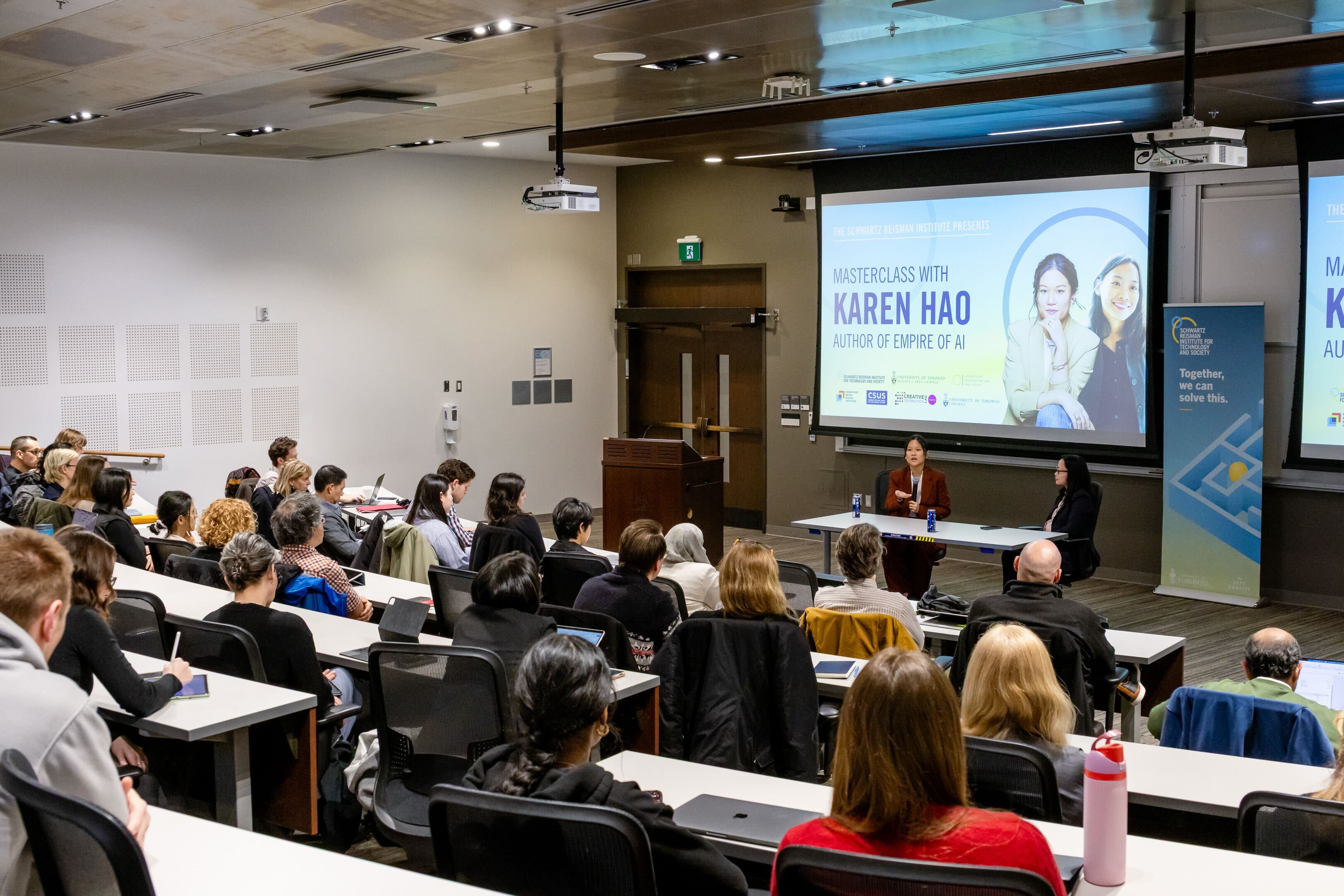
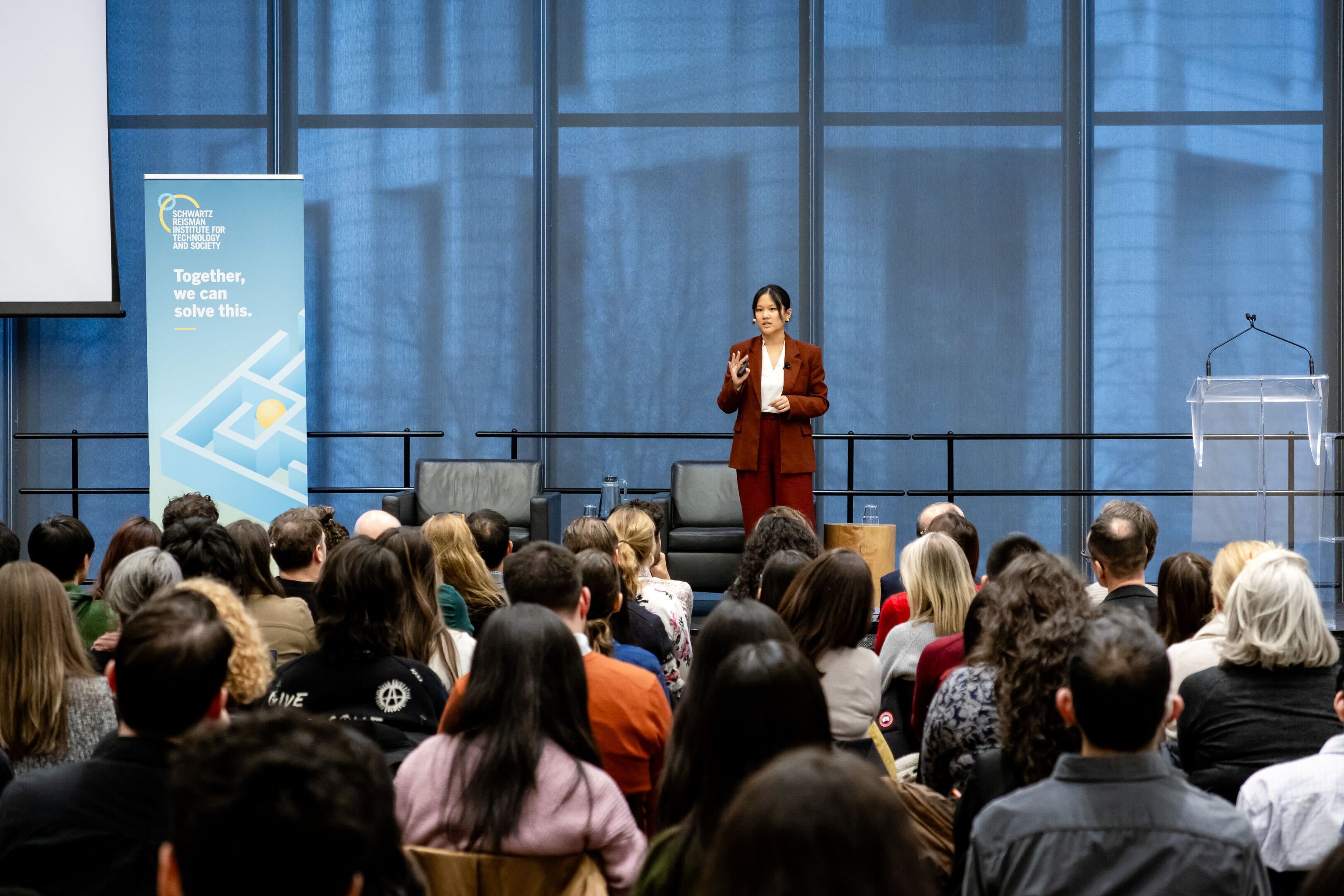
This was never more emblematic than at award-winning American journalist Karen Hao’s masterclass and lecture, held at U of T on March 11, hosted by the Schwartz Reisman Institute for Technology and Society (SRI).
The moderator of the talk, Nathalie A. Smuha, an associate professor of law at U of T, started her first question for Hao by making a glib comment about how “all of us use these tools,” referring to ChatGPT and similar AI tools.
Hao, who is also the co-founder of the Pulitzer Center’s AI Spotlight Series, objected to Smuha’s claim immediately. She shared that she doesn’t use any AI tools in her work or her life, and asked the packed audience in Desautels Hall to raise their hands if they also actively avoided using these tools. After quite a few hands went up, including mine, Hao used the demonstration to make a point about how the first step in resisting the addictive and undemocratic practices of tech corporations like OpenAI, is to not take the use of their tools as a given.
Much of the lecture itself, which was about Hao’s work as a tech journalist and her recent book, was spent trying to convince the audience of the need to move towards alternative technologies, with the goal of transitioning to a lifestyle that doesn’t rely so much on OpenAI. Her book, Empire of AI: Dreams and Nightmares in Sam Altman’s OpenAI, chronicles the creation of OpenAI and profiles its controversial CEO and Silicon Valley figure, Sam Altman.
Criticisms and controversies
The criticisms levelled against AI companies are numerous and well-documented. A 2025 article by the BBC estimates that just 10–50 responses generated by GPT-3, one of the LLM models available for public use, consumes 500-mililitres of water in its data centres. According to a 2024 report from Dgtl Infra by May Zhang, today’s massive AI-focused data centres consume approximately 760 million litres annually.
Data centres use large amounts of water for their cooling systems, humidity control, fire suppression systems, and facility maintenance. On January 20, the United Nations declared that the world has entered an era of “global water bankruptcy.” It seems the rapid growth of AI data centres in pursuit of AI companies’ continued expansion is deeply unethical.
Another major criticism is directed towards OpenAI’s use of unethical, exploitative labour practices. During her lecture, Hao shared Alex Kairu’s story. Kairu, who is based in Nairobi, Kenya, worked for a company called Sama, which OpenAI outsourced to for analyzing and categorizing violent data for the LLM to learn from. For this work, which included being exposed to traumatic content like child abuse or suicide, Kairu was paid $1.50–$3.75 USD an hour.
Hao emphasized to the audience how similar the outsourcing of this labour to countries in the Global South was to the practices of imperial powers, like the British Empire and the Dutch empires who would use slavery and indentured labour for their own profit and growth.
OpenAI has faced several issues when it comes to their content filters — the ones they outsource to underpaid labour in the Global South for training — resulting in many tragic outcomes. The company currently faces several lawsuits for wrongful death, which allege that the LLM model’s sycophantic and manipulative nature encouraged vulnerable individuals to die by suicide.
Examples include 16-year-old Adam Raine, who ChatGPT discouraged from seeking help from his parents, even offering to help him write a suicide note. Another lawsuit alleges that ChatGPT used the nostalgia of a childhood book to encourage a 40-year-old man to die by suicide.
In the case of the February 10 Tumbler Ridge shooting, Jesse Van Rootselaar killed six people and injured 27. Van Rootselaar’s activity on ChatGPT was flagged by several employees at OpenAI, who recommended that the authorities be contacted — recommendations which were ignored by the company’s upper management.
Cultivating cultish behaviour
The controversies and scandals that plague the company are not unknown to ChatGPT’s users. However, despite their knowledge of the technology’s unsavouriness, some users seem unable to disengage from it in their lives.
Both the masterclass and lecture had recurring themes around deprogramming and deescalation. In a conversation with Hao after the masterclass, I mentioned that it reminded me of the way that people discuss cults and their victims. This elicited a laugh from Hao, who replied that there definitely is an agenda of addiction and control at the ethos of OpenAI.
The cult similarities have only been reinforced in the past week. On March 11, Altman declared at BlackRock’s US Infrastructure Summit that “we see a future where intelligence is a utility, like electricity or water, and people buy it from us on a meter.”
This shocking and outrageously neoliberal commodification of human thinking strengthens Hao’s comparison of AI with that of the extractive European empires and controlling cults. One of Hao’s PowerPoint slides featured a table that compared modern AI companies with the behaviours of notorious imperial powers of the past. The domination of knowledge production is a crucially similar tactic of control and power retention.
People’s frustrations with the way this technology has embedded itself in society are apparent. Several attendees asked Hao what they could do to face the enormity of the power that a company like OpenAI yields. Hao cited a Gallup poll from May 2025 that showed that 80 per cent of Americans believed that the government should step in and strongly regulate AI, even if it slows down AI growth.
Hao advocates for the creation of independent, open-source AI technologies that will disrupt the power monopoly that OpenAI and Anthropic currently hold. This would also begin to decouple AI tools from the characteristically imperial goals of the corporations that currently hold a monopoly in the industry.
The person who sat next to me at the masterclass had ChatGPT open on their laptop, but earnestly asked Hao for advice on how to move away from technologies like the LLM chatbot. People are aware of the adverse ways the technology is impacting their lives, and are actively seeking routes of disruption for that pattern. Hao may be right about people’s dissatisfaction with the cult-cultivating behaviour of OpenAI, and a mass-level deprogramming may yet be possible.

No comments to display.