
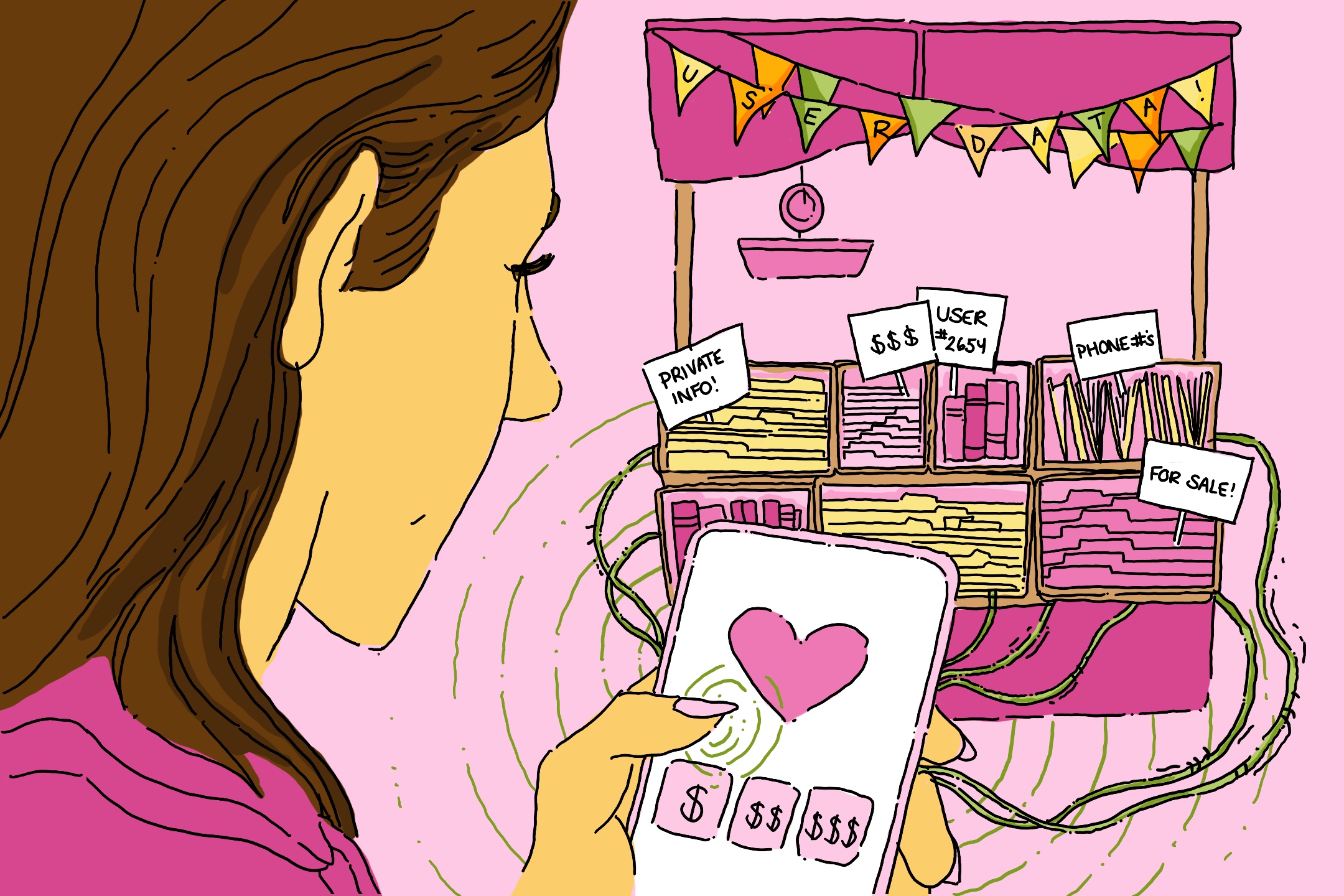
“I’m gonna go turn off Hinge right now.”
In an interview with The Varsity, Elise Corbin, a computer science student, shared that this was her reaction when she learned that, on top of knowing a user’s precise location while the app is actively in use, Hinge can also track a user’s location while running in the background.
Corbin is not an isolated case. As a computer science student, she was aware of the scope of data collection policies. However, consenting to the terms of every app can be overwhelming. “All these [apps] that you have to download, not just in dating, but in your life, they kind of desensitize you to clicking ‘yes’ on these things,” she said.
While many students understand that apps collect data, they are often unaware of the full extent. Many recognize there is a trade-off, but few know where the boundaries lie. Users open the app to meet someone, and suddenly they find themselves navigating permissions, cookies, policies, and sub-policies that stretch on for pages.
The not-for-profit Mozilla Foundation flags dating apps like Tinder, Bumble, and Hinge with warning labels, cautioning users to think twice before sharing highly sensitive personal data on these platforms. As an organization focused on fostering an open, accessible, and privacy-respecting internet, Mozilla acts as a public-interest watchdog.
Location data, sexual preferences, identity signals, and messaging behaviour can be merged into behavioural profiles, enabling inferences and user targeting that extend well beyond dating apps’ stated purpose of connecting users. Even if users technically consent, can that consent truly be considered informed when it is buried in dense legal language and complex processes?
How data translates to revenue
For major companies such as Match Group, which owns online dating platforms like Hinge and Tinder, the vast majority of their revenue comes from direct in-app purchases and subscriptions. The company’s financial report states that 98 per cent of revenue is generated through paid features such as premium tiers, boosts, and visibility-increasing features, making subscriptions and subscription upgrades its core business engine.
While Corbin said paid features do not particularly appeal to her, this financial model still works. A large user base does not require everyone to pay — it only needs a sufficient number of users interested enough to pay for a subscription, while others continue swiping.
That is where data fits in. It powers the system, driving recommendation algorithms, engagement loops, and product development. User behaviour becomes feedback, which fuels optimization, then retention, and eventually revenue.
On its website, Match Group states that “dating is personal, so we do not sell any data to third parties.” However, the term “sell” does not cover every form of data transfer. A firm can avoid formally “selling” data while still sharing information with third parties — for advertising measurement or vendor services — which can meaningfully affect how user data circulates, even if it is not recorded as a distinct revenue line. Mozilla reports that over 80 per cent of dating apps sell or share user data for advertising purposes.
AI powers the algorithm
The development of AI has also increased the complexity of data handling. Match Group has recently unveiled its AI initiatives, including photo selection and enhancement recommendations for Tinder and Hinge. The photo selector helps users identify images that optimize their profile and runs entirely on-device, meaning Tinder does not receive biometric data from that feature.
AI-curated insights aimed at personalizing your connections, however, run server-side. When AI-powered matching features are enabled, data about user activity and model inferences are processed and stored on Tinder’s server. Better matching algorithms may represent a genuine product improvement, but it also expands the data-processing pipeline: more signals collected, more predictions made, and more personal behaviour turned into model inputs.
Even before the rise of GenAI, dating apps often relied on effective — though arguably ethically questionable — algorithms. Historically, Tinder used the Elo scoring system to rank users by ‘hotness’ by determining their ‘desirability.’ The same rating system is used in chess, where players are ranked based on their skill level.
Today, the app employs a machine-learning algorithm that factors in profile activity, “Nopes,” “Likes,” and engagement to determine user visibility. AI certainly enhances the possibilities for how creatively firms can leverage user data.
Security concerns
There is another dimension to this: security. Beyond intentionally commodifying and sharing user data, there are more serious risks — data breaches. Mozilla reports that half of the apps it studied experienced a “data breach, leak, or hack, in the past three years.” In one extreme case, location data from Grindr was later purchased by a Catholic group in the US to monitor members of its clergy. Data is, undeniably, a valuable commodity.
None of this means students should panic-delete every app immediately. After all, the lines between LinkedIn, Instagram, and Tinder are sometimes blurred, making dating apps not so different from traditional social media. If you use dating apps, you consent that your data is part of an exchange, whether you pay or not. The important question is not whether this trade exists, but whether it is fair.
Once the terms become clearer, behaviour changes. In Corbin’s case, the reaction was immediate: she deleted Hinge. Not because she suddenly discovered that apps collect data, but because she decided the specific trade-off was not worth it for her anymore.
Should students think twice before using dating apps? Probably yes — but “think twice” should mean “use intentionally,” not “never use.” Review location permissions. Limit identifiable details. Be cautious when linking other platforms. Decide what you are willing to exchange before the app decides for you. Remember that if you are not paying with your card, you are likely paying with your data, your attention, or both.

No comments to display.