
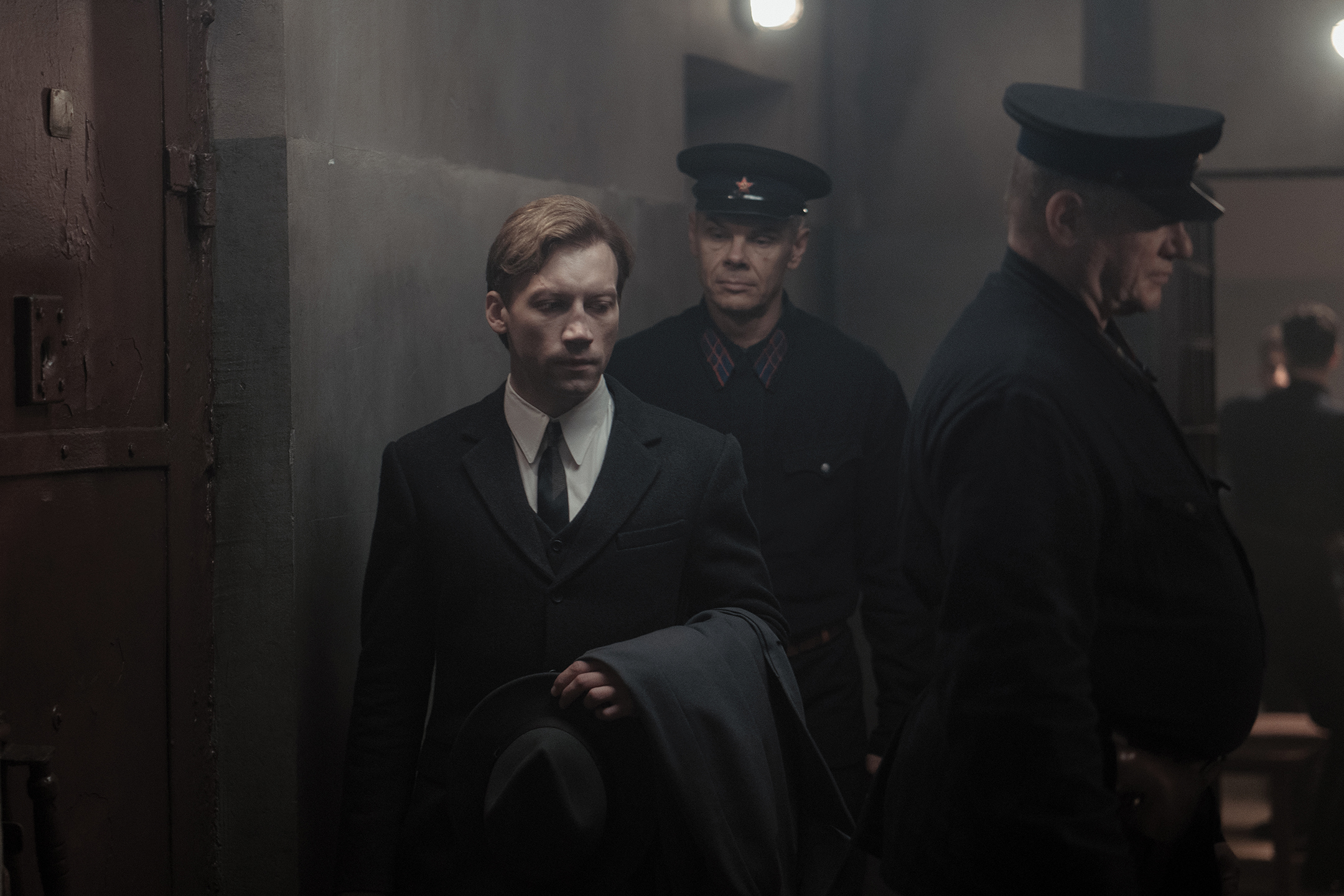
Someone asks a man what he was doing as a Bolshevik before the revolution in 1917. The man said that he was imprisoned. They then ask what he will do now after the revolution as a Bolshevik. The man replied that he’s on his way to prison.
This joke is told by the prison governor to the warden in Sergei Loznitsa’s historical drama, Two Prosecutors, which was recently featured in the Toronto International Film Festival’s (TIFF) 50th Anniversary lineup.
The joke elicits knee-slapping, belly-shaking laughter from the warden and the prison governor. But when the warden leaves, the prison governor’s face falls, and he turns to the camera with panicked dismay. This bleak horror and mundane betrayal is the tone of Loznitsa’s exploration of the bureaucratic machine of The People’s Commissariat for Internal Affairs (NKVD) during Joseph Stalin’s Great Purge in 1937.
In Franz Kafka’s novel, The Castle — one of the materials that the director drew on for this film — the castle is an exaggerated bureaucracy that claims to be a flawless, well-oiled machine. The reader eventually learns that if the bureaucratic machine did not have any flaws, the novel’s protagonist, K., a land surveyor, wouldn’t have been sent to investigate the place. Two Prosecutors has a similar conundrum.
The movie begins with a shot of a rust-red, heavy, metal prison gate that opens menacingly slowly, through which the film’s protagonist, 29-year-old Kornyev (Aleksandr Kuznetsov), a Soviet prosecutor only three months on the job, marches in with purpose. His task is to investigate a complaint from a prisoner that arrived at the prosecutor’s office. The problem is, all complaints are burned by the interned labourers on the orders of the prison warden.
Kornyev discovers that there is a corrupt scheme targeting old Bolshevik fighters and party members, and he tries to take the logical investigative steps to address this outrageous flaw in the bureaucratic system. Like K. in Kafka’s novel, however, he is faced with constant obstacles that delay, confuse, and sabotage his mission.
Loznitsa explores this comically frustrating tomfoolery of bureaucracies with a deft hand. The machine of bureaucracy functions in the same pedantic way in a lowly prison in the far northern city as it does in the high echelons of a government branch in Moscow.
Kornyev is faced by gatekeeper underlings in both settings. In the prison, the warden determines whether Kornyev gets to see the prison governor. In Moscow, the stern secretary of the prosecutor general is upset that Kornyev has made no appointment and has no travel papers, yet has the audacity to request a meeting despite his low rank.
If you do not know how the bureaucratic system works, it is not in its interest to guide you. In the prison, Kornyev manages with his extensive legal knowledge and official papers. In Moscow, there are traps for him everywhere. He is unaware of the various spies gleaning information from him, or that the trust he places in the system to correct itself doesn’t function that way. One bureaucracy he has power over, and one puts him in a labyrinth.
In the question-and-answer session after the TIFF North American premiere on September 9, Loznitsa warned his audience not to see his protagonist as naive, as others have made the mistake of doing.
We have the advantage of historical fact in knowing how things played out. Kornyev’s crime as a character is that he earnestly believes in the revolutionary ideals of his government.
The Bolshevik Revolution occurred in 1917 when Kornyev would have been hardly a year old. He grew up watching his country transform into a rapidly industrialized, global superpower in the span of 20 years.
Why wouldn’t he believe that his new, wonderful country was capable of doing better? This young man is a card-carrying member of the Communist Party. He still recalls the appeal to truth in service of the country that was made at his law school graduation. He has every reason to be hopeful that the people he considers his comrades will not let him down.
This is natural. What is unnatural is that his country and his comrades betray the trust he has placed in them.
We live in a hypercapitalist world that encourages individualism and cynical distrust over any communal ideals. But as Canadians, we also live in a high-trust society. We do not expect to be spied on at every turn. Our citizens are able to express their outrage in the media and demand the honouring of our civil and legal rights when they are abused.
Perhaps we will be labelled as naive in 50 years, as Loznitsa said, for being so blind to the ways our own country betrays our trust in the function of its own power and authority.

No comments to display.