
Director Siyou Tan’s debut feature film, Amoeba, follows teenage Choo Xin-Yu (Ranice Tay) in her last year before secondary school. She finds quick friends in a group of restless girls, Sofia Teh (Lim Shi-An), whose name is misspelled as “Tay” on her uniform nametag; Vanessa Ooi (Nicole Lee Wen), who is apprehensively bound for swimming greatness; and Gina Wong (Genevieve Tan), who remains the gang’s rock.
The film opens with Choo being haunted by a ghost in her room. This could be the ghost of many things: school, the ever impending doom of aging, friends, work, exams, you name it. The scene is completely silent except for the droning of a fan keeping Choo’s room cool.
The man beside me in the theatre, however, thought this would be a good time to systematically shove popcorn in his mouth with the vigour of a starving savannah animal. While he gnawed with his mouth fully agape, I flashed him a couple of dirty looks, which he didn’t see as he was too distracted by his pail of greed. Had I been five years younger, though, maybe I would’ve really said something.
Choo and her friends are contrarians, which doesn’t bode well for the incredibly competitive and ‘authoritarian’ Singaporean education system that Tan wanted to capture in the film. To appease their rebellious spirit, their Uncle Phoon (Jack Kao) helps them form a gang –– a real one; a pact of friendship and brotherhood, with the loyalty and earnestness of any real, life-changing middle school friend group. Calling each other “brother” rather than “sister” made the girls feel like they had more agency, as in Tan’s family –– which I suppose is the patriarchal world standard –– they had a fatherly lineage.
To capture the gang’s closeness and their personal riot for self-rule, many of its escapades are filmed by a camcorder — rather than being filmed by an outsider camera crew — held by the cast themselves.
Scenes like the one where each member of the gang shows off their most “confusing talent,” including fighting, skateboarding, and general athleticism, allowed the cast to film on the camcorder amongst themselves, without Tan’s oversight. Tan and the cast were sitting in the row in front of me in the theatre, and when this scene played, they laughed just as hard as the rest of the room, and afterwards they reminisced about how it was their favourite scene to film. For Tan, the most important part of the casting for the film was to ensure that the actors could “believably be a friend group.”
Through the camcorder, we came to understand many of the dynamics in the film. When Choo is initially accepted into the friend group, their first act of initiation is getting a cameo on the camcorder. Though it belongs to Sofia’s brother, Sofia lets Choo keep it since she sees how much she enjoys recording, solidifying their friendship.
The gang record themselves singing a song from the movie 15, which stars real Singaporean gangsters. The principal uses this as evidence to try to get them expelled for being in a gang, an accusation that obviously, they all deny. At the end of the day, they’re kids, they still have to get into a secondary school, and they can’t have suspensions on their records.
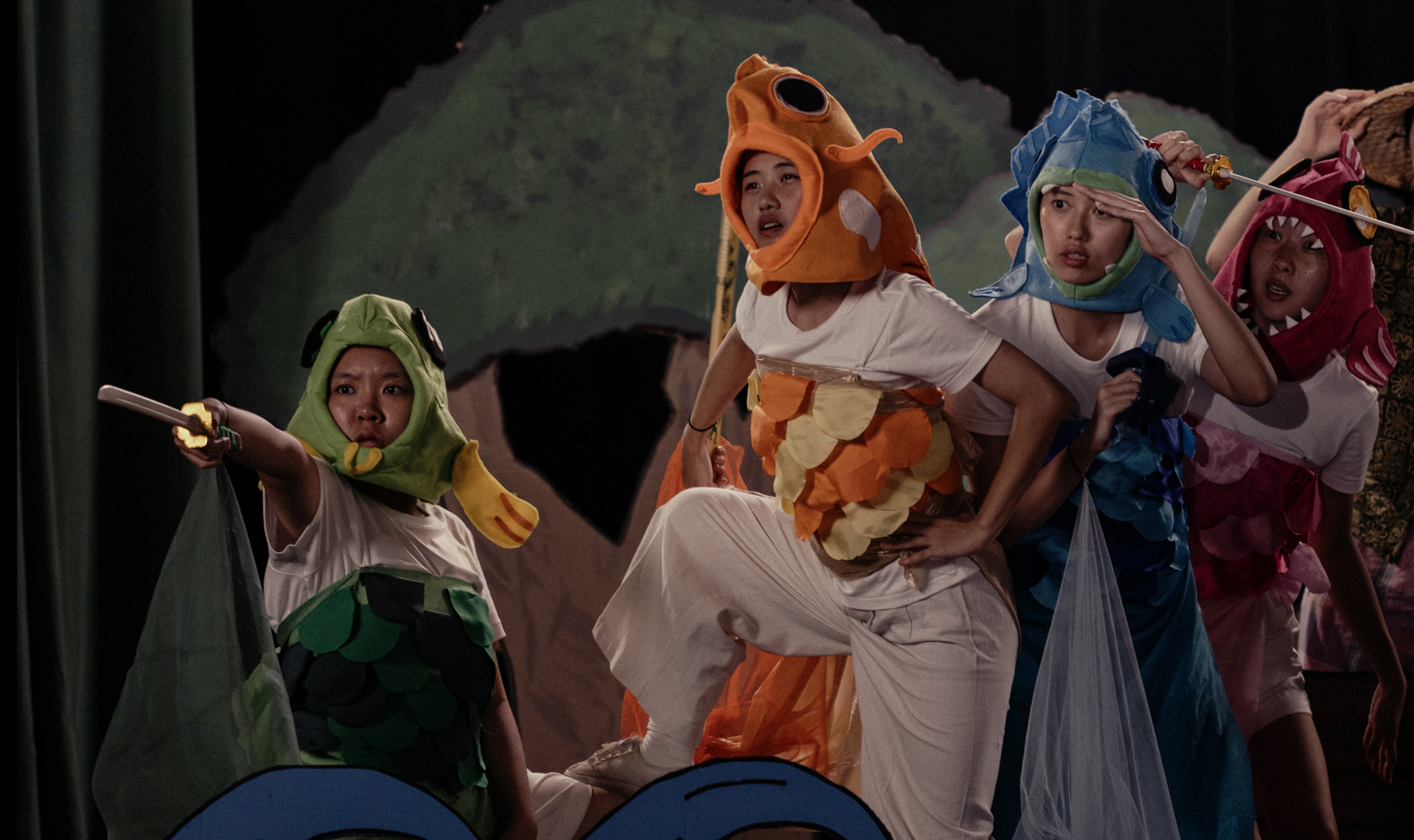
Contrasting the naturalistic filming medium, Amoeba is riddled with surrealist and supernatural elements that make the experience more dreamlike and absurd –– that is growing up, after all, I comment cheekily. The natural and the absurd work together to bring the gang together and tear them apart; they sit together in a candle-lit cave underneath their school, lined with artifacts they don’t understand the value of, but Sofia’s room has AC and a balcony while Choo only has her –– very loud –– fan.
Although we can’t see it, the ghost moves furniture around and pulls on the bedding, keeping Choo awake throughout the night. Choo’s exhaustion invigorates her already adversarial character, but when Vanessa comes over to help her catch it with the camcorder, that’s when Choo’s feelings towards her develop –– confusingly and intensely.
Amoeba feels like Tan’s olive branch to young girls with a temper. My genuine disdain for the man sitting next to me in the theatre was validated. Ultimately, it wasn’t anger towards him specifically, it was about the broader fact that, once again, the self-absorbed ignorance of others –– or that’s just what it feels like, I suppose –– had thwarted my relaxed freedom to enjoy the world.
When asked what the title of Amoeba means for each of the cast members after the film screening, Ranice Tay replied that “Amoeba is the size of rebellion that exists in each of us, that we should never forget, that refuses to get named or labelled and that makes us thrive.”
You revolt, you hide out in caves and run around the city, you don’t study, you get reprimanded, which only makes you want to rebel more. The Ouroboros of youth, if you will. But that’s the point of the whole thing, Tan argues.
Tan decided to remove the ending of the film, in which we learn where the gang ends up in a couple of years’ time. The audience is left without catharsis, we don’t know how the gang does on their final exams, we don’t know if they continue to be friends, or if they end up going to the same secondary school.
Near the end of the film, Choo finds Uncle Phoon’s shrine, a table full of his friends sitting nearby. They usher her over, telling her about Uncle Phoon’s life. He too was in a gang –– a real one –– working as a driver for Sofia’s dad, making the two like a real family.
Phoon’s friends reminisced about their life together, their closeness despite the fact that they spent many years apart. Even the gangsters from 15 are now married with children, working regular jobs, and have only met up once since filming, though it was slightly awkward.
But Sofia has money, Vanessa has swimming, Gina has her uncanny ability to pull through at the last moment, and Choo has her ghost.
Finding yourself isn’t lonely, Tan assures her audience. An amoeba’s power comes from its “shapeshifting blobiness.” You, reading this, are likely in university, planning the future ahead, doing your last bit of growing up. Even though it feels so special, it feels special to everyone; everything you do during these times is along the lines of finding treasure in a cave with your gang of brothers.
And what you take away from that may not always be what you expected, as someone leaving the theatre proclaimed about the movie, “I did learn a lot about the Merlion, though.”

No comments to display.