
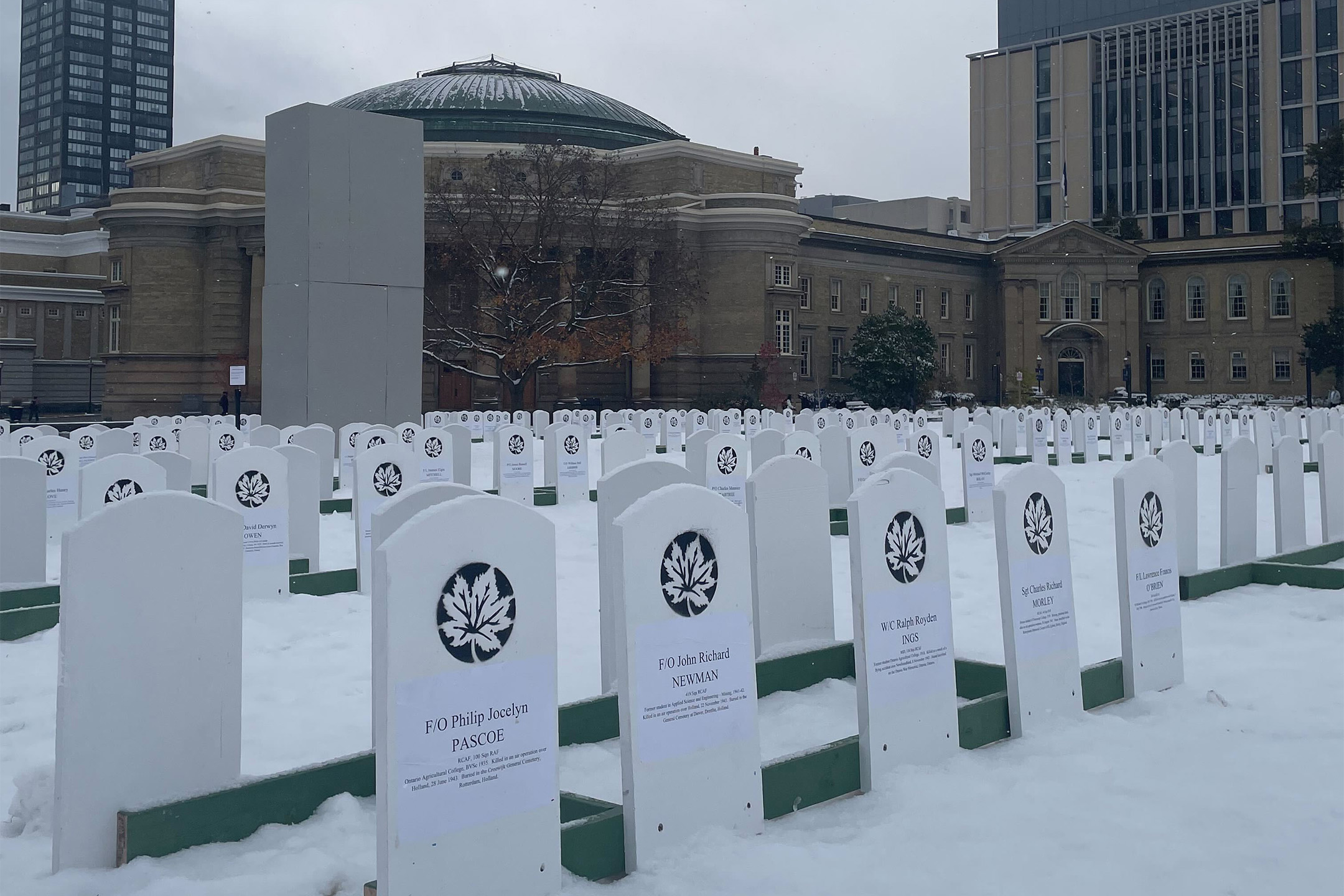
On November 11, all three campuses held Remembrance Day services to honour the fallen soldiers and veterans of the First and Second World Wars, as well as those who serve their country today. President Melanie Woodin and other university leaders offered remarks to the audience of U of T community members and service members.
This year marks the 80th anniversary of the end of World War II and the Canadian forces’ liberation of the Netherlands from Nazi Occupation.
The UTSG ceremony was held at the Soldiers’ Tower, situated at Hart House’s western end. The tower is a monument to the 628 fallen U of T members between 1914–1918, and the 557 between 1939–1945.
Hundreds gathered around Soldiers’ Tower for the ceremony, which began with a land acknowledgement by Peter MacLaurin, chair of the Soldiers’ Tower committee. In the acknowledgement, McLaurin honoured Brigadier Oliver Martin, the first Indigenous person to attain the rank of brigadier in the Canadian military, and who served in both world wars.
President Woodin thanked the university students, faculty, staff, and librarians who served. Afterwards, members of the Hart House chorus sang the Naval Hymn. The event included a reading of In Flanders Fields, written by U of T alum Lieutenant-Colonel John McCrae.
During the UTSC ceremony, U of T Vice-President (VP) and UTSC Principal Linda Johnston spoke to attendees in the room and along balconies. For the first time, the Highland Creek Colour Guard from the Royal Canadian Legion Branch 258 participated in the event.
At UTM, Alexandra Gillespie, VP and UTM principal, gave remarks and laid a wreath during the ceremony, which was held outside the Davis Building near the flagpole.
Different groups laid wreaths at the foot of the World War I memorial wall next to Soldiers’ Tower throughout the UTSG service. Still on view, these wreaths were laid by, among others, the U of T Faculty Association, and various student unions. Of note, Woodsworth College alum Major John D. Stewart attended and laid a wreath.
By the end of the ceremony, the base of the World War I memorial was lined with countless wreaths bearing the symbolic poppy. Above the wreaths and the names of hundreds of fallen soldiers, a reminder to all those who visit is carved into the white marble: “Take these men for your ensamples. Like them, remember that prosperity can be only for the free, that freedom is the sure possession of those alone who have the courage to defend it.”

No comments to display.