
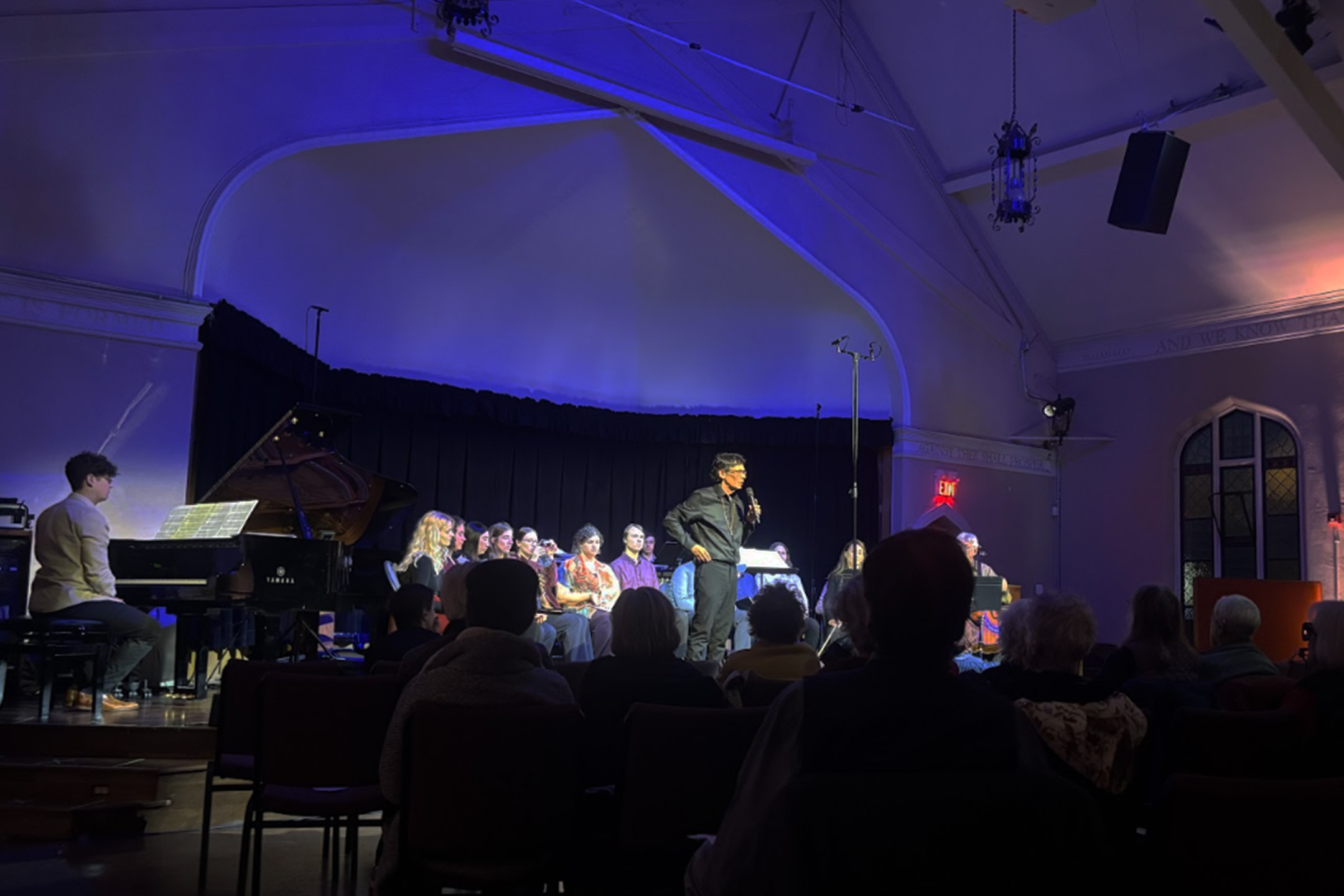
On October 28 at Hugh’s Room Live, I attended a performance of Empire Étrange: The Death of Louis Riel, conducted by Cree composer and conductor Andrew Balfour. The show was part of a series by Toronto-based music presenter Soundstreams called “Encounters,” which puts on free educational performances and talks. The production included a choir, a violinist, a cellist, a percussionist, and a pianist.
Empire Étrange is an oratorio, a musical work for voices and instruments that tells a story — often one that is spiritual or religious. Balfour explained in a Q&A session after the performance, that this production is a soundscape that tells the story of Métis leader Louis Riel and the Red River Resistance, and speaks from an Indigenous perspective.
Balfour wished to fight against colonial perspectives and instead show a perspective of Riel that is normally not engaged with by settler-colonial historians. Both the English and the French present Riel as being either a hero or a villain. However, Balfour found it interesting that Indigenous depictions of him are often left out, since they could provide a nuanced look into this story that considers the full complexity of who Riel was, both as a person and a political figure.
Balfour is from Fisher River Cree Nation, and grew up in Winnipeg, Manitoba — the same area where Louis Riel was born and raised. In the Q&A session, Balfour suggested that history cannot be read about in a book; “you have to experience it.” He recounted how growing up in downtown Winnipeg, he would walk by Riel’s grave every morning and would think about his resistance movement.
Louis Riel, who lived from 1844–1885, was a Métis leader, the founder of Manitoba, and a central figure in both the Red River and North-West resistances. Riel sought to protect Métis political, cultural, and land rights in the face of Canadian expansion, negotiating a “List of Rights” and leading a provisional government in Red River.
Later, frustrated by broken promises over land titles and representation, Riel returned to lead a second uprising in Saskatchewan, asserting Métis nationhood through a provisional government. On November 16, 1885, for his resistance against the Canadian government, Riel was tried for high treason and hanged. Over time, his legacy has shifted from that of being a rebel, to a martyr and founding figure for both Manitoba and Métis rights.
Balfour wrote about Riel because he saw Riel’s life as dramatic, politically powerful, and still shaping Canadian identity long after his execution. Balfour’s goal was to tell the story of a figure considered controversial in settler-colonial narratives through an Indigenous perspective, which he feels is often lost in mainstream history lessons. Every musical moment is meant to explore the Indigenous peoples’ perspective of a political conflict they had no say in.
The oratorio is set during the Battle of Batoche in 1885, at a time when the bison of the land were already nearing extinction, and tens of thousands of Cree and their communities were being pillaged. The show opened with sounds of wind and grass from a flute and a drum. In the background, whispers from the choir sang ominously, “Do you know me? You cannot escape me. I see you! Ha ha ha! I see you! I’ve found you… Are you watching?” The audience was transported to Riel’s childhood, where he first witnessed a fence being built on the land he grew up on, his home.
Balfour told the audience that it didn’t make sense to Riel that this new border was being placed on the land, and that Riel wrote in his diary that Turtle Island was facing a European settler awakening.
Balfour addressed the audience before the next movement, “Awasis,” to give context. The text in the movement translates to “Always be at peace with oneself, Child.” The next song began with Pôni-Pimâtisiwin, which means “The end of living,” with the drums beating menacingly and the choir joining with a tone of anticipation and foreboding.
The fourth movement was an unconducted interlude scored for piano and violin. It is about the speech John A. Macdonald made about Indigenous people. The violin and piano make abrupt screeching sounds, while a soloist sings part of the speech, “We must vindicate the position of the White man. We must teach the Indians what law is.”
The piece concludes with the day of Louis Riel’s execution in Regina. On the land the Cree call Oscana, “Pile of Bones,” his rushed political sentencing and death were ordered by MacDonald and the City of Ottawa. Balfour returned to the stage to introduce the final song, “[Riel] thought for all intents and purposes he was going to be pardoned, but he must have realized last minute he was not going to get away with it, so he recited the Lord’s prayer in français.”
In the Q&A, Balfour explained that Empire Étrange is an amalgamation of parts of a different oratorio of his from 2013 with the same name. With this updated oratorio, Balfour wanted to share a broader story about Riel’s advocacy for Indigenous populations.
Balfour shared his experience as a survivor of the Sixties Scoop and how he was colonized at six months old when he had been taken from his family. He shared how it is therapeutic to learn his Cree language, and refers to it as pre-ancestral medicine. Balfour also mentioned how he is relearning his history from an Indigenous perspective. Indigenous language revitalization and reclamation is one of the key components of the Truth and Reconciliation Commission, as it contributes to healing of a cultural loss.
In a statement before the production, artistic director of Soundstreams Lawrence Cherney explained that although stories can’t bring stability to a fractured world, they can bring reflection upon and context to our world. Bringing stories from diverse voices, such as Indigenous creators in Canada, is vital to cultural preservation.
Jasmine Wemigwans is an Indigenous artist, researcher, and graduate of the Master of Information and Library Science program at the University of Toronto. Her work bridges Indigenous knowledge systems and information studies, exploring how creativity, digital design, and cultural protocols can coexist in academic and technological spaces.

No comments to display.