
The more criticism that artists with apolitical attitudes receive from the general public, the more I appreciate artists who promote progressive values — not so much by making placating social media posts or annual charity donations, but by creating, organizing, and circulating educational content.
I am particularly fascinated by a link between music and radical literature: our critical reading skills can be translated to how we appreciate lyrics. Musicians can carry us from record to manifesto.
In light of politically vocal sellouts like Nicki Minaj and Snoop Dogg, who choose to entertain the MAGA crowd in complete disregard for the well-being of their Black community, which artists are for the people, and specifically for their people?
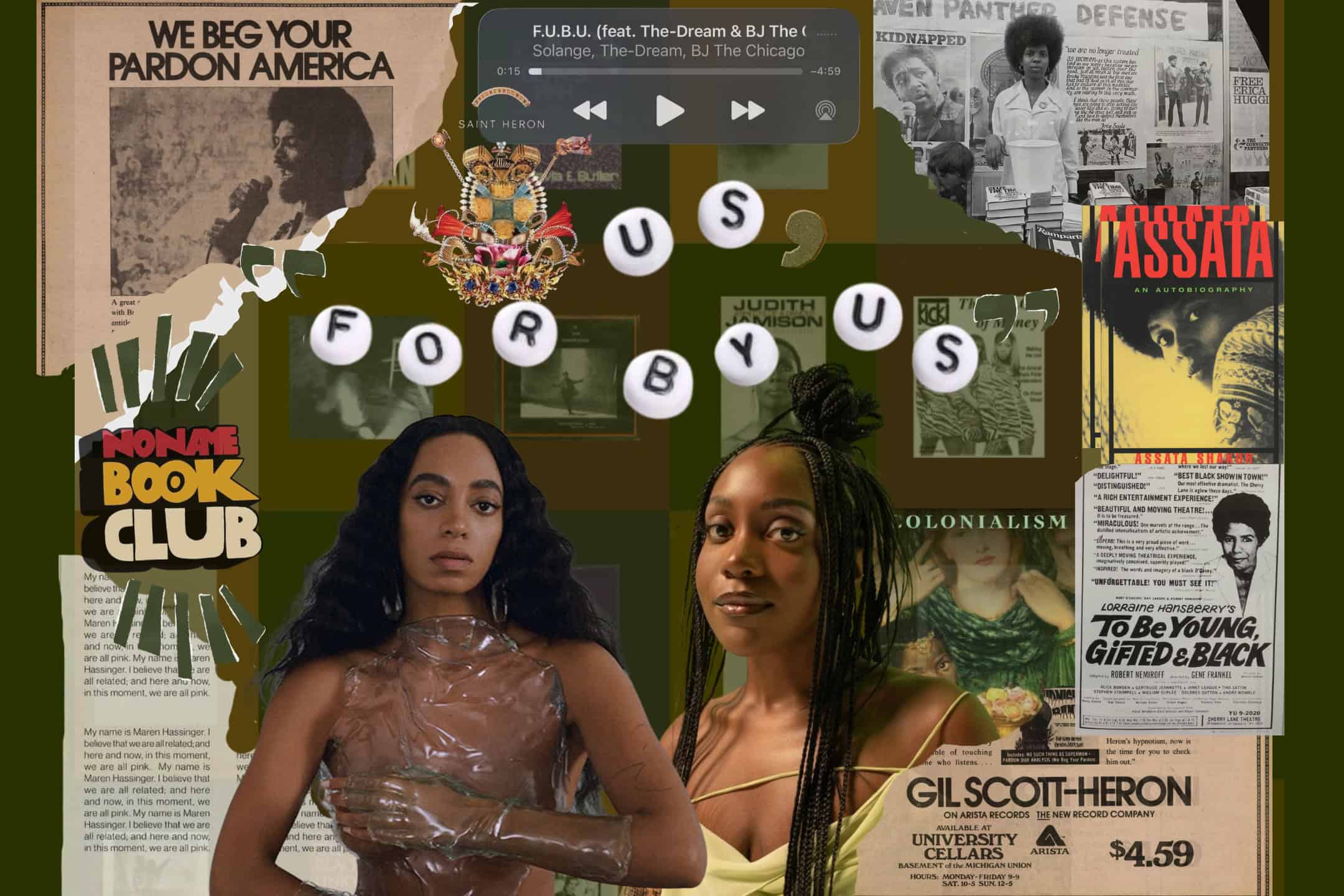
Noname’s international book club
After following African American rapper Noname’s journey for years, I emailed her in April 2025 with an interest in starting a Toronto chapter of her international book club. To my surprise, this new chapter was already in motion. More shockingly, the response email was signed “Fatimah,” the government name of my favourite rapper.
Noname Book Club launched its Toronto chapter in May 2025. The club features texts like Assata Shakur’s Assata: An Autobiography, Aimé Césaire’s Discourse on Colonialism, and Octavia E. Butler’s Parable of the Sower. From life stories to theory to fiction, Noname seeks to educate, connect, and empower the Black diaspora.
Not only had Noname assumed political responsibility in her lyrics, large-scale organizing, community fostering, and the education of 1,500 incarcerated book club members, but she had also taken the time to reply to my email. This is what separates one famous political activist from the next: getting personal with the audience that funds the activism, and with the people one seeks to uplift.
Saint Heron Community Library
African American musician Solange Knowles launched the Saint Heron Library in September 2025. According to her Instagram post announcement, the library provides free access to “primarily rare, out of print, and 1st edition titles by black & brown authors” across America. Operating on an honour basis that all texts borrowed and shipped out will be returned within 45 days, the Saint Heron Library offers the luxury of education to all socioeconomic classes.
The founding of Saint Heron Library invokes the affirmations in Knowles’ pro-Black anthem “F.U.B.U,” which exclusively addresses the global Black community, acknowledging specific racial pains and consoling listeners. Saint Heron credits a team of entirely Black collaborators, effectively making the library “for us, by us.”
Saint Heron Library does not hide educational material behind a paywall. It does not create elitist educational and class divides. It does not spotlight white authorial superiority. It is not a branch of a larger, whiter, liberal literary project. As Audre Lorde said, “the master’s tools will never dismantle the master’s house.”
Black History Month features at the municipal library, white-authored texts about Blackness, or university courses on race will not free the Black mind to the point of revolutionary change. But, maybe, with time and growth, the collective efforts of Black bookworms will.
At the intersection of music and literature
The relationship between literature and music is not new, but a dynamic I’d position as critical to the Black radical tradition. Gilbert Scott-Heron, one of the inspirations behind the name “Saint Heron,” folded his political ideologies into both his discography and his literary works. He navigated revolutionary politics on his record, Pieces of a Man, and his novel, The Nigger Factory.
Similarly, Harlem Renaissance legend Langston Hughes balanced songwriting, poetry, playwriting, and novel writing. Hughes collaborated with composers to create operas, musicals, and oratorios throughout his lifetime, incorporating the Black experience into his works. Hughes established jazz poetry, where he composed his poems in the rhythm and improvisational style of jazz.
Music and literature can originate from the same mind, exist in the same piece of art, and interact with each other on multiple levels. The music talks to the literature, and the literature talks to the music.
I think it’s important to note that we do not need to rely on the rich, famous, or successful to lead us. However, I think it is important to evaluate the political beliefs of the artists we support.
Noname’s Book Club and Saint Heron Library are exemplary, well-publicized literary projects that spread knowledge on egalitarian terms. Projects like these stimulate Black readership, offer a site for intellectual discourse, build community, and make reading more accessible.

No comments to display.