
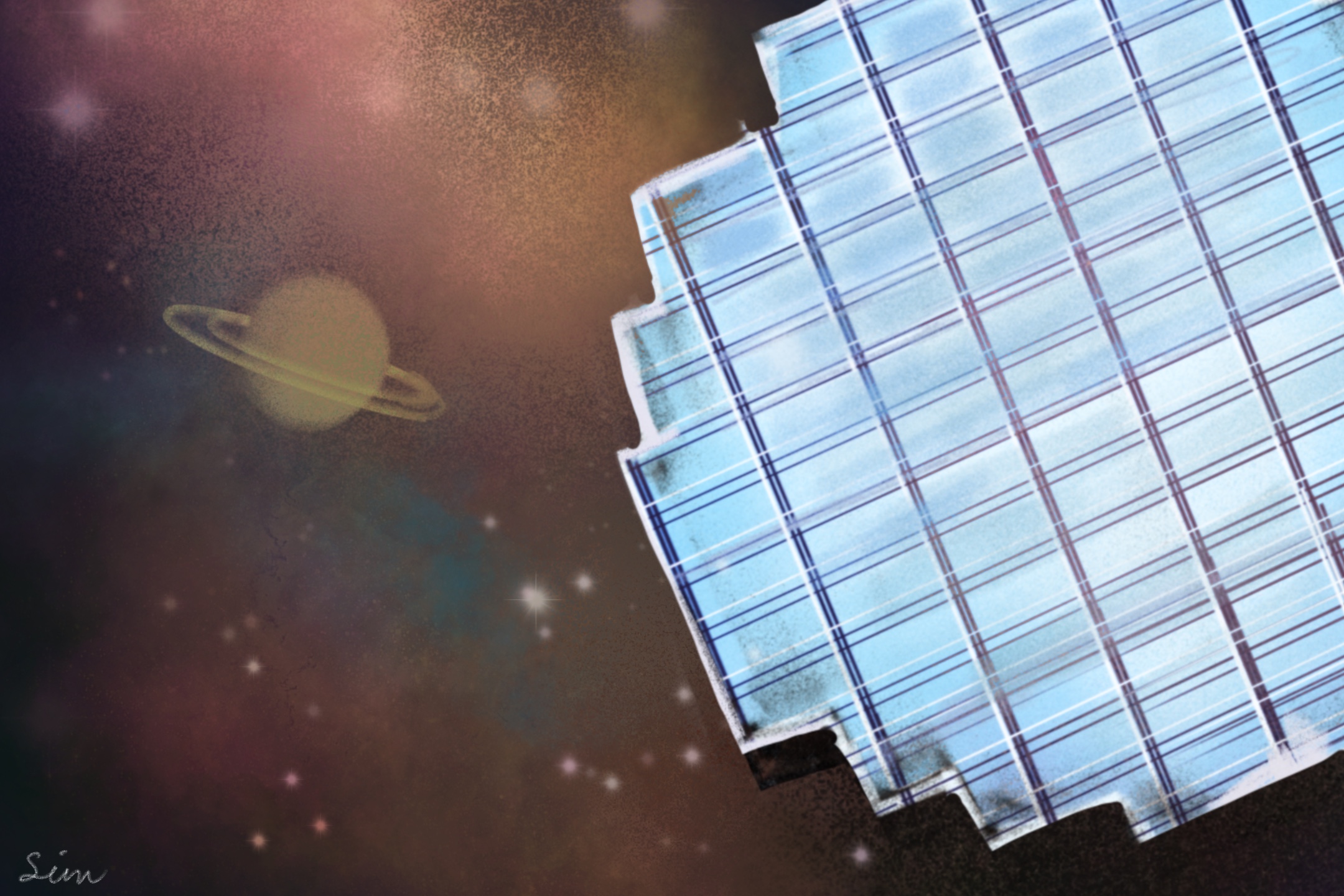
It takes smoke to study dust — at least, in the case of space dust. Aerogel was first invented in 1931 by American scientist and chemical engineer Samuel Kistler, and up until 2012, it held the record for the lowest-density solids we know, still making it one of the lightest solids in the world. This strange and eerie material was labelled as “frozen smoke” by some scientists. However, it was not until decades later that its practical applications emerged. For example, NASA uses aerogel to capture dust distributed in space by comets.
Upon viewing aerogel, one might conclude that it is too delicate for practical applications, as if a light touch could cause it to crumble. However, due to its fragility, aerogel has played a vital role in space exploration.
Aerogels are 99.8 per cent air. They are formed by removing the liquid from a gel, such as silica gel — a drying agent to absorb moisture often found in packages like clothes and food — and replacing it with air.
It is typically made using a sol-gel process, which turns liquid ingredients into a lightweight, porous solid. In this process, silicon-based chemicals are mixed with water, alcohol, and a small amount of a catalyst that helps the reaction along. These chemicals slowly form a jelly-like network or a gel, and when the liquid inside the gel is carefully removed, the extremely light and porous structure of aerogel remains.
The solvent, or liquid, from the gel is extracted through a procedure termed supercritical drying. This involves heating and pressuring the solvent until it attains a supercritical condition. In a supercritical state, the solvent assumes a character that is neither that of a gas nor that of a liquid but of a combination of both.
Since there is no clear distinction between the gas and liquid states, the liquid can be removed without forming the surface tension that would cause the solid to collapse, which results in the final airy structure. These unique characteristics render aerogels exceptionally fragile, but their placement in rigid supports or protective enclosures allows them to be handled, stored, and deployed safely for scientific applications.
But what does all this have to do with space dust?
The problem with space dust particles
Space may look empty, but it is filled with tiny particles left behind by star explosions, or even asteroids and comets. These interplanetary grains are older than Earth and act like time capsules, preserving clues about the materials and conditions present when the solar system first formed.
There’s just one problem: speed. Dust in space rushes along at around 20 kilometres per second relative to a spacecraft during comet flybys — this is around 16 times the speed of a rifle bullet. When they strike a solid surface like metal or glass, all the energy gathered from travelling is released instantly, causing the tiny grains to vaporize on impact.
For decades, scientists searched for a method of collecting them intact. Some experiments relied on foil plates mounted on spacecraft or high-altitude rockets, which were exposed to incoming dust streams, with the hope that some pieces of dust might be left intact after collision.
In other tests, silicone oil-coated plates were used to capture dust in space. The oil helped reduce particle shattering upon impact, providing gentler collection than bare metal plates, but they still couldn’t fully prevent damage to the fragile grains.
As useful as some of these tests might have been, the speed at which the dust was travelling made the particles shatter or dissolve upon colliding, leaving researchers with pieces of debris that were not indicative of the original composition of the particles.
What scientists needed was a material capable of slowing particles gradually rather than stopping them abruptly. An ideal collector would allow dust grains to lose their energy over a short distance, preserving them in a state close to their original form. Aerogel, distinguished by its soft and porous structure, emerged as an effective solution.
Why aerogels work
Despite being classified as solid materials, aerogels have an internal structure that resembles a weak network rather than a compact mass. A large portion of its volume consists of small air-filled cavities — this is around three orders of magnitude or 1,000 times thinner than the diameter of a strand of hair.
The cavities are upheld by a very delicate solid structure composed of interconnected silica strands from the solid component of silica gels. This unique structure enables aerogels to exhibit their exceptional capacity to interact with rapidly moving objects softly and gently.
When a high-speed particle penetrates an aerogel, it does not collide with a solid surface or abruptly halt. Rather, the particle slowly decelerates as it moves through consecutive layers of air and thin, fragile, solid threads.
As the particle loses energy, it leaves behind a visible trail in the aerogel made up of compressed, broken silica from the aerogel’s delicate network, slowing down and preserving the particles.
The aerogel tiles are deployed in a rigid collector tray extended from the spacecraft and oriented toward the dust stream, then retracted and sealed inside a return capsule for safe transport back to Earth.
The aerogel’s success contradicts the more intuitive idea that stronger materials are inevitably superior. In this instance, agility, adaptability, and meticulous design proved to be significantly more efficient than mere durability.
The Stardust mission
NASA subjected aerogels to rigorous evaluation during the Stardust mission, which was a spacecraft designed with a complete sample‑return system. Launched in 1999 with the ambitious goal of collecting material from a preserved comet and returning it to Earth, the spacecraft carried unique collection panels made of silica aerogel.
It travelled through the inner solar system to intercept Comet Wild 2 — a relatively pristine periodic comet whose ancient ice and dust offered a rare scientific opportunity to study how the early composition of the solar system — before safely returning the samples to Earth. While Stardust travelled through the comet’s dusty tail, tiny particles in the comet’s trail struck silica aerogel panels mounted in a rigid collector tray at the front of the spacecraft.
The aerogel’s ultra‑porous, sponge‑like structure gently slowed and trapped the high-speed particles, preserving them from shattering. Though delicate on Earth, the aerogel was supported and encapsulated within the spacecraft. That allowed it to withstand the vacuum of space, intense radiation, and the forces of launch and rapid flight, before being safely returned to Earth for analysis.
In 2006, Stardust returned to Earth with these valuable samples, marking the first instance of comet material being retrieved for direct laboratory examination. Scientists examined the characteristic impact tracks in the aerogel under microscopes and utilized precision tools to carefully extract small wedges of aerogel that contained embedded particles.
That dust particles contained minerals that could only form at very high temperatures, conditions much nearer to the young Sun than the frigid outer areas of our system where comets arise. This finding suggests that in the early solar system, materials from very hot and very cold regions moved and mixed over great distances, meaning the solar system was much more active and interconnected than we used to think. By capturing these delicate grains, aerogels not only gathered cosmic dust but also aided in revealing new understandings of the history of our solar system.
From space labs to everyday life
While aerogels are primarily recognized for their significant contribution to space exploration, their applications have now expanded well beyond the realm of space research and exploration.
Currently, aerogels are utilized in advanced insulation materials for buildings and vehicles, aiding in heat retention while contributing little to no weight. In addition, aerogels are being considered in medical technologies, including wound dressings and drug delivery systems, where lightweight and insulating materials are crucial.
From the mid-late 2010s, aerogels have even started to infiltrate the fashion sector. Designers and producers have tested fabrics infused with aerogel to develop jackets, gloves, and footwear that offer remarkable warmth without the heaviness of conventional insulation. This is because aerogel’s highly porous, mostly-air structure drastically reduces heat transfer.
Despite these increasing day-to-day applications, aerogel’s most remarkable impacts are still linked to space exploration. By reconsidering the intended functions of materials like silica gels, scientists converted an atypical lab substance into a versatile tool whose impact stretches from space exploration to daily technologies.
