
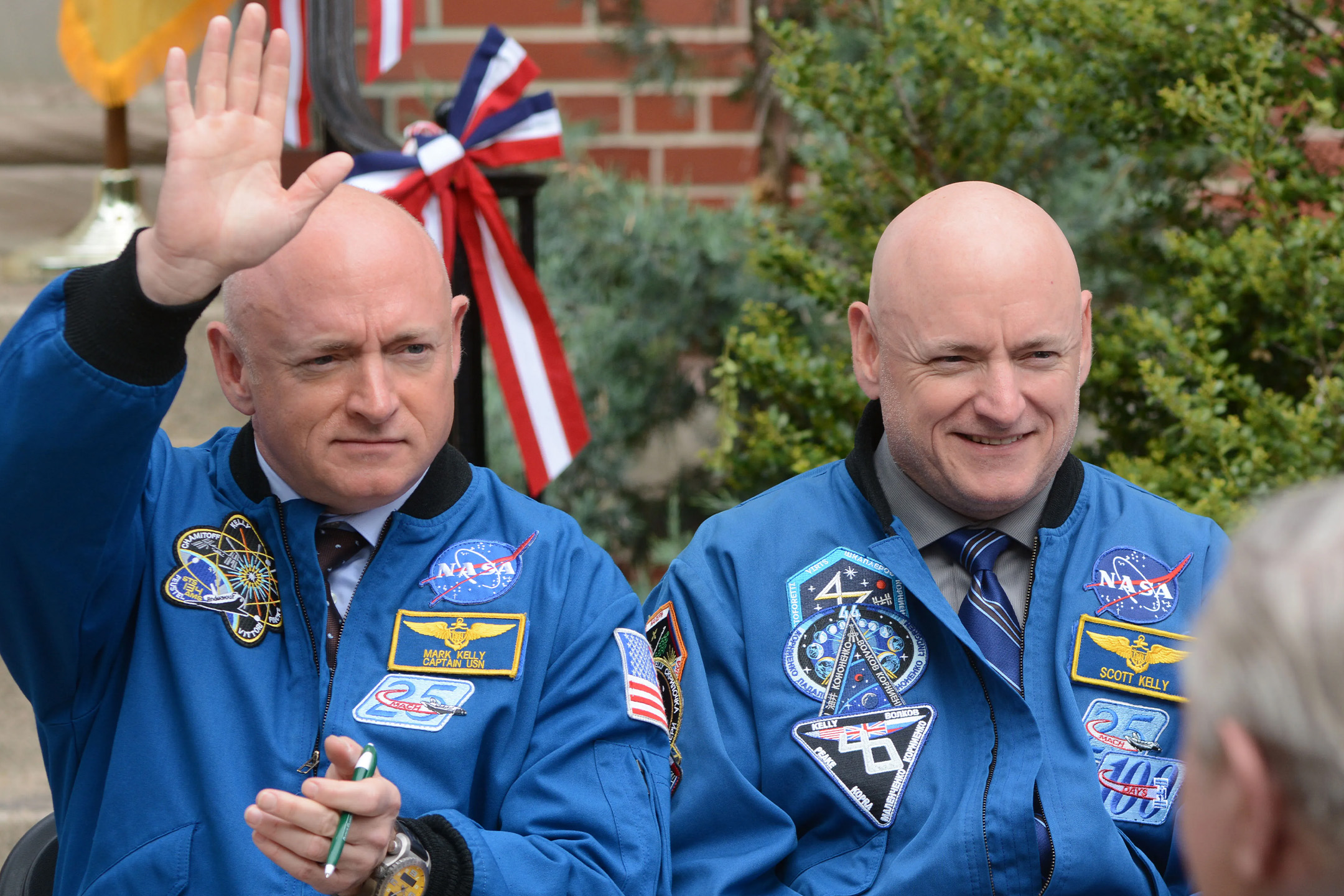
The Twin Paradox poses the following: given a pair of identical twins, if one stays on Earth and the other flies off into space, who is older by the end of the trip?
The answer comes from a counterintuitive result of special relativity, a field of physics which is notoriously difficult to wrap your head around. Understanding the theories of space travel and the health of astronauts may prove key to future explorations into the vast universe beyond our planet.
Spaceflight and health
In March 2015, NASA conducted the Twins Study. The goal was to study the effect of spaceflight on the human body. Identical twin astronauts Mark and Scott Kelly were the subjects, with Scott spending a year in orbit about the International Space Station (ISS) while Mark remained on Earth. By comparing two people with the same genetic makeup, NASA’s researchers were able to isolate the hazards of long-term exposure to space travel.
By the end of the study, NASA’s researchers had found that the 340-day mission was associated with short-term and long-term changes in human health and genetics. Short-term changes to Scott’s health included a seven per cent decrease in body weight, as is expected for astronauts, along with changes in digestive bacteria, which were suggested to originate from the changes in diet and socialization. These effects returned to baseline measurements after the end of the mission.
The more concerning findings of the study are symptoms which may affect astronauts in the years or decades to come. A notable decline in Scott Kelly’s cognitive speed, accuracy, and efficiency lasted up to six months post-flight, a major concern for any manned missions to the moon or other planets.
Potential cardiovascular damage persisted after the mission, as well as changes to genes which control the immune system and DNA repair. These changes in particular might cause long-term health concerns for astronauts, and will require future studies to determine their severity.
The Twins Study concluded that the health of astronauts can generally be maintained over a one-year spaceflight; however, it is important that future long-duration space travel address the concerns raised by NASA’s researchers. To understand the thought experiment that mirrors this study, let’s take a look at some of the scientific theories that aim to explain the universe.
Understanding special relativity
Special relativity is Albert Einstein’s theory of how space, time, matter, and energy interact to form the universe. A specific application well-known to physicists is its explanation of the strange behaviour of objects travelling near the speed of light. One real-world example of such objects is muons: subatomic particles which travel so fast that time passes 40 times slower for them, as they experience an effect known as time dilation.
Time dilation is predicted by a mathematical framework used in special relativity called the Lorentz factor. While studying special relativity is incredibly challenging, the Lorentz factor can be understood simply as the effect of measuring time from the point of view of a moving object. As all observers of objects must obey the speed of light and other fundamental laws of the universe, the time, mass, and distance travelled of that object will depend on how close to the speed of light it’s travelling.
In the case of time dilation, this means that an object travelling near the speed of light will experience time at a much slower rate, like muons. The tangible effect of time dilation was even supported by a 1971 experiment by J.C. Hafele and Richard E. Keating showing nanosecond-level differences in time measured by clocks on an airplane versus the ground.
With this context, one may wonder whether Scott Kelly experienced the effects of special relativity on his one-year mission with NASA. The ISS orbits the Earth at approximately five miles per second. This may sound unbelievably fast, but for comparison, near-lightspeed travel would need to approach 186,000 miles per second. It seems that time dilation must be incredibly small for the Twins Study.
As done in Hafele and Keating’s experiment, however, it is still possible to quantify the time dilation that took place in the Twins Study. The Journal of Biomedical Physics & Engineering published a letter to the editor in 2023 explaining that the theory of special relativity would predict that Scott Kelly’s one-year-long flight would cause him to experience time dilation of approximately 0.01 seconds. Therefore, Scott should now be 0.01 seconds younger than his identical twin, Mark.
So, what exactly has NASA’s research revealed about the answer to the Twins Paradox? According to special relativity, there is no paradox — Scott Kelly experienced time passing at a slightly slower rate due to time dilation. Consequently, the twin who stays on Earth must be older by the end of the trip.
While time dilation of this scale is negligible, the health concerns raised by the Twins Study are very real. Astronauts are exposed to the radioactive wasteland of space we know so little about, and any dreams of extraterrestrial human habitation must plan for the unknowns of space travel. NASA’s research is an important first step that will pave the way for future manned missions into the cosmos.
If you’re interested in learning more about the topics discussed in this article, undergraduate students can take courses including APM426 and PHY483 from the Faculty of Arts and Science; additionally, the Faculty of Engineering also offers PHY294.

No comments to display.