
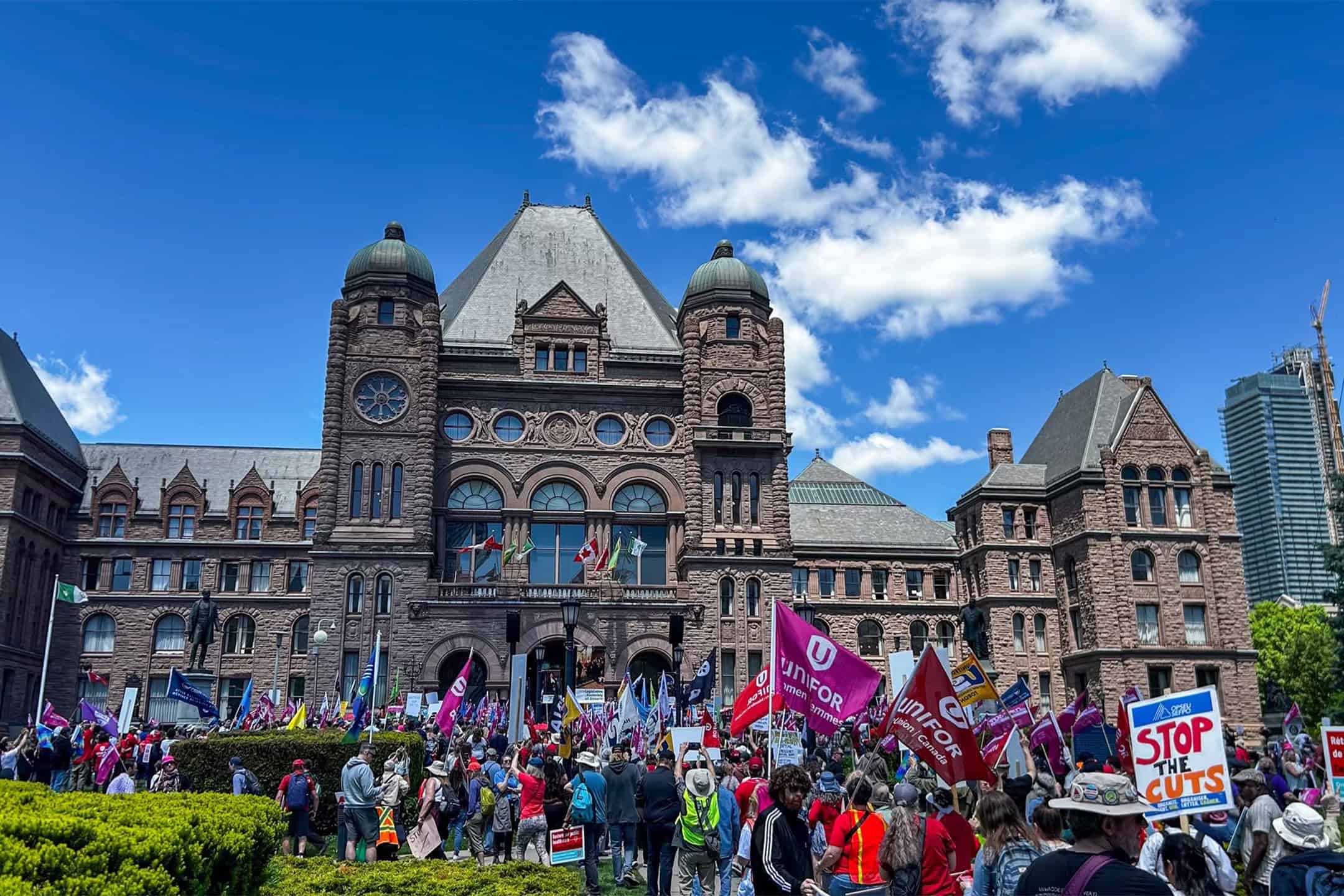
On May 28, health care workers, patients, and advocates from across Ontario gathered to protest the expansion of publicly-funded procedures available in private clinics. The Queen’s Park rally was organized by the Ontario Health Coalition (OHC) as part of its Stop Doug Ford’s Hospital Privatization Train Wreck initiative.
Across the board, hospital workers are facing burnout, leading many to leave the profession. U of T students entering the health care field can expect long work hours and heavier workloads. Ontario has tried solving this problem legislatively, but privatization doesn’t guarantee that all future patients and healthcare workers will see improvements in hospital conditions.
Ontario’s private clinic expansion
In 2023, the Ontario government passed the Your Health Act, which allows privately operated clinics to perform certain surgeries and diagnostic tests at the taxpayers’ expense. The legislation aims to improve patient wait times, patient experience, and access to care.
These procedures include eye surgeries, diagnostic scans, endoscopies, and some orthopedic surgeries. In practice, a surgeon could replace a patient’s hip at a for-profit clinic with OHIP picking up the tab.
In a system under duress, shortening wait times has its appeal. Data from Ontario Health shows that in May of this year, emergency room patients waited an average of 17.1 hours for a hospital bed. But critics of the act argue that expanding private clinics treats a symptom — long wait times — without treating the disease: a public hospital system lacking sufficient funding or staff to meet demand.
The Ontario government’s Your Health Act will allocate almost $300 million over two years to 61 new private clinics while public hospitals remain underfunded. A 2026 report from the Canadian Centre for Policy Alternatives showed that Ontario’s per capita public hospital spending was the lowest in the country in 2023, at $1,967, compared with the Canadian average of $2,168. The same report found that 55 per cent of Ontario hospitals’ annual expenses exceeded their revenues from 2024 to 2025.
Staffing shortages are of additional concern; the number of vacancies for hospital jobs rose by 101 per cent between 2016 and 2025. Simultaneously, wages for available positions decreased. Critics argue that stagnant wages could drive healthcare professionals out of public clinics and into private ones.
At Queen’s Park, the OHC’s executive director, Natalie Mehra, argued that the private clinic expansion is more than a small add-on to the public health system. “They’re privatizing our hospitals,” she told the crowd. “And unless we fight, we will lose.”
Privatization in Ontario’s healthcare system
The word “privatization” can refer to several distinct changes. In an interview with The Varsity, Raisa Deber, professor emeritus at U of T’s Institute of Health Policy, Management and Evaluation, says the privatization debate is really about deciding whether to privatize healthcare financing or delivery.
At the federal level, the Canada Health Act sets national conditions for public health insurance. Provinces must follow these terms to receive federal health care funding. However, provinces decide how health care is organized within their own systems.
In Ontario, that means health care legislation, like the Your Health Act, requires OHIP to cover essential services. Everything else, such as physiotherapy, prescription drugs, and dental care, isn’t publicly insured.
Deber explained that Canadian health care has never been truly public in its delivery. Unlike the UK’s National Health Service, where doctors and nurses work directly for the government, Canadian hospitals have historically been privately operated, mostly by non-profit organizations.
She argued that the current debate is about shifting from not-for-profit to for-profit health care delivery. With respect to for-profit healthcare, Deber said “it’s a waste of money, because [it means the taxpayers are] paying for [company] profits.”
In a not-for-profit model, money spent on health care is reinvested and covers the system’s operational costs. Her concern is that for-profit providers are responsible to the shareholders rather than the patients.
Underfunding public hospitals leads to long wait times, which makes private alternatives seem all the more necessary. Then, for-profit health care providers can find services that fall outside OHIP’s coverage and charge patients for them.
The OHC has filed formal complaints on behalf of patients who were charged thousands of dollars for procedures that are fully covered under OHIP, with senior patients reporting bills of up to $11,000 for cataract surgeries. In practice, the Canada Health Act’s goal of prohibiting billing for medically necessary services is eroding.
What private clinic expansion means for U of T students
For U of T students in the health sciences, Ontario’s health care crisis is an unavoidable part of the system they’re planning to enter. Medical and nursing students learn and eventually work in hospitals, clinics, and community placements. Understaffing and financial deficits can affect the quality of mentorship by further straining the workers responsible for teaching the next generation.
In a 2025 article from Humber Et Cetera, Jessica Gahunia, a former nurse, describes the mismatch between the classroom and real life. Often, nurses were expected to handle care they had not been trained to provide. “Some of us would have to watch YouTube or consult nursing books before we go into the patient’s room,” she said. Future nurses can expect to experience the same issues as Gahunia, so long as funding for the public health system is diverted to private clinics.
Looking ahead
Ontario is facing a critical choice, but it isn’t just a matter of public versus private care. Other countries with universal health care, such as Germany, Switzerland, France, and Australia, use a combination of private delivery, public funding, and policies, such as activity-based funding, to achieve shorter wait times.
Health care advocates in Ontario say that the province needs a workforce strategy, one with region-specific solutions, competitive wages, and plans for small communities that suffer most acutely from staff shortages. These fixes are prerequisites for meaningful clinical training for health science students.
For current health sciences students hoping to create a better future for Ontario’s healthcare, tackling this issue could take many forms. It might look like taking public health courses, such as PHS103H1, following debates over hospital funding, joining groups focused on health equity, or supporting campaigns like the OHC’s.
As future workers, voters, and members of the public health system, U of T students have skin in the game.

No comments to display.