
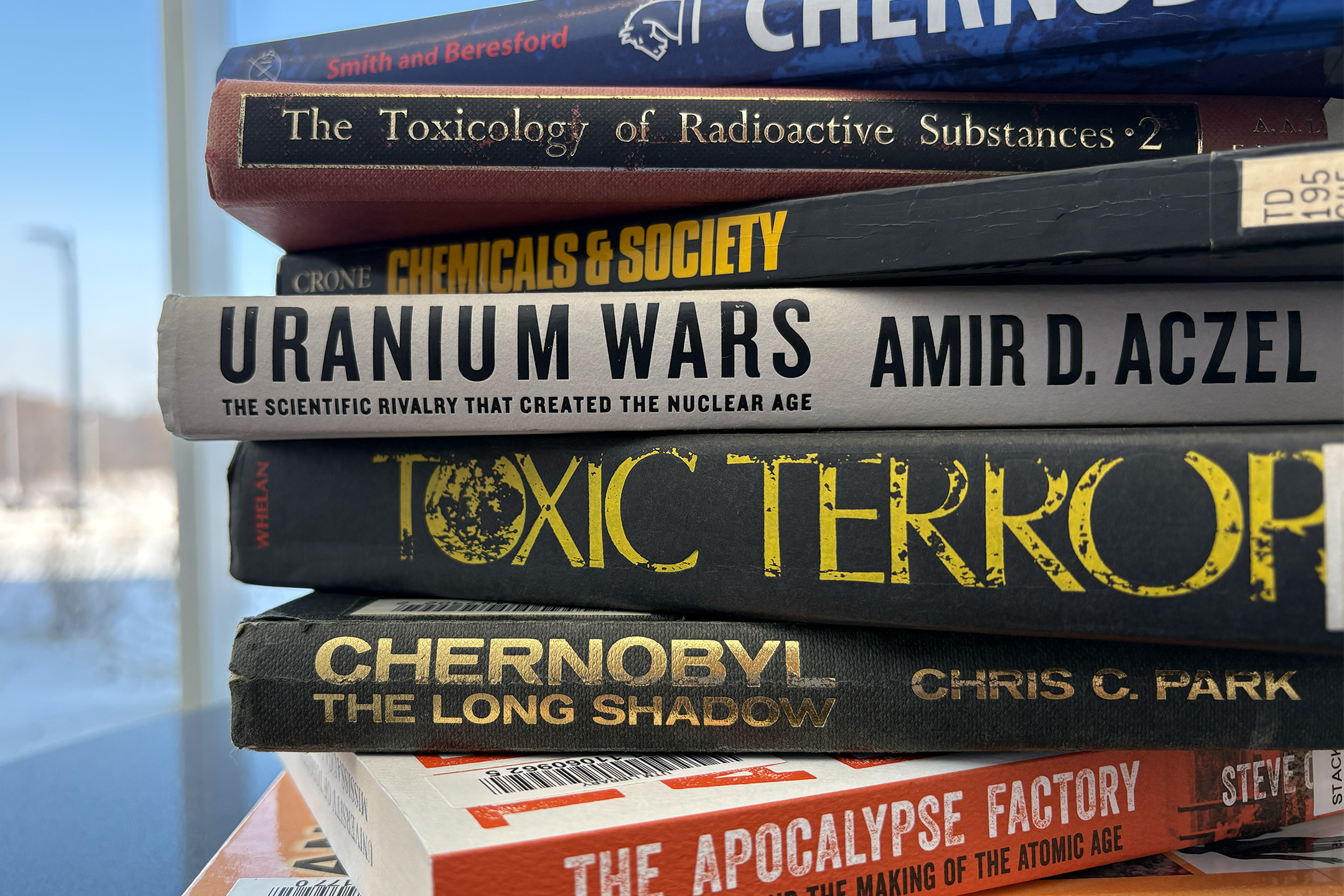
The 1986 meltdown of the no. 4 reactor at the Chernobyl Nuclear Power Plant in Ukraine was the largest nuclear reactor accident in history, contributing to the spread of uranium misinformation. Built by the Soviet Union, Chernobyl was a power plant supplying electricity to neighbouring towns.
Uranium is a heavy metal most commonly found in the mineral pitchblende. It is obtained from mining natural deposits, with the largest deposits residing in Canada, Namibia, and Kazakhstan. It has been used for centuries — from the yellow pigment in Roman ceramics to modern energy and weapons production due to its ability to produce high amounts of energy from a small amount of material.
What happened at Chernobyl
The belief that the Chernobyl explosion was caused by uranium is one example of the misunderstandings surrounding this powerful and potentially planet-saving element. When the no. 4 reactor exploded, it did not form a giant mushroom cloud, but instead a huge blast of steam which released iodine and uranium into the air. The uranium used in nuclear plants is 2 per cent isotope 235 (U-235) and 98 per cent isotope 238 (U-238). Isotopes are variations of the same chemical element that differ in the number of uncharged particles, called neutrons, in their nucleus.
U-235 is much more unstable than U-238; therefore, it is much more liable to split when more neutrons are added to its core — a fact that nuclear physicists take advantage of. When the atom is split by a slow-moving neutron inside a reactor, it breaks down and produces iodine and cesium as byproducts. Other byproducts include neutrons that can strike other uranium atoms, causing a chain reaction. This reaction releases major amounts of energy. This same principle is applied to nuclear bombs as well.
This energy, released in the form of heat, is removed from the reactor via circulating water. This cools the reactor, producing steam that spins turbines that generate electricity.
Reactors contain control rods, which can either slow down or shut down the nuclear reactions; conversely, their removal can accelerate the reaction. These rods are critical for controlling reactions and ensuring a safe environment. Control rods are made out of neutron-absorbing materials, such as silver or boron. To slow down the reaction, control rods are inserted or removed from the reactor to manage the reaction speed.
Commercial nuclear reactors do not contain enough U-235 to cause a nuclear explosion and are designed to contain the atom splitting in a controlled setting. However, nuclear bombs utilize high amounts of U-235 (around 80 per cent) to produce uncontrolled splitting, which forms explosions.
Some may have the misconception that it was uranium itself that caused the Chernobyl meltdown. However, it was actually due to engineers with little expertise on reactor physics. They conducted a test to ensure that during an electrical blackout, the momentum of the spinning turbines could still generate enough electricity to run water pumps and cool the reactor down until emergency generators started.
To mimic this blackout, the engineers shut down the reactor’s power regulating system, which controls how much splitting is occurring, and its emergency cooling system, which provides water that cools the core in an emergency. When water floods the reactor, it also acts as a neutron absorber. However, when it turns into steam, the change in density makes it a less effective neutron absorber.
Anatoly Dyatlov, known for his ill-temper and arrogant attitude towards Chernobyl operators, was in charge of this experiment. Leonid Toptunov, a 25-year-old who had only been a senior reactor operator for two months and had never shut down a reactor before, noticed that power levels were too low and suggested shutting down the reactor in accordance with procedures.
However, Dyatlov threatened Toptunov, ordering him to withdraw more control rods that would increase the power to levels originally planned for the test. This violated the minimum operating reactivity margin, which is the number of control rods that must remain in the core to ensure safety.
Thus, with fewer control rods and the water having turned to steam, there were far fewer neutron absorbers, meaning more neutrons became available. This abundance of neutrons caused the chain reaction to accelerate, leading the reactor to increase in nuclear activity, running progressively faster and hotter.
The test failed, leading to the no. 4 reactor meltdown — the core overheated and melted, leading to the collapse of the reactor. That huge buildup of steam, paired with the safety violations, is what drove the explosion, not just the use of nuclear energy.
The aftermath
Widespread attention surrounding Chernobyl as well as the initial lack of transparency by the Soviet Union during that time led many to speculate and sometimes exaggerate the aftermath and death toll of the meltdown. On the day of the accident, approximately 600 workers were present at the site. Of these, 134 developed acute radiation sickness (ARS), and 28 died at a later date.
The explosion forced thousands of residents living within a 30-kilometre radius to evacuate, although there does not seem to be a record for any evacuees developing ARS.
Exposure to radioactive iodine led to around 20,000 cases of thyroid cancer from 1991–2015 seen in those under 18 years of age in Ukraine, Belarus and Russia. Around 5,000 cases are attributed to the consumption of milk from cows grazing on grass contaminated with radioactive iodine.
The Chernobyl explosion created a toxic mess that needed cleaning up. Seeing this, the Soviet Union sent in the “liquidators”, which were composed of 600,000 firefighters, janitors, soldiers, and miners. They cleaned up the streets, washed off houses within the 30-kilometre explosion zone, and much more while exposing themselves to intense radiation. Thousands have perished from radiation-caused cancers, whereas tens of thousands more suffered from major long-term health problems.
The evacuated zone, now devoid of humans, is becoming a wildlife refuge for lynx, bison, deer and over 60 rare plant species. This disaster also prompted the development of national and international programs improving procedures for nuclear emergency management and preparedness, which are continually followed and improved to this day.
Where are we now
Misconceptions about Chernobyl have prompted people to overlook the benefits of nuclear energy. For starters, only 100 grams of uranium is needed to produce 11,000 kilowatt-hours (KWh) of energy, while the same amount of energy would need 1.5 tons of coal or around 1176 litres of oil. In 2022, the average household in Ontario used 741 KWh/month, meaning 100 g of uranium could power the average home for 14.77 months.
A nuclear reactor’s carbon footprint is minimal compared to other energy sources, creating 15–50 g of CO2/KWh. In comparison, a coal generator produces 1,050 g CO2/KWh while gas-powered generators produce 450 g CO2/KWh. For 100 grams of uranium to generate 11,000 KWh, it releases 165–550 kg of CO2, and 1.5 tons of coal creates around 11,550 kg of CO2.
While Chernobyl put thousands of lives in danger, nuclear energy is still the safest form of energy. In the United States, coal mining was associated with 3,242 worker deaths in 1907, which had decreased to 48 by 2010. In contrast, one death was reported from uranium mining accidents in 2010 in the States.
From 1999–2020, air pollution from coal mining in the United States contributed to around 460,000 deaths. In comparison, there has been no record of the general public dying due to radiation pollution from commercial nuclear reactors apart from Chernobyl.
And while there is no long-term storage solution for spent nuclear fuel at this moment, there are short and mid-term storage solutions. The Nuclear Waste Management Organization is working with the public, governments, and scientists to solve this issue. However, with the current lack of funding and interest, it takes more time to find this long-term solution.
The Chernobyl disaster was horrific and would never have happened if proper protocols had been followed by the associated engineers. While the accident had serious consequences, its long-term health impacts were relatively more limited and led to lasting improvements in nuclear safety regulations. Misunderstandings surrounding Chernobyl continue to influence public opinion, overshadowing the efficiency and low carbon emissions of nuclear energy.
If we are to learn anything from Chernobyl, it’s to learn from past human error. Scientists and governments have learnt from Chernobyl, and there has not been a nuclear accident of that severity and scale due to human error since.

No comments to display.