
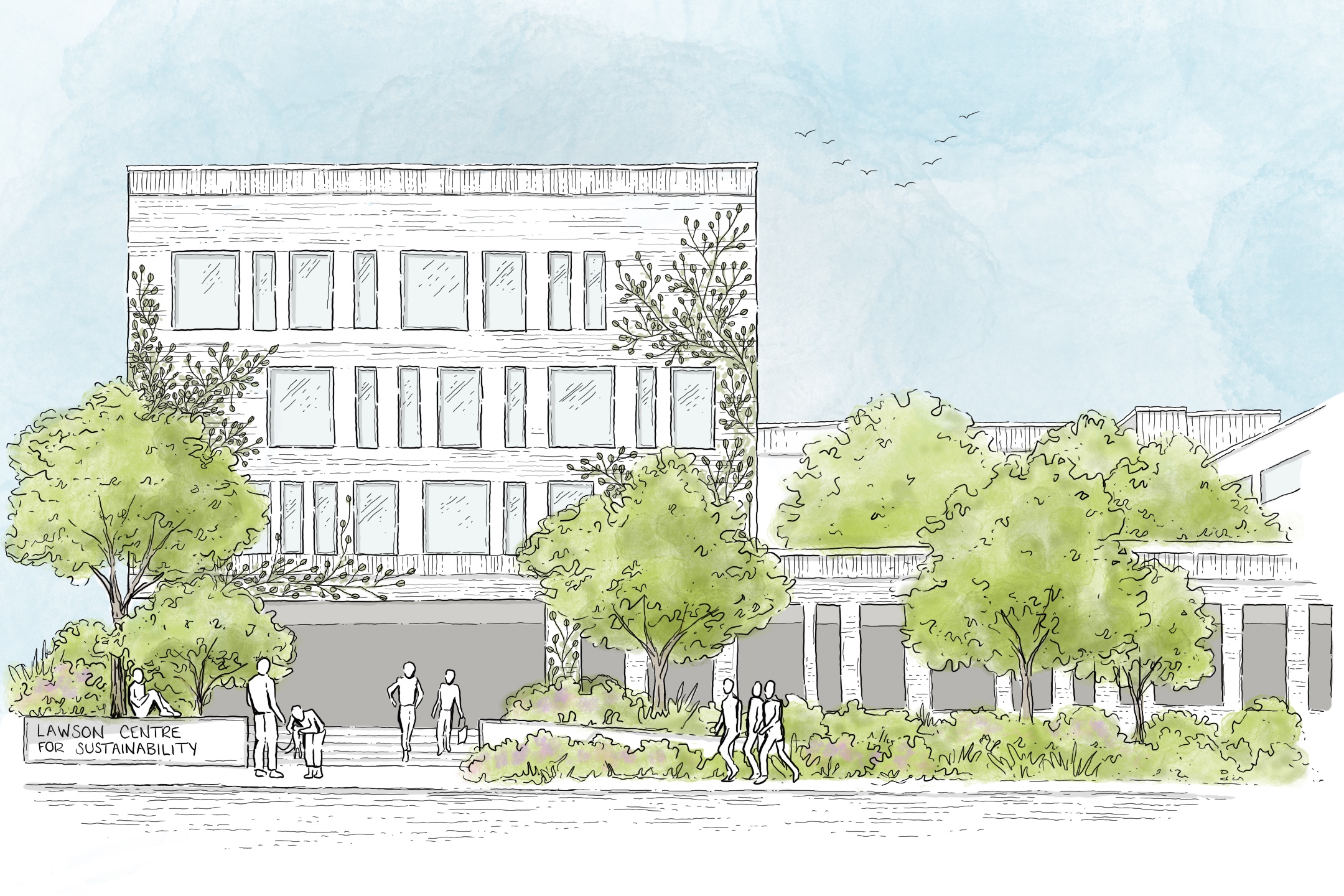
Last October, Trinity College’s new Lawson Centre for Sustainability won the Holcim Foundation Award. The foundation honours Regional Grand Prizes to 20 projects across the world for “outstanding contributions to sustainable construction,” with each winner receiving a prize of 40,000 USD.
The Lawson Centre — which will provide Trinity College with new residential, academic, and dining spaces — was designed with sustainability in mind. For example, the architects sourced almost all building components from Ontario and have included rooftop solar panels in their designs.
The Lawson Centre is one of many new eco-friendly buildings popping up on campus. Seeing as globally, construction is responsible for almost 40 per cent of carbon emissions, the climate incentives behind these investments are clear.
Moreover, the idea that sustainable construction projects can often have high upfront costs still persists, even though a recent study from the Green Building Council of Denmark determined that there is little correlation between construction costs and CO2 emissions.
In fact, building design often plays a bigger role in increasing costs than the higher prices associated with some eco-friendly technologies due to the necessary research and development required to implement them. Given this, are there any economic motives for builders to make sustainable investments?
What is sustainable construction
A sustainable building not only employs sustainable construction practices but also has minimal negative impacts on the environment throughout its lifetime.
Effective material use is an important component of sustainable design. Projects generally try to limit their resource use while also sourcing more sustainable materials.
Examples include mass timber projects, which use a wood product made up of smaller wood pieces bound together. The production processes of conventional building materials like steel and concrete emit a lot of CO2. Mass timber provides a lower-carbon alternative.
In fact, the City of Toronto is working on an affordable housing pilot project using this mass timber. These homes are expected to be completed in the fall of 2026.
Sustainable buildings also make use of renewable energy and are energy-efficient as a result. The Lawson Centre makes use of a geothermal exchange system to efficiently heat and cool the building. The system uses the Earth’s constant underground heat, eliminating the need for fuel-based temperature regulation systems in the building.
Ultimately, both environmental and social well-being are key guiding principles in sustainable design.
The incentive to be sustainable
Beyond environmental reasons, companies have an incentive to invest in sustainable projects due to the increased ability to attract consumers. According to a 2024 Forbes article, there is high consumer demand for eco-friendly buildings due to greater public awareness of the detrimental effects of climate change. This can increase the value and marketability of these properties.
Despite perceived high upfront costs, these projects can be cost-friendly as they are also usually eligible for more government subsidies. Moreover, their energy efficiency means that occupants will incur lower energy costs.
These factors result in tangible financial benefits for property owners — a study conducted by researchers at Maastricht University in the Netherlands revealed that sale prices for energy-efficient buildings are 12 per cent higher, and their rent is 3.5 per cent higher.
Is sustainability a buzzword?
The financial benefits associated with labelling a building as ‘sustainable’ can cause construction companies to make misleading claims about being environmentally conscious. These companies may simply focus on receiving energy-efficiency or environmental certifications to attract consumers who care about sustainability rather than making genuine design choices to reduce the carbon footprint of their buildings.
While certifications can help buildings take the first step towards being sustainable, they often focus on the wrong things. The Leadership in Energy and Environmental Design (LEED) certification is a common system that measures building sustainability in Canada. Buildings must meet certain criteria to earn points and reach specific levels of this certification.
However, construction companies may then choose to simply match the easiest criteria to receive the certification rather than overhauling unsustainable practices to pursue wholly green construction.
The future of the industry
Still, the significant growth expected in the sustainable construction materials market indicates that the industry is truly beginning to prioritize eco-friendly construction — according to Grand View Research, global market value in 2030 is projected to be $47.9 billion, almost double the value in 2024, which was $26.6 billion.
U of T’s Academic Wood Tower, a sustainable mass timber project that will house Rotman, Munk School, and Kinesiology and Physical Education (KPE) facilities, is expected to open this year. Moreover, the Canadian government introduced the ENERGY STAR Portfolio Manager system, where users can monitor and optimize their buildings’ energy use.
Ultimately, there is a clear business case for sustainable construction, fueled by public demand, cost-efficiency, and government incentives.

No comments to display.