
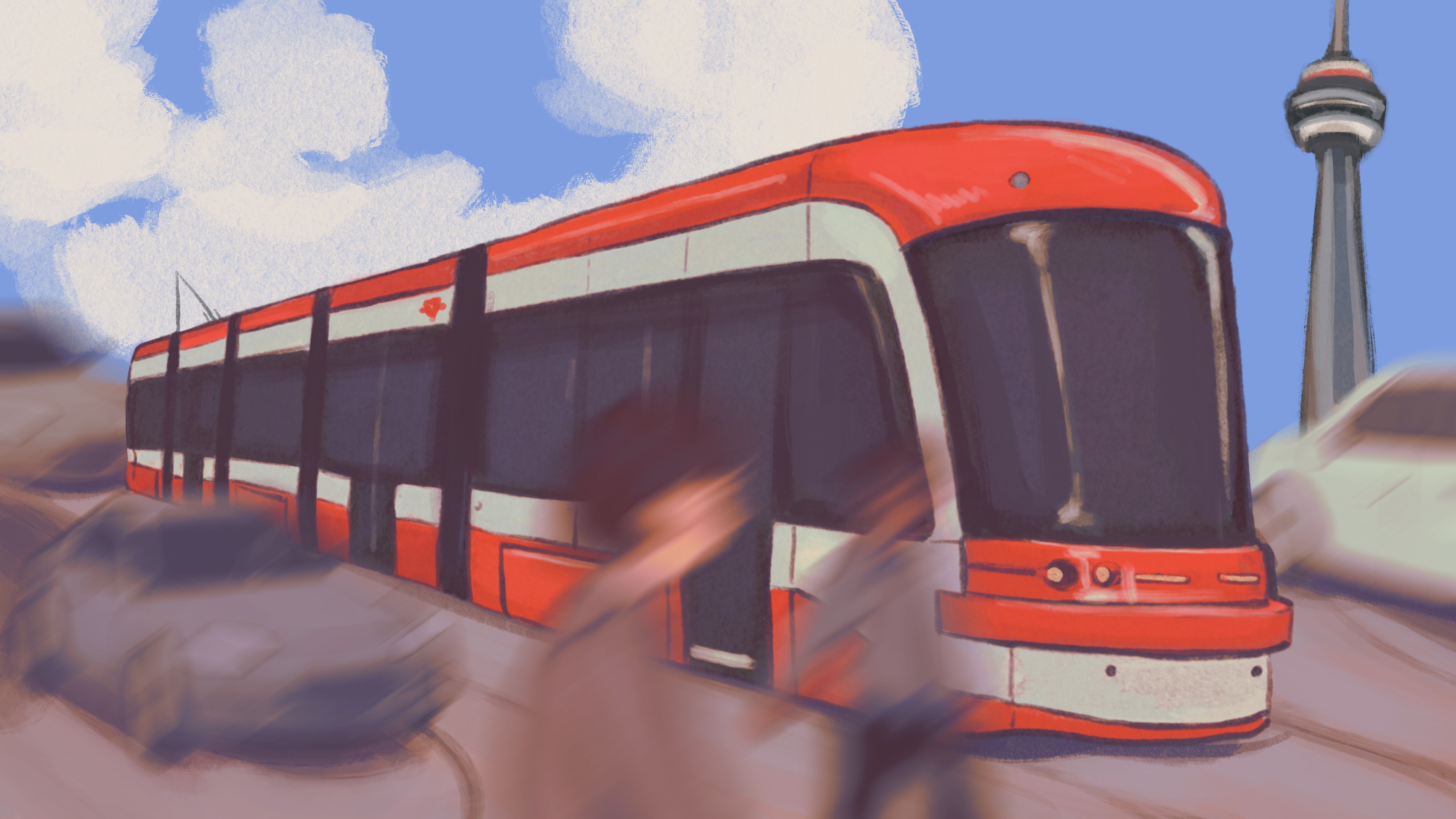
Running toward the intersection of Spadina Avenue and Nassau Street last Monday night, I channelled all of my energy into catching the 510 Spadina streetcar that Google Maps said would be at the stop within three minutes. When I finally arrived — hoping no one I knew had witnessed my frenzied sprint — I saw no streetcar. I peered up and down Spadina, but nothing arrived.
Suddenly, I heard the hissing of a bus behind me and turned to see the “510 to Broadview” in orange pixelated text. I assumed that there was some issue with the streetcar and hopped on the bus without a second thought. I got to Queen’s Quay 20 minutes earlier than my typical commute on that streetcar route.
After getting home, I went online to find that there was a days-long 510 streetcar service interruption. This is only one event in a series of recent unreliable TTC streetcar experiences that are burned into the memories of Torontonians.
Car-centric road prioritization
Riders might be familiar with a recent study by the International Union of Public Transport that ranked TTC streetcars among the slowest in the world by a significant margin. The TTC streetcars serve over 200,000 riders each day — so why are they still so slow, with an average speed of only 10 kilometres per hour?
A 2022 report by the Mobility Network at U of T concurs that car-centric prioritization is illogical, noting that “downtown as we know it simply could not exist” without the public transit network that serves millions of patrons each day. The report argues that the Line 1 subway, as well as the streetcar and bus networks, are vital to getting people around the city.
A November 2025 video by Brice Lan on his YouTube channel, flurfdesign, adds that Toronto’s urban design politics seem to cater to car drivers in the city. This is a relic of the advent of the car, upon which urban planning in cities has centred around the idea of cars as the vehicle of the future. Thus, design choices related to transit signal priority, street parking, and lanes are made by prioritizing the car driver’s perspective.
The 2022 U of T report also exposes that although public transit can move many more people around downtown Toronto than cars, the TTC has been underfunded by the government for decades. This is also an effect of the ideal of car-forward cities — funding is not invested into transit because cars are seen as the main priority on the roads, and conflicts between politicians exemplify this.
In 2014, then-mayor Rob Ford opposed increasing spending on streetcars, arguing that as the population grew, cars should take priority on the roads in gridlock situations. He criticized then-mayoral candidate Olivia Chow for wanting to “spend, spend, spend” in relation to her plan to increase buses on the road.
This illustrates how on the roads, cars are the only vehicles prioritized, and politicians have long been opposed to spending on streetcars. Many, like Ford, prefer that public transit be reduced to subways, so that it doesn’t impede on cars. But it is not always practical to have cars and public transit in different spheres.
In an interview with The Varsity, second-year political science and urban studies student Ziena El-Gewely said, “Some people, all they know is car-centric infrastructure here in Toronto, which is very unfortunate because there’s so much more to life than sitting in a metal box.”
According to the 2021 Toronto census, 73.8 per cent of workers commuted by car, truck, or van. As such, streetcar priority tracks and signals may inconvenience drivers, who would have to wait for streetcars to pass an intersection before turning left.
Nonetheless, when the King Street priority corridor was implemented in 2017, streetcar priority lanes greatly increased streetcar reliability. However, the U of T School of Cities reported a daily average of 6,800 illegal turns on the corridor, 99.7 per cent of which are not ticketed.
El-Gewely added that small businesses are also concerned about TTC expansions, such as in 2025, when the Bathurst streetcar priority lanes were announced. “There was a lot of signage in storefronts that said ‘say no to the priority lines, this is going to destroy our business.’ ” A Reddit user explained on r/Toronto how these business owners feared losing business because driving customers wouldn’t be able to park with the implementation of the RapidTO lanes.
El-Gewely exemplified how the opposite has been true in other places, like Vienna, Austria, and the Netherlands, where roads that are designed to prioritize pedestrians, cyclists, and public transit can stimulate business for stores on the street. If streetcars can coexist with cars and pedestrians in other countries and major cities, why do politicians and the people of Toronto still struggle with it so much?
According to the New York City Department of Transportation, after the Fordham Road bus route was extended to the Bronx subway lines in 2008, business sales were found to have increased 71 per cent by the third year after the extension. Comparatively, in 2009, congestion cost Toronto around $2.7 billion each year from lost productivity.
This seemingly endless back-and-forth between prioritizing cars and public transit might stem from a phenomenon Lan highlighted in another flurfdesign YouTube video. Lan explains that before new, high-density urban neighbourhoods are developed, their public transit network must be created so that residents are immediately accustomed to using public transit.
Toronto did this successfully with the implementation of North York Centre subway station on Line 1, which occurred before North York was revitalized as a medium-density residential and employment hub. This hasn’t been the case with the Port Lands, however, where the streetcar has not yet been developed due to a lack of funding, and residences have already been built and begun to house people.
This forces new residents to design their lives around car use, which makes public transit redundant when it is eventually developed. The Canadian Centre for Economic Analysis reported that the city loses $44.7 billion each year to lost productivity due to lengthened commutes from traffic congestion. Coming up with funding for a solution to this problem seems like an obvious, yet long-unachieved, imperative.
Slow and unreliable streetcars
Beyond designs and rules that seem to set streetcars up for failure, their slow speeds are another common critique. In the summer of 2025, marathon runner Mac Bauer challenged different streetcar lines to a race and won. He ran alongside the 509 Harbourfront, 511 Bathurst, 510 Spadina, and 504 King, sharing his journeys on Instagram.
Clementine Fiorentino, a second-year global health student, recounts talking to people who live in Toronto or near streetcar lines who have never taken the streetcar because they are infamously unreliable.
One key factor that contributes to streetcar slowness is bunching, which occurs when several streetcars stop at once, causing a long wait time until the next batch stops in that area. This leaves increasingly large groups of riders stranded, and when they finally do get on, the streetcar is overcrowded.
Another issue with streetcars in Toronto is the lack of accessible infrastructure for riders. One main advantage of trams and streetcars should be their accessibility for wheelchair or other mobility aid users, or people with strollers. Streetcars with level platforms attached prevent riders from having to walk out into the road to board.
But Toronto’s streetcars lack such platforms, forcing riders to press a button to signal to the driver that the ramp is needed. The driver must stop driving, exit, and walk to the accessibility door to activate the ramp, all of which takes a long time.
A more accessible option for mobility aid users would be the levelling of the streetcar platform height to that of the streetcar floor. Trams in other cities, like the Kitchener-Waterloo LRT line in 2019, have successfully implemented this.
Another streetcar problem unique to the TTC is the outdated track switches, which have caused enough derailing incidents to introduce the convention of prohibiting streetcars from passing one another at intersections. This makes for much slower commutes, as sometimes, during route changes, streetcar drivers must step out of the vehicle to manually fix the switches. To top it all off, the switches are only produced by a single manufacturer, and their original design for the switches has apparently been lost in a fire.
Why pay for poor service?
Built-up frustrations with unreliable streetcar service experiences have prompted U of T students to question whether the fare for their commute is justified. “The TTC has a duty to [be reliable because] you pay an expensive amount,” said El-Gewely. The TTC fare for students is $3.30, which is the same amount as the regular adult fare using PRESTO.
All those taps add up after daily commutes each semester. El-Gewely is frustrated with the expectation to pay because the unreliability often means riders turn to alternatives like Uber. “You can’t get to your work, you can’t get to your school, you can’t get anywhere, and then you have to pay an additional $10 [for Uber]… It’s exorbitant, and it’s not fair.”
Mayor Olivia Chow has proposed rolling out a system where, after a rider pays for 47 TTC trips in one month, they get automatically free rides for the rest of the month. By 2027, Chow plans to lower that threshold to 40; however, the original proposal hasn’t been approved yet. A similar discounted ride system has already been implemented on GO Transit, calling into question why the TTC takes so long to catch up.
Jason Sagle, a second-year urban studies major, told The Varsity, “I feel like it’s very important that I’m able, as a student, to be able to use a low-cost means of transportation to get to and from campus.” He said that when touring universities in high school, he found that many schools offered a local transit package that made transit free for students.
When speaking to Sagle, I was reminded of a time when my friend from the University of Guelph came to visit me. We hopped on the 506 streetcar, and she was shocked at the fact that I had to pay for public transit as a U of T student.
Reflecting on U of T’s significant TTC commuter population, Fiorentino recalled that most of the people she meets in her classes are commuters. “Especially after the first year, when it’s much rarer to find people living in dorms, almost everybody I know lives on a streetcar line.”
Next steps
While Chow has begun addressing key issues of streetcar reliability, significant challenges remain.
Many commuters welcomed the long-awaited opening of the Line 5 Eglinton LRT. But this line’s construction history made more sour memories for residents of the Eglinton area. El-Gewely, a lifelong resident of the Eglinton line, describes the closure of so many small businesses over 15 years of construction as “heartbreaking.”
Although the implementation of public transit infrastructure has been proven to increase foot traffic and boost local economies in some cases, prolonged construction delays can have the opposite effect.
“What comes to mind is Little Jamaica,” she continued, “and all the small businesses that were open and places that have been since demolished or just been under construction due to the Eglinton LRT. It kind of feels like it was for no good reason.”
In an article published this year by City News, Claude Thompson of Little Jamaica was interviewed about his experience being forced to close his small business, Natural Flavas juice bar, right as Line 5 opened. The prolonged construction drove patrons away from Thompson’s and many other small business owners’ stores on Eglinton.
To prevent incidents like these, El-Gewely argues that transit construction processes should be more streamlined, and that our policymakers should prioritize them more. “There is no reason in the world why a light rail has taken 15 years of construction,” El-Gewely says.
Looking forward, Chow has stated that Line 5 is “up next” for transit signal priority. If implemented effectively, this development will help to bring much more foot traffic to communities like Little Jamaica.
The TTC seems to be slowly taking steps toward improved streetcar and other transit reliability through measures like streetcar signal priority. Compared to other streetcar and light rail systems around the world and even here in Canada, we should have been able to achieve this a while ago. Slowness seems to be a defining characteristic of transit planning and politics in Toronto, but we need to be able to speed up the pace to keep up with the busy lives of Torontonians all around the city.

No comments to display.