
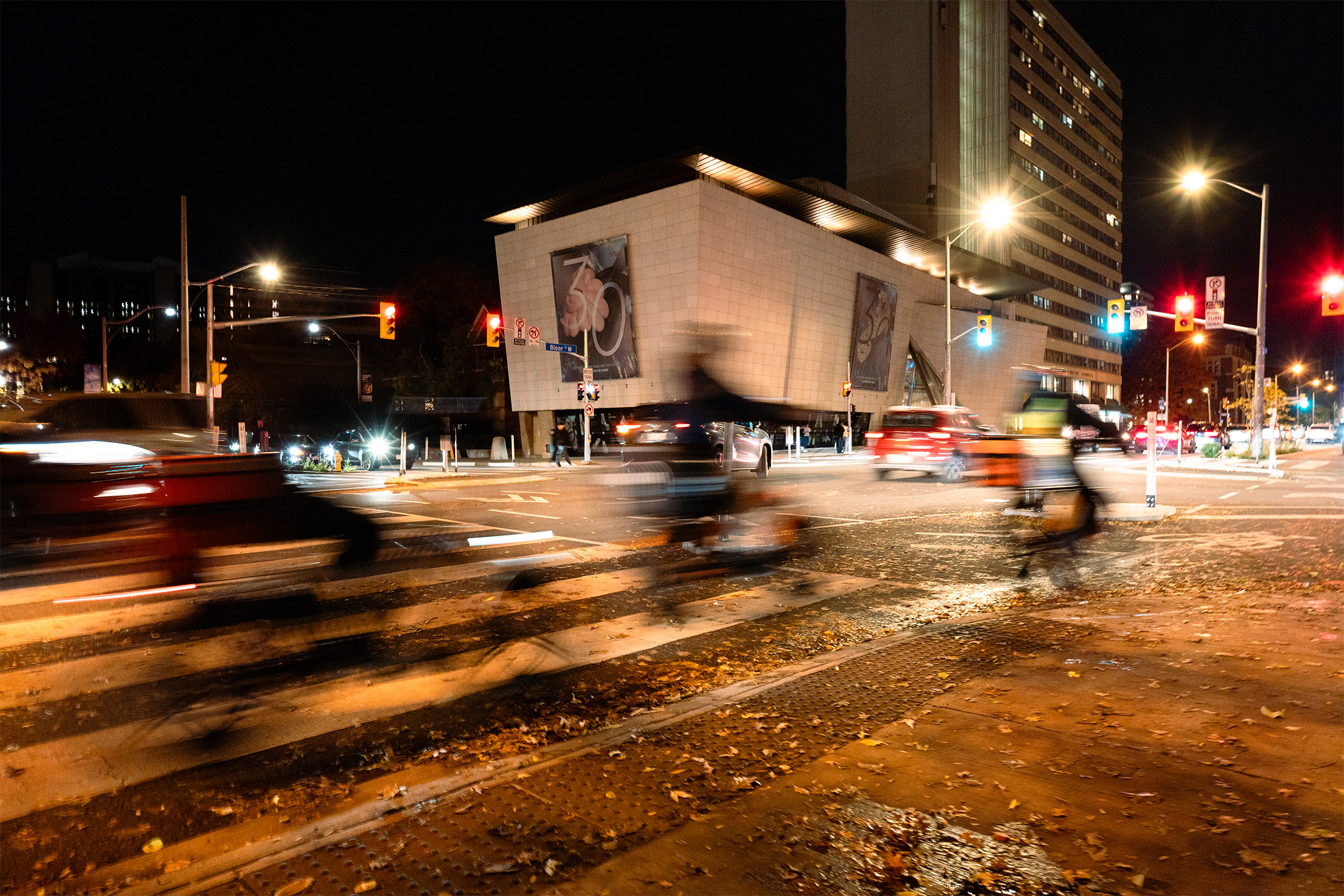
U of T has three campuses that span the GTA. In Mississauga, to the west of downtown Toronto, lies UTM. All the way in the east end of Toronto, Scarborough is home to UTSC, and back westward, in the heart of downtown Toronto, sits UTSG right in the middle.
With such a dispersed university geography and over 100,000 students, U of T students are bound to become proficient at navigating the streets, sidewalks, and semi-safe crosswalks in between, which get them to and from class.
After making endless stops at the same intersections we use to get to class every day, it’s natural to start thinking: how safe is U of T for pedestrians? After nearly getting hit by a car at Military Trail and Ellesmere Road –– a hotspot location for pedestrians crossing to UTSC –– I asked myself that same question.
In order to gain more insight, I asked U of T students questions about their commutes. What do they think is the most dangerous intersection for pedestrians near campus? Which part of campus do they feel is at most risk of accidents? Are U of T’s intersections and streets overall safe for pedestrians and drivers?
Coupled with the independent research on collision reports on and around each campus, these students’ answers help paint a picture of the most dangerous intersections on and near campus.
UTSG
It’s the main campus, the most populous of them all. UTSG boasts an undergraduate student population of over 49,000 and a land area of 138 acres. Interwoven with four major streets –– Bay Street, Bloor Street, College Street, and Spadina Avenue –– UTSG is embedded in the heart of downtown Toronto.
Amalia Enache, a first-year life science student at UTSG, identified College Street and University Avenue as one of the most dangerous intersections for her because of its narrow sidewalk and large crowds. This portion of University Avenue at College Street is split by medians into two one-way lanes. This widens the gap between street sides, and increases the time pedestrians spend in the intersection.
Enache also thinks danger lurks a few blocks west at the “stretch of St. George [Street] between Ursula Franklin [Street] and Sidney Smith, where there are no crosswalks with stop lights.”
The lack of a stop sign or street light makes priority crossing feel more unsure between drivers and pedestrians. As Enache highlights, “pedestrians are instructed to ‘wait for gaps’ in traffic,” making crossing the street feel even more unsafe without a firm system displaying when it is safe to cross.
I’ve seen countless students hovering near the edge of the road, tediously timing the next batch of cars to gauge whether they’re far away enough for them to cross. This heightens the risk of crossing the street — something students simply going to and from class shouldn’t worry about. Enache feels that the planning of this stretch of road makes the risk of accidents higher if drivers or pedestrians are not paying attention.
In 2016, a pedestrian was hit on St. George near Ursula Franklin at a mid-block pedestrian signal — which is specifically designed to regulate traffic and ensure safe crossing for pedestrians. St. George and Ursula Franklin has recently been deemed an “urgent safety risk” by BlogTO, as drivers struggle to cross it amid the constant flux of students who cross it with no streetlights to direct anyone. This illustrates how driver behaviour mixed with poor road design can be a recipe for catastrophe.
In 2018, driver behaviour similarly proved fatal for a U of T student who was hit and killed just a few hundred meters southwest at College and Huron, while crossing the street with the right-of-way.
Enache proposed changes to increase safety. For the intersection of College Street and University Avenue, she proposes increasing the crossing times for pedestrians from 10 to 20 seconds. Enache suggests that for St. George and Ursula Franklin, there should be more prominent signage, particularly for drivers.
UTSC
My own campus is known for traits like its proximity to the Toronto Pan Am Sports Centre and the extensive Highland Creek Ma Moosh Ka Win Valley Trail. UTSC is less populated than UTSG, with an undergraduate population of 14,000, but greater in size, with a 300-acre sprawl.
First-year UTSC management student Ali Tabandeh identified two major intersections near UTSC that he feels are dangerous: Military Trail and Ellesmere Road –– where I was almost hit –– and Military Trail and Pan Am Drive.
“During peak rush hour, the road is filled with both cars and slow-moving traffic. This frustrates drivers, leading them to rush to make turns on [yellow] lights and sometimes even red lights. Additionally, since Military Trail is a one-lane road, if a bus is stopped, some drivers may swerve around it.”
The intersection of Military Trail and Ellesmere Road “stands out as the most dangerous because of the pedestrian platforms. On the northwestern and southeastern sides of the intersections, there are dedicated right-turn lanes [for cars] that split the pedestrian platforms.”
Tabandeh opined that this sharing of road and sidewalk space is contentious for drivers, which often leads them to “attempt to turn right regardless of the [pedestrian] block, increasing the risk of accidents.”
Interestingly, Tabandeh speaks from the perspective of someone who both drives and walks around UTSC. This unique point of view allows him to empathize with the fears of both pedestrians and drivers; cars, pedestrians, and buses are often interlocked in a battle for the road during rush hour, which poses safety risks for all of them.
Drivers’ attitudes in particular seem to reflect a sense of entitlement to the roads, which acts as a detriment to pedestrians. Drivers sometimes think that roads are built primarily for them, leaving others to adapt to however they choose to drive. This manifests in small but telling ways, with drivers edging forward at crosswalks, honking impatiently at slow walkers, or even turning as pedestrians are midway through an intersection.
This mindset becomes especially dangerous when it’s reinforced by car-centric road designs — narrow lanes and short light cycles send the subtle message that vehicles take precedence over pedestrians.
Tabandeh also feels that the western parking lot G also poses accident risks, as “it opens right onto Military Trail.” This lot doesn’t have sidewalk entrances, so students who want to enter on foot often walk in through the car entrance.
This prevents cars from exiting the lot, and enhances impatience, as drivers who’ve had to wait for pedestrians to walk through are more eager to turn out of the lot and “might try to ‘make the best’ of a lull in pedestrians and advance quickly, possibly missing a student and hitting them.”
A 2019 article from The Varsity reported that a UTSC student was struck and injured in a collision near the intersection of Military Trail and Ellesmere. According to the Toronto Police Service’s Safety Data Portal, there was another collision on Military Trail and Ellesmere in 2020, which led to major injuries.
As a UTSC student, I agree with Tabandeh’s opinions on these intersections. Having traversed both Military Trail and Pan Am, and Military Trail and Ellesmere Road on a regular basis, I’ve witnessed several dangerous situations firsthand. I have seen students barely miss getting hit by a vehicle, risking major harm.
I’ve also seen the intersection of Military Trail and Pan Am suffer from similar issues — especially when there is an influx of students entering campus. The aggregate of pedestrians and heavy traffic flow — especially in the early morning — makes it a potential safety risk beyond its perceived danger.
Like Enache, Tabandeh highlights some potential solutions. [Road safety] is a two-way street, and drivers should also do their part to increase [pedestrian] safety.” For students, he recommends that they “Wear light colours at night, don’t jaywalk, be fully aware of your surroundings, respect pedestrian lights, and don’t cross at a red light.”
UTM
The only campus lying beyond the geographical boundaries of the City of Toronto, UTM — like UTSC — is enmeshed in nature, with the UTM Nature Trail. It is also larger in acreage than UTSG, with 225 acres of land. Slightly larger in student body than UTSC, it has an undergraduate population of over 15,000.
Valeria Martinez Sanchez, a first-year computer science student at UTM, feels that the Mississauga Road and Dundas Street West intersection near campus is the most dangerous due to its heavy traffic flow.
“It’s always packed with cars, buses, and [oncoming] traffic, making it tricky for both drivers and pedestrians.” In September 2023, a crash occurred at Mississauga Road and Dundas Street West, an intersection just east of the UTM campus.
Despite these incidents, Sanchez states that “Overall, the area is fairly safe, but it can feel tense during rush hour.” She implores students to “stay alert and use crosswalks whenever possible.”
This echoes Enache’s sense of the danger at UTSG, which stems from “The planning of intersections,” which she thinks “makes the risk of accidents higher.” These insights point to two key elements of road safety that come into play beyond tangible accidents: perceived danger and road planning.
This idea of perceived danger shows how fear can reshape public spaces. A 2024 Open University UK study found that when walking, pedestrians are prematurely cautious about things like “lack of streetlights, insufficient crossings, poor signage… road works, and obstructions of pathways.” On campus, this can manifest in students avoiding certain routes after major accidents.
Toronto’s road planning also affects how people feel on their commutes. An April CBC News report notes that the city council approved a congestion plan and a new “traffic czar” to better coordinate construction and improve intersections. Even seemingly small factors like poorly timed lights or ongoing roadwork can heighten pedestrians’ danger, showing how both perception and planning collude in shaping how safe students actually feel.
Final verdict
Attending university at campuses that are so enmeshed in urban and suburban sprawls means we have to get familiar with how to navigate each road, sidewalk, or random back alley we use to get to class each day. It means that whether we’re on foot, in our cars, or cycling, we have to be more cognizant of each other, and adopt a mutual care for each other’s safety on our daily commutes.
Projects like Toronto’s Vision Zero Road Safety Plan promote safer urban design and transportation habits across the city. Vision Zero aims at “reducing traffic-related fatalities and serious injuries on Toronto’s streets.”
Dalla Lana School of Public Health professor Bruce Kuimi similarly frames road safety as a public health concern, and urged in a U of T News article to implement the Vision Zero approach, which looks at ways to design roads and policies that account for human error. Kuimi said that, on the road, “people will always make mistakes.”
It’s hard to assert whether the solution to pedestrian-vehicle danger lies in the hands of pedestrians, drivers, or urban planners. It might be a shared responsibility between all three. Either way, we all have a part to play when we’re navigating our days at U of T to make sure we feel safe when we leave the classroom.

No comments to display.