
Two roads diverged in a wood, and I—
I took the one less travelled by,
And that has made all the difference.
— Robert Frost, “The Road Not Taken”
I find myself reflecting on the past few years as I sip the final dregs of my undergraduate degree.
One’s roaring 20’s are said to be the most monumental years in a lifetime, only to be plagued by a plethora of arbitrary expectations that are supposed to be a one-size-fits-all for young adults.
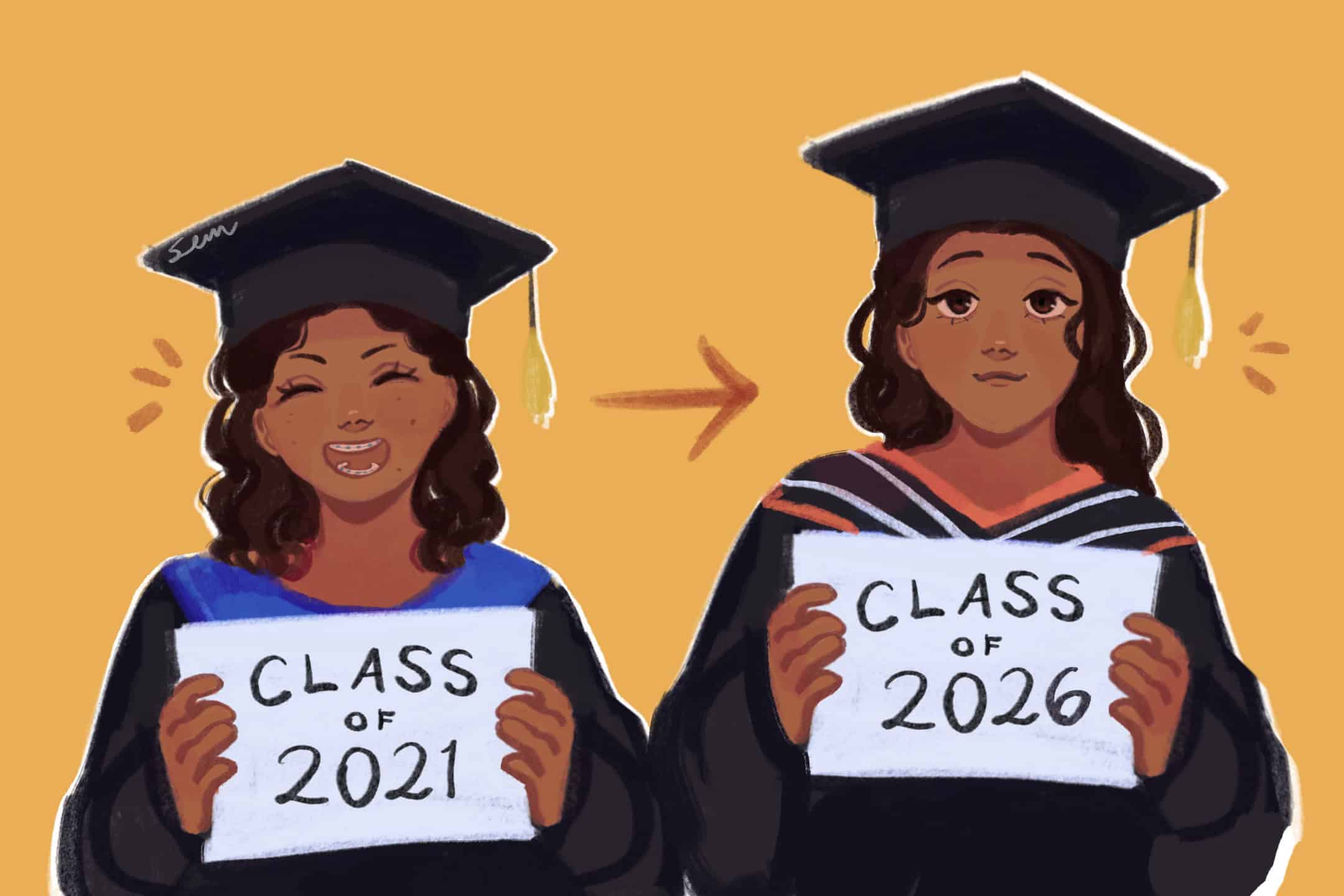
As I tiptoe closer to the finish line, having started university during a pandemic, taken a semester off, and faced everything life can throw at a 20-something-year-old student, I’ve come to the conclusion that the standard length of time for completing an undergraduate degree should be five years instead of four. This realization was a hard pill to swallow and only came after not being able to finish my degree in four years, which wasn’t because of a lack of trying.
I believe that there’s a lot of shame surrounding not completing a degree in the ‘standard’ four years. Feeling behind or not smart enough to handle the life of a student, not doing ‘enough’ or not being motivated to be able to… the list goes on. Beyond these emotions shared among students, I will aim to argue that stretching a degree into five years is objectively better.
We’re all in this together
To put things into perspective, let’s bring in some facts! According to Statistics Canada, “Almost three-quarters (74%) of the 2014/2015 cohort of Canadian students had completed a bachelor’s degree after six years. As for the ‘on-time’ rate – 44% of the 2016/2017 cohort of students had graduated after four years.” For the American super seniors out there, the New York Times shared in 2014 that only 19 per cent of full-time students attending American public universities graduated with a bachelor’s degree in four years.
These statistics reflect that taking longer than four years to graduate is not an exception, but is becoming the norm. Yet, from my experience, the four-year timeline is still favoured and seen as the standard measure of success.
I’ve stumbled upon countless posts on the U of T subreddit from struggling students who are attempting to reach out and find fellow students who may be in the same boat. One Reddit user wrote, “university life is non-existent, the courses are grueling, and the profs. are rude. The weather makes everything so much worse. Give me some ideas, what can I do to make my life better here?” Another wrote, “I feel so hopeless and lonely, thinking about dropping out.”
The expectations of what schooling should look like, shaped by what we see online, are inconsistent, limited, and explain why students struggle with these notions.
A four-year degree assumes financial stability, perfect homelives, uninterrupted and superb academic progress, and strong mental health — none of which are guaranteed. On the other hand, a five-year degree allows students time to adjust to life’s ups and downs, take a slightly reduced course load, work part-time, and meaningfully engage with their education rather than winning an imaginary race.
Going against the grain
I think ‘the grind’ or hustle culture is put on such a high pedestal, but what is admirable about stretching yourself so thin that you have no time or energy to live and enjoy your life?
Back to Reddit, which is a great place for casual research, one user asked, “Taking 5 courses one semester, any advice for this course load?” One of the answers that caught my eye read, “I took 6 courses a semester in my final year and finished with a 3.95. Understand that sacrifices will need to be made in order for you to succeed — winners understand this, losers do not.” I’d like to think that this user must have misunderstood the story of the tortoise and the hare.
Stretching out my degree has been beneficial, allowing me to take four courses a semester instead of five or six. It has given me the space to take advantage of my education, as well as engage with my life outside of school. Instead of measuring my success and worth by how much I could handle at once, I began measuring it by how well I could feel and show up — and then doing well in school followed seamlessly afterwards.
Taking a break
I took a semester off from school in my third year. I was overwhelmed, unsure about what I was studying and if I even liked it, and I was struggling through each course, contemplating whether university was even for me.
I barely told anybody around me about this fact until more recently because I was embarrassed and thought I was a failure. I had internalized the idea that pausing or not sticking to the “four-year plan” meant I was falling behind, as if time was a measure of worth and not just progress.
In retrospect, my four-month break from school was objectively unproductive, but not unrewarding. I owe that break to finding The Varsity and the lovely community of people who work here. During that period of time, I figured out what I wanted to study and that I actually like being a student, and that even in the most unproductive of times, learning can still happen.
I’d like to mention that I acknowledge that I speak from a place of privilege — I have supportive and open-minded parents and the most amazing friends a gal could ask for, as well as some semblance of financial aid to “half-fund” (let’s get into this another time, shall we?) my schooling.
I recognize that not everyone is as fortunate to have support systems that they can rely on. To those folks out there, readers and fellow students alike, I hope you can pursue something you enjoy, something that makes your heart sing. Or at least something that doesn’t make you want to pull your hair out. After all, even though we might be slaves to a capitalistic system, we might as well try to enjoy our lives while we can.
Zaneb Asad is a fifth-year English, political science, and creative writing student at UTM. She is also an Associate Opinion Editor and Lead Copy Editor at The Varsity.
