
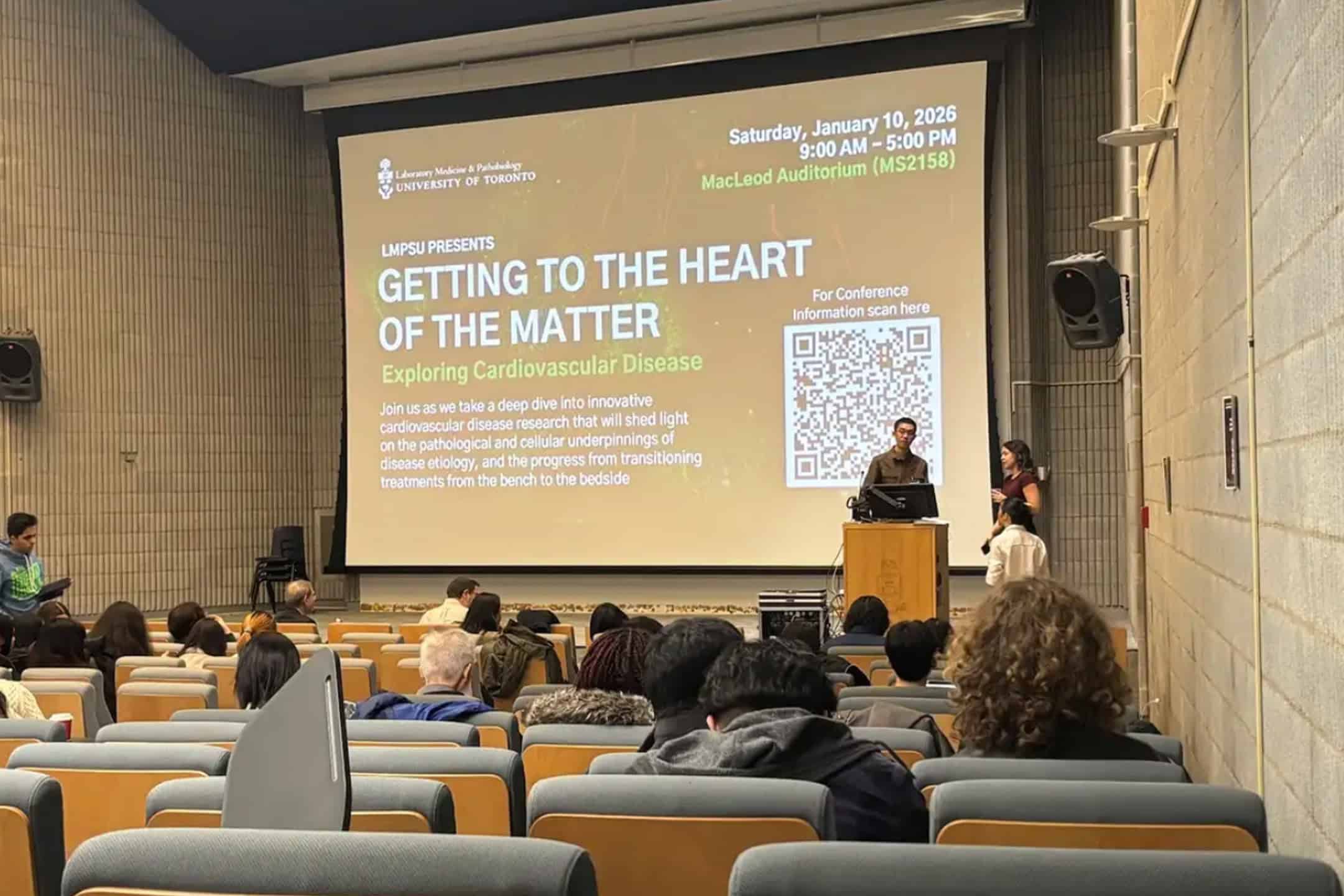
The Laboratory Medicine and Pathobiology Student Union (LMPSU), a University of Toronto student association, hosted its 14th Annual Undergraduate Research Conference on January 10. The symposium serves as a bridge between distinguished researchers and undergraduate students. It is designed to facilitate the exchange of cutting-edge developments in the field of cardiovascular disease, while also giving a platform for researchers to educate and inspire the next wave of scientists.
Dr. Rita Kandel, Chair of the Department of Laboratory Medicine and Pathobiology, delivered the conference’s opening remarks. One of the day’s presentations was delivered by Michelle Bendeck, a University of Toronto researcher and professor who has contributed to pioneering research in cardiovascular disease, specifically the molecular mechanisms involved in various heart conditions.
A novel nanotherapy for artery disease
With cardiovascular diseases remaining as the leading cause of death globally, Bendeck’s research aims to address the biological mechanics of atherosclerosis.
Atherosclerosis is a specific form of arteriosclerosis, a cardiovascular condition characterized by the restriction of blood flow and resulting stiffening of the arterial vessels. Arterial vessels are thick-walled arteries transporting oxygenated blood away from the heart. This restriction of blood flow, and the consequent reduction in oxygen and nutrient transport from the heart to the body, is driven by the accumulation of lipids, cholesterol, and calcium within the innermost layer of the arterial wall.
Current treatments like angioplasty — which involves surgically widening the artery with a balloon and often a metal stent — are effective at restoring blood flow, but patients often experience a relapse of symptoms. To address this challenge, Bendeck and her laboratory team have proposed a targeted delivery method using microscopic particles engineered to act at the molecular level. Their research uses a specific protein to potentially reverse or manage the progression of the disease.
Bendeck highlighted the phenomenon known as restenosis, where a vessel re-narrows after treatment. This occurs because the physical trauma caused by opening the artery triggers the body’s natural repair system. In an attempt to heal the side, the body’s internal structural cells migrate and multiply to form a thick layer of scar tissue, which ultimately blocks the artery again.
Currently, doctors combat this using stents, which are small, expandable metal tubes that act like internal scaffolding to hold the vessel open. To prevent the body from growing scar tissue in a reaction to the metal, these tubes are soaked with potent chemicals.
However, Bendeck noted that these are essentially chemotherapy drugs that are highly toxic. While they kill the muscle cells causing the blockage, they can also destroy the vital lining of the blood vessel responsible for healing and preventing clots.
The N-cadherin solution
Bendeck’s lab proposes a more precise approach: a therapy that selectively stops the harmful scarring while leaving the helpful cells intact. The team identified a protein called N-cadherin, a cell adhesion molecule that helps cells stick together. Crucially, only the cells that block the artery produce high levels of N-cadherin, whereas the cells that line the blood vessel rely on a completely different protein.
By designing a specific peptide — a small protein fragment — that targets N-cadherin, the researchers can effectively trick the harmful cells. When the peptide binds to the cell, it mimics contact with another cell, signalling the scar tissue in the arteries to stop migrating and growing. Because the blood vessel cells do not rely on N-cadherin for adhesion and movement, they remain unharmed and can continue to repair the vessel lining.
The nanoparticle delivery system
The delivery mechanism for this therapy is as novel as the peptide itself. Standard drug delivery methods are ineffective for this application, as the treatment must remain localized to the damaged artery to be successful. Therefore, there is an alternate way of delivery as Bendeck describes.
These nanoparticles are spray-coated onto a standard angioplasty balloon. During a procedure, as the balloon is inflated to mechanically widen the artery, it simultaneously embeds the peptide into the interior vessel wall. This localized approach ensures the therapy persists within the tissue over a period of 24 hours, providing a sustained healing effect directly where the damage occurred.
Promising results
Bendeck presented data from animal trials using rat models. The results showed that the peptide-coated balloons significantly reduced the formation of scar tissue two weeks after injury compared to untreated subjects. Most importantly, the therapy did not impair the regeneration of the healthy blood vessel lining, solving the major toxicity problem found in current drug-releasing stents.
The implications of this research also extend beyond the heart. Bendeck suggested this technology could be vital for treating Peripheral Artery Disease (PAD) in the legs. PAD is a blockage of blood circulation to the leg, leading to poor blood supply to the legs and feet. Metal stents are not always effective for PAD and often require another surgery in one to two years.
The LMPSU conference concluded following a series of technical discussions and closing remarks. Along with the specific scientific proposals, the event succeeded in its broader mandate: creating a collaborative environment for the pathology community at U of T. By highlighting underrepresented nuances within cardiovascular research, the LMPSU conference continues to uplift the field, fostering the next generation of scientific inquiry.
Correction: This article was updated to reflect that Michelle Bendeck was not the keynote speaker of the day.

No comments to display.