
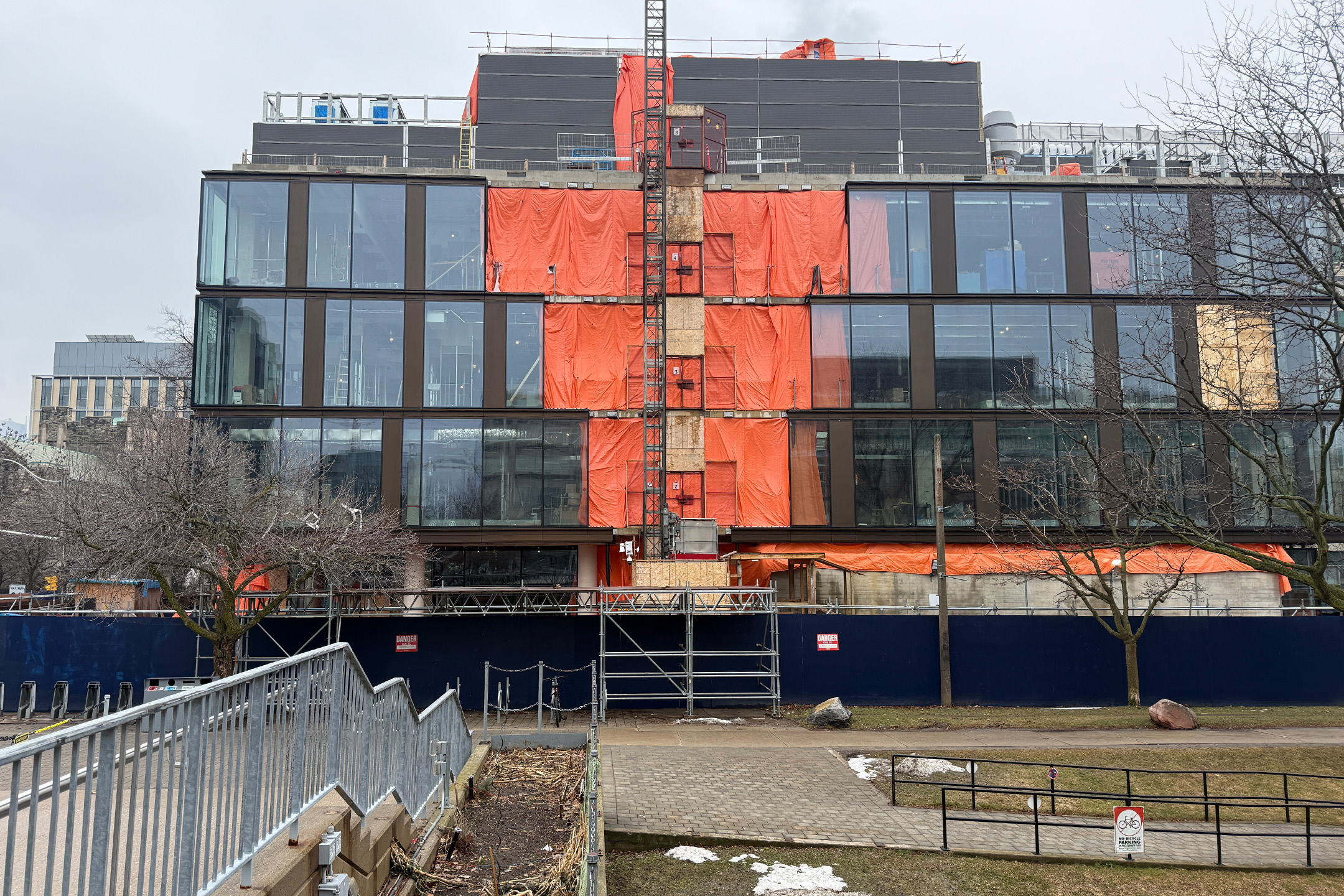
In the heart of UTSG is Lash Miller Laboratories, a familiar building for many STEM students. Currently, the Lash Miller Building Expansion, which includes renovated lecture halls, one new lab and the principal investigator’s office, is set to open in fall of this year. The project is funded in part by a $199.5 million grant from the Canada First Research Excellence Fund (CFREF) and $180 million from U of T.
Along with these renovations is a new centre for the Acceleration Consortium (AC), which is currently spread across six labs at U of T and one lab at the University of British Columbia. The AC is a global collaboration between governments, universities, and industry that aims to revolutionize the speed of discoveries using AI and automation. Mark Lautens, chair of the Department of Chemistry at U of T, explained the project’s purpose in an email to The Varsity. He wrote, “The goal was to bring together researchers… to accelerate discovery in materials science, medicinal chemistry, cell growth, [and] engineering.”
Transforming research through self-driving labs
Self-driving labs (SDLs) are central to the AC’s vision to enable the creation of new materials. This automation aims to reduce the time and cost of discovery for researchers.
SDLs integrate machine learning (ML) — an umbrella term for computational methods that identify patterns in data to make predictions — and robots to carry out experiments. “SDLs can make advancements in almost any kind of scientific endeavour, reducing manual and reliance on human intuition,” said Sean Caffrey, chief administrative officer of the AC, in an interview with The Varsity.
Instead of testing ideas at random, scientists first decide what properties they want for a material, and the AI model suggests a list of possible options. The AIs control an autonomous lab, which then automatically makes and tests these materials, and the results are fed back into the system to improve the next round of testing.
This cycle repeats until a better material is found. This approach allows adaptability, as the system troubleshoots until the desired outcome is achieved.
Compared to the traditional methods that use human intellect alone, this initiative may speed up the pace of discovery. According to Caffrey, “SDLs[’]… use of active learning to determine which experiments give the most information, [have] faster reproducibility than humans and ultimately [create] safer materials.”
Material synthesis by SDLs holds significant economic potential, yielding an estimated $1 trillion industry over the next decade. From infrastructure to pharmaceuticals, AI-driven material synthesis is the next step forward in scientific research, and U of T is leading the way.
Acceleration Consortium’s impact
SDLs have already shown promise, enabling practical applications in biotechnology and energy.
A notable project by researchers at U of T’s Leslie Dan Faculty of Pharmacy includes the SDL-enabled discovery of novel lipid nanoparticles (LNPs). LNPs are tiny, fat-based particles that can carry molecules in the body for messenger RNA (mRNA) delivery. mRNA is a type of genetic material that gives cells instructions to make specific proteins, such as in the COVID-19 vaccine, which employs this technology.
LNPs are key components in next-generation vaccines and gene therapies, medical treatments that replace the genetic material in cells. LNPs help safely transport mRNA into cells, and in this case, enable highly efficient gene editing in lung cells.
Another project, co-led by Yang Bai, Maral Vafaie, Amin Morteza Najjariyan and Ali Shayesteh, focuses on improving hydrogen production. By optimizing catalytic materials and reaction conditions, the project aims to enhance clean energy generation.
Beyond its research impact, the AC plans to create new opportunities for both graduate and undergraduate students at U of T through scholarships and research placements.
What does the future hold for AI-driven research?
Lash Miller’s construction is expected to be completed in late 2026 with an anticipated grand opening at U of T’s bicentennial celebration in early 2027.
Although fully autonomous labs are met with excitement, they are also associated with their share of challenges. Building systems that run complex experiments and training a skilled workforce to design these systems are some of the many hurdles to overcome. All the while, there are notable legal and safety concerns when using AI, which require the creation of guidelines and building regulatory standards to ensure its responsible use.
These legal challenges raise important questions that have yet to be fully addressed. How will labs ensure compliance with regulations for handling hazardous materials? How is intellectual property ownership defined when AI systems are contributing to discoveries?
Addressing these uncertainties is critical to ensuring that SDLs can be adopted safely and ethically. As Lash Miller plans to lead the way in AI-driven research, it’s important that accountability measures take center stage alongside technological innovation.
