
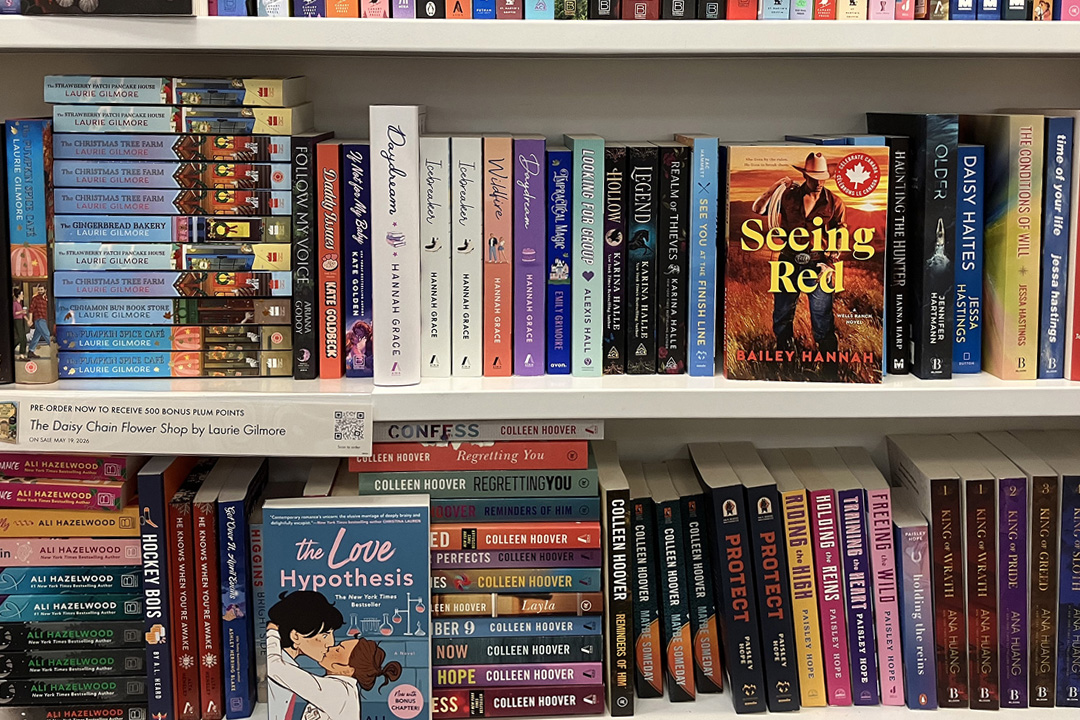
Love may feel timeless, though the way it’s sold is anything but. Romance is a billion-dollar industry — according to WordsRated, a research organization focused on the publishing industry, romance is the highest-grossing fiction genre. While overall readership numbers flounder, the romance genre’s consumption is steadily growing.
Much of romance’s renewed popularity stems from innovative marketing strategies. A particularly striking example of this dynamic is ‘BookTok,’ the ‘reading corner’ of social media giant TikTok.
Publishing’s dark horse: The effect of BookTok
BookTok — a section of TikTok dedicated to reviewing books and sharing recommendations — is a widespread marketing medium for the romance genre. This platform took off during the pandemic and became a place for avid readers to discuss their favourite books and recommendations.
Though other online book communities like ‘BookTube’ on YouTube have existed in the past, perhaps what lies behind BookTok’s singular success is its authenticity. TikTok’s short-form video content lends itself to distilling emotions and reading experiences into quick, snappy clips. Organic presentation fosters trust with readers, and virality generates fear of missing out.
BookTok has since driven fundamental shifts in the literary marketing landscape. The phenomenon allowed decade-old works to be rediscovered by a new generation — Madeline Miller’s The Song of Achilles, a tragic romantic retelling of the Trojan War, sold 20,000 copies in its first run in 2011, but sold two million copies by 2022 after gaining popularity on TikTok.
The literary merit of romance
On a broader scale, the accelerated success of the romance genre also reflects readers’ desires beyond the industry itself. In a time of political turmoil, readers gravitate towards feel-good stories, citing them as an escape. This has begun to reshape the contemporary literary landscape, as publishers increasingly prioritize romance in a self-reinforcing cycle of demand and profit.
However, there is a lot of discourse surrounding whether the rise of the romance genre is beneficial. A 2025 NPR/Ipsos poll showed that only 51 per cent of adult Americans reported reading a book in the past month. The romance genre could motivate more adults to read — WordsRated also reported that 78.3 per cent of romance readers finish a novel every month. On the other hand, an article on BookRiot, an editorial book site, argued that it homogenizes literature, marginalizing non-romance narratives.
The (very) lucrative business of book-to-screen adaptations
Even as critics debate its literary merit, the publishing industry ultimately runs on profit, and few genres deliver returns as consistently as romance.
Romance book-to-screen adaptations are particularly lucrative — Netflix spent upwards of $230 million for Season 3 of regency-romance series Bridgerton, based on Julia Quinn’s novel series of the same name, and the series is now one of Netflix’s most-watched original shows of all time.
These works have a built-in fanbase, translating to guaranteed revenue returns. Adaptations, thus, can be seen as a low-risk venture in the wider landscape of the entertainment industry. Moreover, these productions also expand readership of the source material, which in turn fuels further adaptations, producing a positive feedback loop within both the publishing and entertainment industries, and a promise of more romance projects to come.
Ultimately, the romance genre is less of a guilty pleasure than a cornerstone of the publishing and media industries. While the genre itself is far from new, its expanding diversity has also broadened its readership, allowing more audiences to see themselves reflected in stories of love — Crave’s hit TV show Heated Rivalry is based on a romance novel of the same name that features a relationship between two male hockey players. Knowing this, it’s really little wonder that publishing’s most beloved and lucrative genre and what we come back to, continues to be love, actually.

No comments to display.