
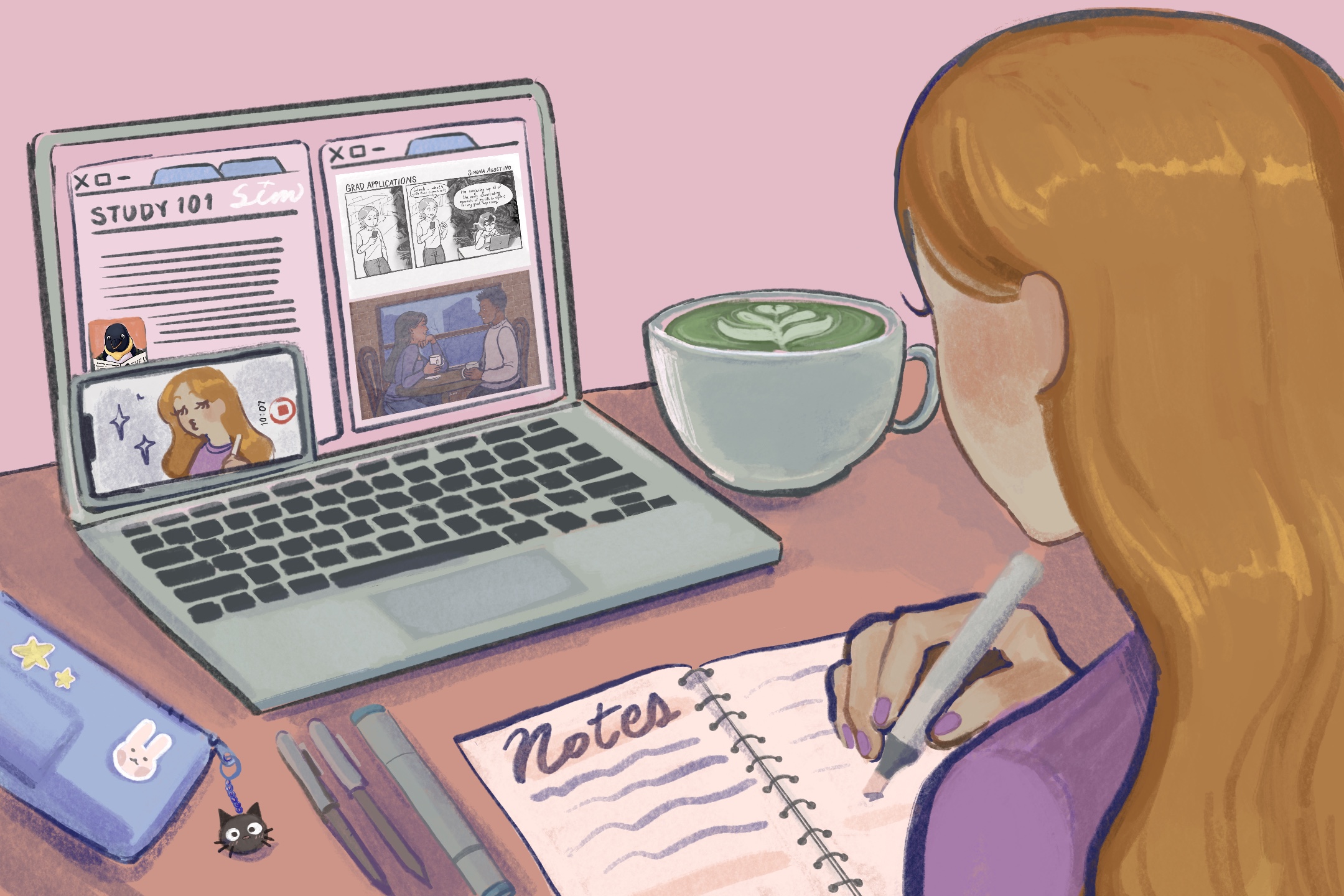
If you’ve spent any amount of time on TikTok lately, you may have come across a video like this: a young person seated in the cozy nook of some Romanesque-revival library or café, a matcha latte with extravagant foam art in one hand, and a pretty pastel highlighter (instead of the generic, garish, neon ones) in the other. Behind their open laptop rests a spiral notebook with an embossed, floral-patterned cover, diligently filled with pristine, stylized study notes and littered with cutesy monochromatic stationery.
The romanticization of academic life is nothing new. Internet aesthetics like Dark and Light Academia, first popularized on Tumblr and more recently on TikTok, glamourize the more abstract concepts of intellectualism and scholarship (though often devoid of critical engagement with the literary and textual material it appears to worship).
It’s perhaps not surprising, then, that these highly aestheticized studying videos often echo other forms of embellished ‘lifestyle’ content — images or videos of fancy desk layouts plastered with cookie-cutter motivational sentiment; or, conversely, explicitly ‘toxic’ rhetoric telling viewers to ‘suck it up’ and study.
Regardless of the approach, study-oriented videos frame studying as another form of pulling yourself up by your bootstraps, wrapped in the rhetoric of self-care. Just as we force little kids to eat icky vegetables because they’re good for them, study content tends to acknowledge that studying is ‘tough,’ but emphasizes and even shames viewers to instead think about the bigger picture: that near-constant productivity will be rewarded with academic success, and that academic success will set you on track for a successful life.
The emphasis on ‘near-constant’ productivity is no exaggeration, either. Many ‘study with me’ videos feature creators emphasizing the number of hours they spent that day studying, championing the idea that excessive grinding sessions are necessary for success –– sleep and burnout be damned.
Other discussions of romanticizing studying make explicit the idea of performance — encouraging students to imagine themselves as the main character with a hypothetical audience observing them as an incentive to be productive.
The effectiveness of this kind of study content — and the aesthetics they implicitly encourage viewers to adopt themselves — is inconclusive. On the one hand, factors like physical environment and writing notes by hand almost certainly play a role in productivity and memory retention. On the other hand, becoming preoccupied with how studying looks can take away from the point of study-oriented content in the first place — to actually help you study. In fact, occupying your time with curating the precise look of studying may just turn into another, more deceptive form of procrastination, one sometimes referred to as ‘productive procrastination.’
It’s similar to how one might feel the sudden, unexplained urge to clean their room top-to-bottom when made perfectly aware of the upcoming deadline for a paper or date of an exam. Taking the time to set up your study nook and creating elaborate stylized headings for your notes may just become busywork done in lieu of hunkering down and doing what needs to get done.
Much of this study-oriented content on TikTok and other social media platforms has become something of a money-making venture for the many accounts that have gained a following from it. Study influencers tend to get sponsorships from various productivity-based apps and workspaces, and also take great care in showing off the writing utensils and other materials they use to curate the perfect study environment.
Obviously, it’s dubious to think that $10 matcha lattes, scented candles, and calligraphy headings done in Copic marker will, on their own, lead to anything more than an empty bank account. Could ‘sexy studying’ content be goading students into believing that mastering the appearance of studying will actually make them more productive and academically successful?
‘Study with me’ content does have the potential to actually be helpful. The idea of romanticizing the less fun aspects of your life is not necessarily a bad idea in principle. We shouldn’t have to dread every second we spend studying or scrupulously crafting a paper, but we also shouldn’t be led to believe that the key to productivity lies solely in the aesthetics of it all.
Rather than being preoccupied with making studying ‘sexy,’ perhaps we should be working to make it tailored to us. Find a study space that you feel comfortable in. Play some white noise or a three-hour-long video of someone else studying if you find it helps. Explore different study methods and tips, and figure out which ones work best for you. Above all, remember that aestheticized study and school-oriented content is just that — aestheticized, curated, and performed.

No comments to display.