
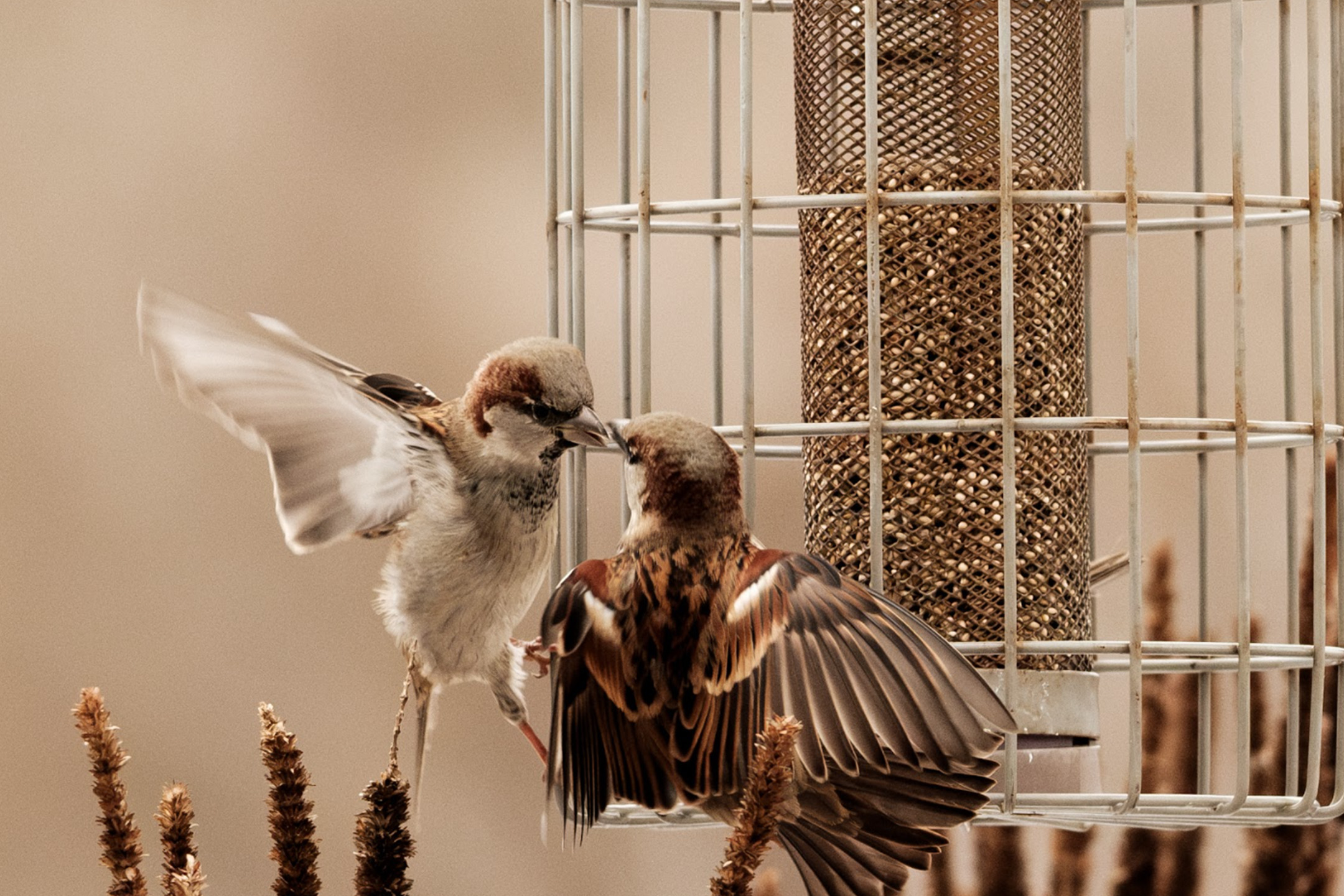
With Valentine’s Day upon us, you might be wondering how other animals find love. And, if you are one of those people who woke up and finally started noticing the birds everywhere, you may be wondering about birds in particular. It might be surprising to learn that birds — like humans — don’t flirt or mate at random, but rather have courtship rituals that have fascinated zoologists for centuries.
Sexual selection
A species’ tendency to find certain traits in other individuals more attractive than others is a repeating phenomenon throughout the animal kingdom. Among birds, finding a desirable mate — whatever that metric may be for different birds — often increases the chances of hatching viable offspring.
We humans might flirt by giving our crush a flower bouquet or dressing to the nines on a dinner date. Many bird species do their version of the same with the limited resources they are given in the wild.
Most bird species practice monogamy because bonded pairs are more likely to survive harsh environmental conditions. For example, an egg can only grow if it is kept in a narrow temperature range and protected from predators. This is easier for mating pairs than groups to coordinate among themselves.
Birds haven’t always been monogamous; in fact, the ancestors of today’s birds likely didn’t have strong pair bonds. But now, a minority of birds in many species engage in some form of polygamy when the sex ratios align — for example, if there are many more females than males, one male is more likely to mate with multiple females at different times. Black coucal birds are an interesting example of polyamory in birds, where females defend large territories and form social polyandrous groups; the females breed for the entire mating season while the males are solely responsible for parental care.
Therefore, in the bird world, mating can be a feisty competition where only the best performers win over their love interest.
Take me to the ballet: Dancing and feathers
One common mating strategy is for one bird — typically, the male — to show off bright plumage in a dance or musical sequence, in hopes that the other will approach them out of curiosity. Male magnificent frigatebirds (that is their actual name), which are mostly jet black, inflate a red, heart-shaped pouch on their throat (yes, really).
Martha Fischer, an audio archivist working with the Cornell Lab of Ornithology’s Bird Academy, captured footage of these birds on an island in the Dry Tortugas National Park in Florida, USA. That footage showed them using their inflated pouch to make a drumming noise, which attracts female frigate birds soaring high overhead.
Another well-known example of this visual attraction strategy is the ocelli or mock eye pattern on a male peacock’s long tail. Interestingly, males with blue-green ocelli seem to have more success than other colours, but the exact biological function of this behaviour remains a mystery. During mating, male peacocks fan out their feathers and vibrate them in a way that makes the ocelli shimmer.
However, looking pretty and dancing isn’t the only way to flirt.
Singing (and/or screaming)
Many birds sing to woo potential mates — sometimes in a way that is pleasant to the human ear, and sometimes, not. Like human languages, the variation and diversity of bird song often vary by geographical location, forming different dialects. This can help birds identify local species that are likely best adapted to their particular environment.
In 2010, the Weir Lab at UTSC conducted an evolutionary biology study on a variety of bird species and discovered that oscine bird species — those that learn birdsongs culturally rather than innately through evolution — have evolved more complex birdsongs at polar latitudes than those at tropical latitudes.
In contrast, it was the obnoxious scream of male white bellbirds that captivated Jeff Podos’ research team and his colleagues in the National Institute of Amazonian Research in 2019. In courtship exclusively, these birds have the loudest bird call ever recorded, reaching 125 decibels, which is comparable to standing next to an exploding firecracker.
Male white bellbirds are able to reach this threshold due to their chest, which is five times thicker than that of the same-sized birds of other species, and an unusual trumpet-shaped beak.
Nest-building and gifts
In F. Scott Fitzgerald’s famous work The Great Gatsby, the titular character purchases a mansion and throws bedazzled house parties weekly in the hopes of wooing his long-lost love, Daisy Buchanan. Like Gatsby, some birds (usually males, again) build nests in hopes of demonstrating some aspect of their fitness as mates. For example, there was a correlation found in the mating success of male black wheaters and the amount of stones they carried to their nest sites; this further correlated to a potential fitness advantage of males with larger wing areas being able to carry more stones.
A similar, although more subtle, style of courtship is gift-giving. Some gifts are unconventional and purely practical.
For example, the great gray shrike spears rodents with thorns, creating a rodent ‘kabob.’ In pleasant contrast, penguins court each other with pebbles in anticipation of building a pebble nest together.
During our own season of love, frantically innovating creative ways to secure our date may leave us feeling hopeless and existential. In the meantime, we find it fascinating to watch birds woo each other in whatever ways they can, whether through heart-shaped chest pouches or screaming in public. We suppose that, collectively, the entire animal kingdom is just trying to ‘figure love out,’ even though we have pursued it at every stage of our evolution.
We would not recommend going bird-watching to gather inspiration for Valentine’s Day (also unofficially known as human courtship season). Unless, perhaps, you were thinking of gifting your crush whimsical trinkets as a form of human penguin-pebbling.

No comments to display.