
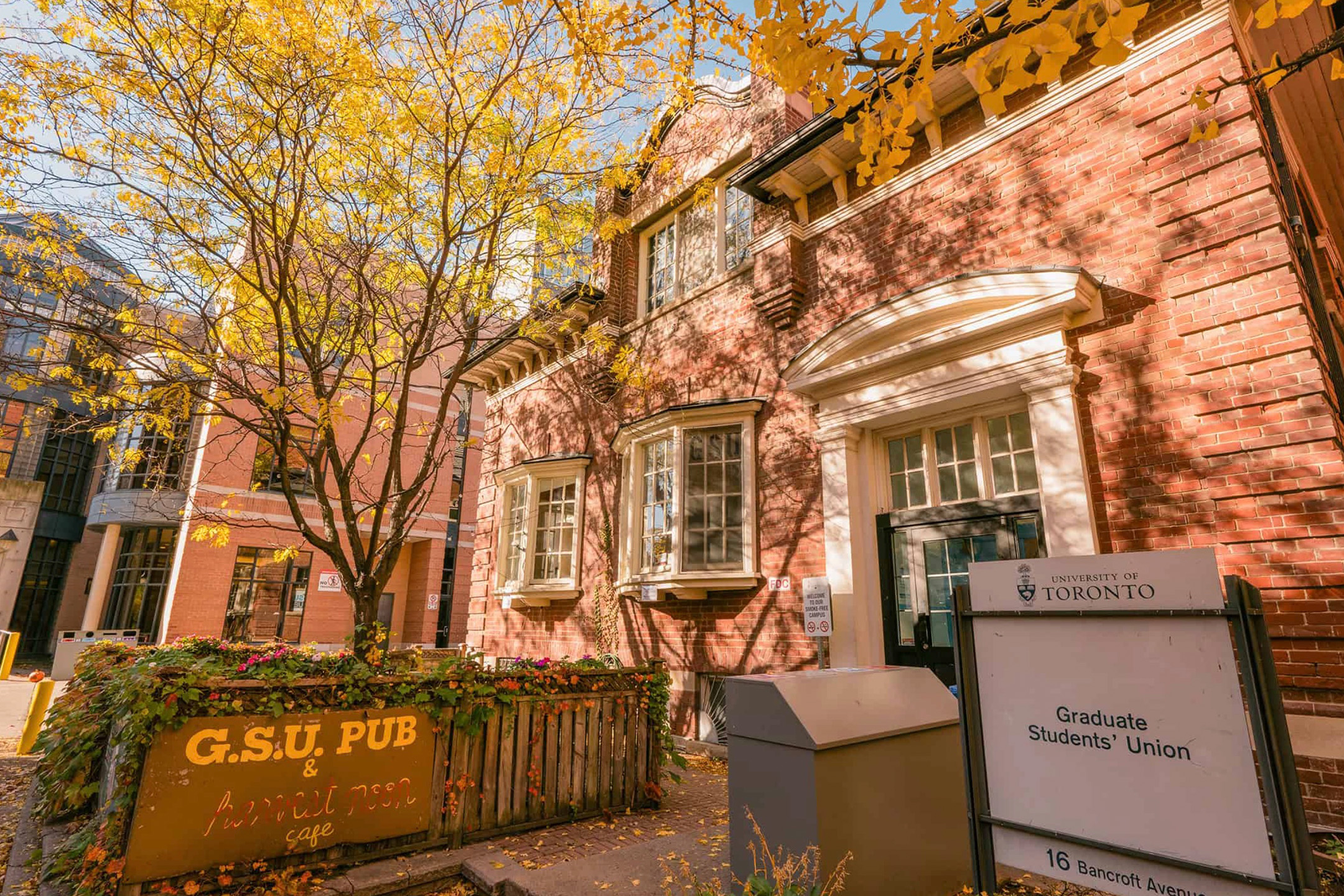
On January 29, the University of Toronto Graduate Students’ Union (UTGSU) held its first Board of Directors (BOD) meeting of the semester. During the meeting, directors allocated funding for anti-sexual violence advocacy, discussed a new campaign centred around increasing funding for master’s students, and withheld approval of a new ancillary fee for the Hart House Building Renewal Project.
Centre for Women and Trans People
A motion to contribute $1,000 from the Center for Women and Trans People (CWTP) restricted fund to Students for Consent Culture’s Open Secrets Report carried. In 2024, funds collected through the UTGSU’s CWTP levy were withheld from the center after it failed to submit the required documentation on time.
The collected funds — now totalling approximately $20,000 and held in a restricted reserve — can “only be used for the purposes it was collected, namely to facilitate programming, advocacy and services for women and trans identified people,” according to the motion.
Students for Consent Culture is a national campus advocacy group focused on addressing sexual violence on campuses. The organization requested funding from the UTGSU for its Open Secrets Report, which evaluates rape culture and institutional accountability at Canadian universities using survey data collected over the past three to four years. The funding will support bilingual services, design, and other resources needed to produce the report.
As the levy no longer exists, a motion to rename the “Centre for Women & Trans People Fund” to the “Gender Equity Fund” also carried. The gender equity fund will support similar projects or programs that would otherwise have fallen under the scope of the former levy.
Master’s funding justice campaign
Division I Director Sadaf Sohrab introduced her master’s funding justice campaign, which outlines three main goals. The first is to demand a minimum annual funding guarantee of $30,000 for students in research-based master’s programs and needs-based financial support — including emergency grants, bursaries, and financial aid — for students in professional master’s programs.
The second goal is to increase funding transparency by advocating for all master’s programs to publicly disclose their funding minimums. The third calls on programs and departments to ensure that funding commitments are met and reported in annual funding reports.
“Of course, with any campaign, we need to have a measure of success,” Sohrab said at the meeting. “Our measure of success would be more than 2000 petition signatures, 20 plus departmental letters… and a written commitment from the university regarding funding towards master students and meeting what our demands are.”
Master’s students make up more than 50 per cent of the graduate population, and often lack access to the multiyear funding packages available to PhD students. Professional master’s students typically receive no funding, while research-based master’s students often receive stipends below the poverty line.
Hart House Building Renewal Project
A motion to allow the board to direct the UTGSU’s representatives on the Council of Student Services to vote in favour of a new ancillary fee to fund the Hart House Building Renewal Project failed.
Vice President (VP) Nicholas Silver said the project would cost $240 million and take 20 years to complete. Hart House proposed a fee of $60 per term for full-time students at St. George and $12 per term for part-time students, with the fee increasing by two per cent annually. The proposal prompted opposition among directors.
“I vote against this because I feel like we [the BOD] have no mandate to approve this kind of thing. That’s a huge cost [for] all graduate students,” said VP Internal Dominic Shillingford. VP Student Life Eliz Shimsek spoke to the fact that despite three presentations on the subject, most graduate students were unaware of the project or the proposed increase to their fees necessary to fund the project.
Other business
VP External Seema Allahdini was granted signing authority and appointed to the Finance Committee, assuming the responsibilities of the VP Finance role following Farshad Murtada’s resignation in November.
The finance committee reported an operational surplus of $440,000, and passed a motion allotting $100,000 to the student conference bursary fund and $75,000 to the international student bursary fund.
Near the meeting’s end, Division III Director Sina Ahmadi Malayeri acknowledged the escalating crisis in Iran and called for solidarity for Iranian graduate students experiencing distress. “Many Iranian graduate students in our community are experiencing significant distress right now [due] to the escalating crisis that’s happening in our country… I hope we can ensure that they know about the resources and hope that we may be able to offer.”

No comments to display.