
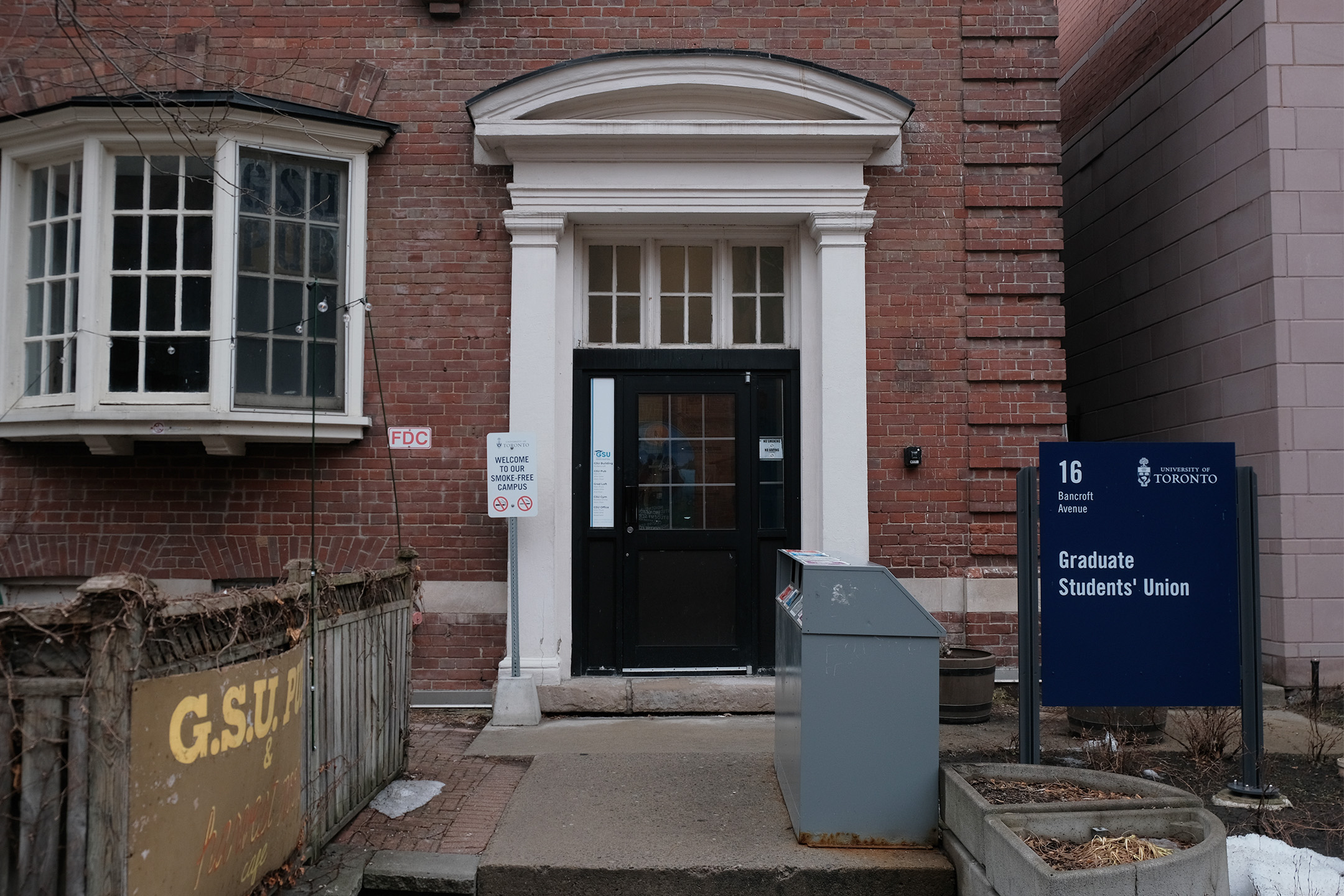
On Monday, March 2, the University of Toronto Graduate Students’ Union (UTGSU) convened for a monthly Board of Directors (BOD) meeting.
Directors came together to approve specific motions on workplace harassment, and the collection of and accountability for financial policies. They also approved the increase in the remuneration of the executives to reflect the work increasing from 15 to 17 hours a week after the resignation from the Vice President (VP) Finance position.
They began the session with a roundtable discussion on committee work, their experiences and feedback in the various committees on which each director serves. Directors especially noted their sense of empowerment and excitement for two of the more active, multi-year committees — Food Security and Base Funding. VP Internal Dominic Shillingford ended by encouraging directors to reach out to him for feedback on the committee process.
Funding questions
After the 2025 Annual General Meeting (AGM), UTGSU members directed the Base Funding Committee to define the goals and mandate of their new caucus.
The approved definition goes: “Broadly defined, the Base Funding Caucus is a space for members of the UTGSU who perform unrecognized work at the University of Toronto as a requirement for completing their degree programs. Unrecognized work involves tasks such as research or internships that would typically be completed by a paid worker. Some of these Members receive stipends or fellowships to offset tuition and cost-of-living expenses.”
President Amir Moghadam emphasized the role UTGSU needed to play in contesting the Ford government’s cuts to the Ontario Student Assistance Program (OSAP). Moghadam made clear that these changes were made without consultation with students. He also asserts that the Cost-of-Living survey sent to graduate students gave UTGSU data to prove the risk of widespread OSAP cuts.
He then encouraged Directors and their constituents to attend the March 4 and 23 rallies and the March 10 town hall to raise their concerns.
Member petitions
A motion for the proposed policy on Board of Directors meetings and agendas sought to rescind the existing policy on petitions. The motion was eventually amended and tabled.
In the current policy, a petition of 300 signatures can compel the union to use council powers for a certain action. A petition cannot overturn a referendum, a decision from an AGM, break a legal agreement, violate the law, or do something unfeasible within the union’s operational and financial restraints.
The rationale to rescind this petition policy was that it allows members to compel the BOD to undertake actions against their best interests. Additionally, the UTGSU’s petition policy is not common in contemporary student unions. The union also already has existing avenues for members to bring their matters to the BOD’s attention, such as during elections and AGMs.
On February 11, the Governance Committee voted to recommend the adoption of a Member Proposals policy. Rather than a petition, members may use proposals to either request that a director submit an agenda item for a BOD meeting on their behalf, or to submit a Member Proposal directly to the VP Internal. They may use proposals as long as they received 100 signatures and the Chair did not deem it out of order. Under the proposed policy, the member must submit a Member Proposal 10 days prior to a BOD meeting and has entitlements for speaking rights to motivate the proposal at the meeting.
The directors spoke at length about the implications of the policy. They questioned whether the number of signatures sufficed as a mandate, if the number of signatures adequately represented members across divisions, and if the proposal was accessible for students across satellite campuses.
An amendment sought to lower the number of signatures to 50, rather than the initial 100, at which point discussion of whether 30 signatures would be more adequate proceeded. Ultimately, the directors decided to table the motion, given some of the concerns raised.

No comments to display.