
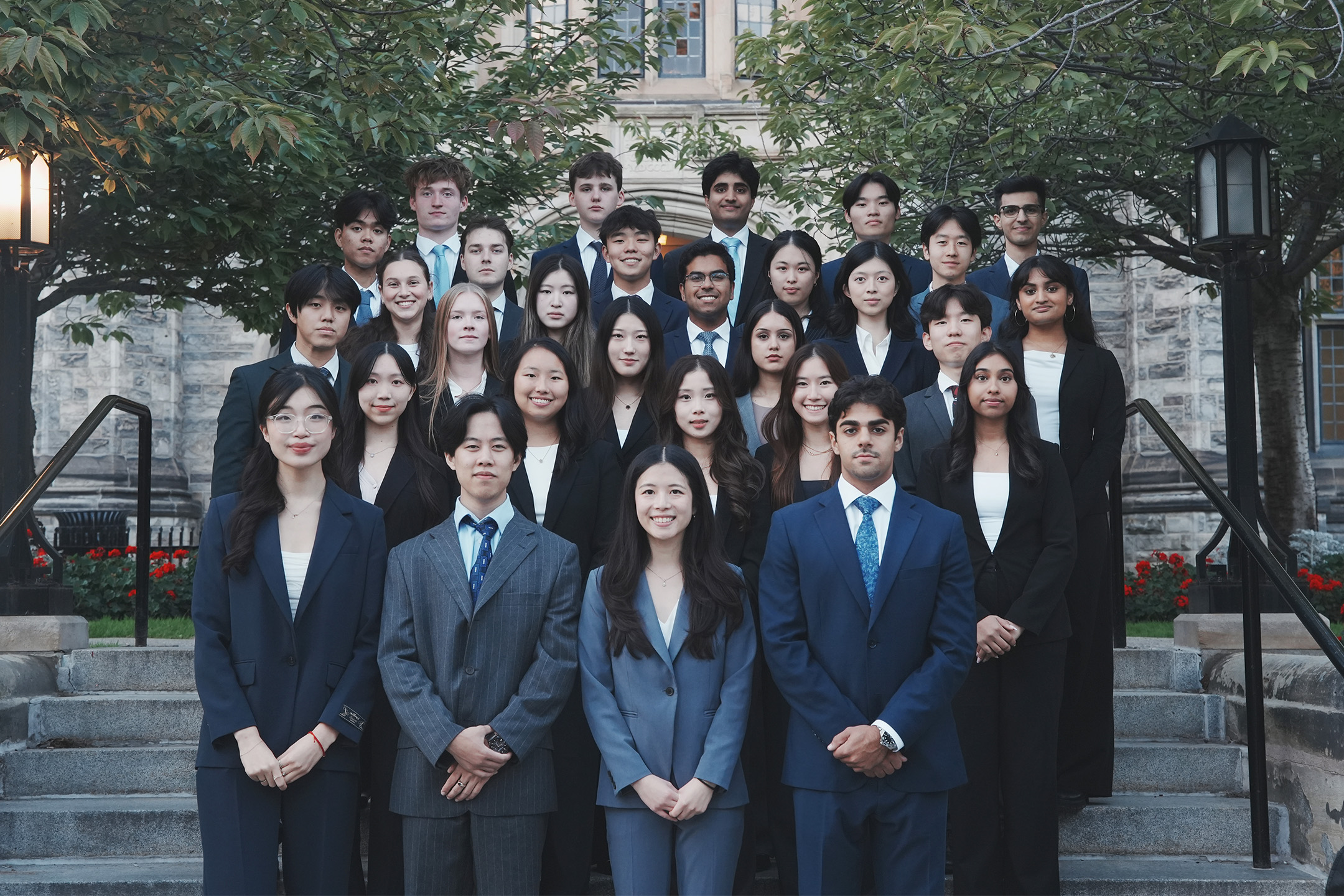
The Rotman Commerce Competition Team (RCCT) is one of the business program’s most exclusive student organizations, with competitors attending case competitions across Canada and on the world stage. In these competitions, students are given business scenarios — known as a case study or case — and present solutions addressing them. From Hong Kong to Copenhagen, its members tackle some of the business world’s most demanding and emerging challenges, like AI integration.
The Varsity had the opportunity to speak to two second-year Rotman Commerce competitors, Kailey Cheng and Gracia Wang. The pair revealed what it takes to be a competitor, the rigorous preparation involved at each stage, and what they have personally taken away from these unique experiences.
How to get involved
Making the cut for RCCT is no easy feat. While students might be accustomed to simply submitting a resume and completing a short interview for most university extracurriculars, RCCT has a more comprehensive hiring process that can be broken down into three stages.
The first stage consists of a traditional resume submission, as well as a case study that requires a write-up and video submission. If selected to proceed, applicants must complete an independent 24-hour case and behavioural interview, with the last round consisting of a five-hour case with a group of a few other students.
To students who are not accustomed to the recruitment process in consulting, finance, or other competitive industries, this may seem like overkill. First-year students usually do not even know what a case study is, let alone have the experience to complete one effectively.
However, Cheng explains that perfection is not necessarily an expectation. “A misconception is that you need to have prior experience back in high school to have a higher chance of getting to RCCT,” she said in an interview with The Varsity. “There are other factors that we consider, such as critical thinking skills, creativity, and also compatibility — if you’re able to work as a team, not just individually.”
The secret behind their success
Once students are in RCCT, their workload increases significantly. Competitors are not immediately shipped off to high-profile events across the world. Instead, their first year consists largely of preparation and participating in case competitions hosted by Rotman.
This can look like hours of Excel and PowerPoint modules, weekly training, and internal case competitions with upper-year students. This is an effort to make participating students well-rounded, not only comfortable with public speaking or making slide shows, but also with strategic thinking and quantitative analysis.
Wang reflected on her experience in her first year, saying, “It was definitely a lot to manage on top of all your other school work, but at the same time, it felt like you had fun with it. If you enjoy the people who you were doing it with, it’s definitely doable.” Both Wang and Cheng emphasized the sense of camaraderie they felt with the team during their first-year.
“A huge reason why teams win is their team chemistry… especially when you’re doing cases for 24 hours or even 30 hours,” Wang explained. Cheng echoes this sentiment, recalling a competition where her team nearly placed last in the opening round, only to make a remarkable turnaround — one she credits entirely to the trust and faith they had in one another.
Competing on the world stage
Cheng and Wang both attended their first long-distance case competition this past fall — Cheng at the Alberta International Case Competition (AIBC) in Jasper, Alberta, and Wang at the Australian Undergraduate Business Case Competition (AUBCC) in Melbourne, where their respective teams both placed as finalists.
In preparation for them, team captains will organize the teams strategically and then do mock cases that mirror the structure of the actual competition.
Both Cheng and Wang noted how it was interesting to see how other schools approached case competitions. “They also have their own strengths, for example, one school was really great at public speaking, or they have a lot of charisma, while other schools were very technical,” Wang said to The Varsity.
Why you should join RCCT
Although RCCT is a smaller organization, it provides members with a huge competitive advantage when it comes to applying to internships and jobs, as it provides access to a strong network of alumni.
Wang describes RCCT as a launch pad for its members, accelerating the development of skills like using Excel or applying financial concepts, which she found to be helpful during job recruitment. Although these fundamentals may sound basic, she notes that mastering them creates a chain effect, with skill development quickly compounding over time.
In a similar vein, Cheng notes that RCCT has given her a greater sense of confidence in her own capabilities — providing her with the platform to actually execute and apply skills that she may have already possessed but didn’t have the opportunity to put into practice.
Beyond professional development, both noted that the nature of the commitment — hours spent training, travelling, and learning from one another — has turned RCCT into a second family, with some of their closest friendships being made along the way.

No comments to display.