
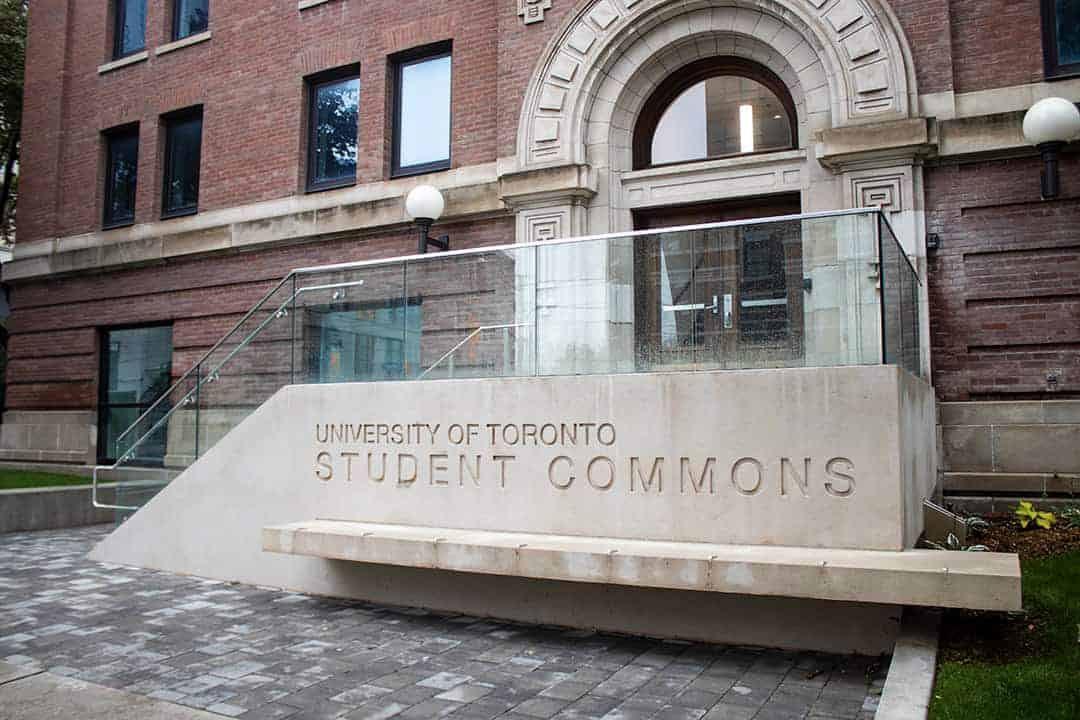
As the newly elected President Marie Kinderman prepares to assume the office for the 2026–2027 term, The Varsity discussed the union’s accomplishments with the current president, Melani Veveçka.
During the 2025–2026 term, University of Toronto Students’ Union (UTSU) launched a second round of its partnership with Metrolinx, and implemented the Respect, Educate, Empower Survivors (REES) project at U of T in collaboration with the Sexual Violence Prevention Centre. The union also continued consultations on bidet initiatives.
$100,000 for student aid funding
In response to a question about the achievements of UTSU this year, Veveçka wrote in an email to The Varsity that it was difficult to pinpoint a single defining achievement, instead emphasizing the breadth of initiatives undertaken.
However, if she had to choose one, “it would be the emergency referendum for student aid funding… I worked closely with the members of my team who were available and with our Board of Directors to draft, promote, and pass a referendum that now will generate an additional $100,000 in funding for student aid at a minimal cost to students through the membership fee.”
She added that this funding would help ensure support systems remain in place as new Ontario Student Assistance Program (OSAP) policies take effect after her term.
“I would not suggest that any student union can resolve every concern within a single term […] I believe the UTSU had a positive and measurable impact on students’ experience this year,” Veveçka wrote.
Initiatives in progress
Veveçka acknowledged that some initiatives remain incomplete, including the creation of an affordable, “grab-and-go” healthy food option in the Student Commons.
While the project has not been finalized, she said the UTSU has been in discussions with Regenesis, completed initial scoping, and identified a viable model for grab-and-go. Veveçka expressed confidence in Kinderman, who “shares this same goal and brings strong experience through their own work with Regenesis,” to bring the project to completion.
Another ongoing initiative is the flexible Credit/No Credit policy. Veveçka explained that UTSU collaborated with the Scarborough Campus Students’ Union (SCSU) and the University of Toronto Mississauga Students’ Union (UTMSU) to draft a proposal, which is now being prepared for presentation to university administration and registrars.
“The foundation is there, and I trust it will be carried through.” Veveçka wrote.
Reflecting on the scope of the union’s role, Veveçka noted that certain decisions — such as tuition costs — are made at provincial and institutional levels. “The UTSU can advocate on those issues, and we do,” she wrote.
Addressing criticisms
Regarding student groups’ disappointment with a perceived lack of public statements from the UTSU on international conflicts, Veveçka emphasized the union’s approach of connecting students with appropriate resources.
“Throughout this term, students have approached the UTSU for support in relation to a range of concerns, including those about international events. In every case, we have worked to ensure those students were connected with the appropriate resources available to them, including mental health services, financial assistance, and relevant institutional support,” she wrote.
In response to questions about whether internal tensions within UTSU affected its operation, Veveçka denied the existence of any turmoil, “[We are] a professional body, and every individual who serves on this executive does so with an understanding that the role carries obligations of conduct that are not discretionary.”
Last words before leaving the office
According to Vevecka, the UTSU’s role “is to represent student interests within the existing decision-making structures, not to substitute for them. This is a meaningful distinction, and I think it’s important for students to understand it as an accurate description of where the UTSU’s authority begins and ends.”
Veveçka expressed gratitude for the collaborative environment her team built to accomplish the union’s achievements beyond the outcomes themselves.
“I owe a great deal of thanks to a great deal of people. To my executive team, to the permanent staff at the UTSU, to the student clubs and groups who trusted us enough to bring us their concerns and their ideas (and who held us accountable). And, of course, to the student body, for trusting me with this responsibility and giving me the opportunity in the first place.”

No comments to display.