
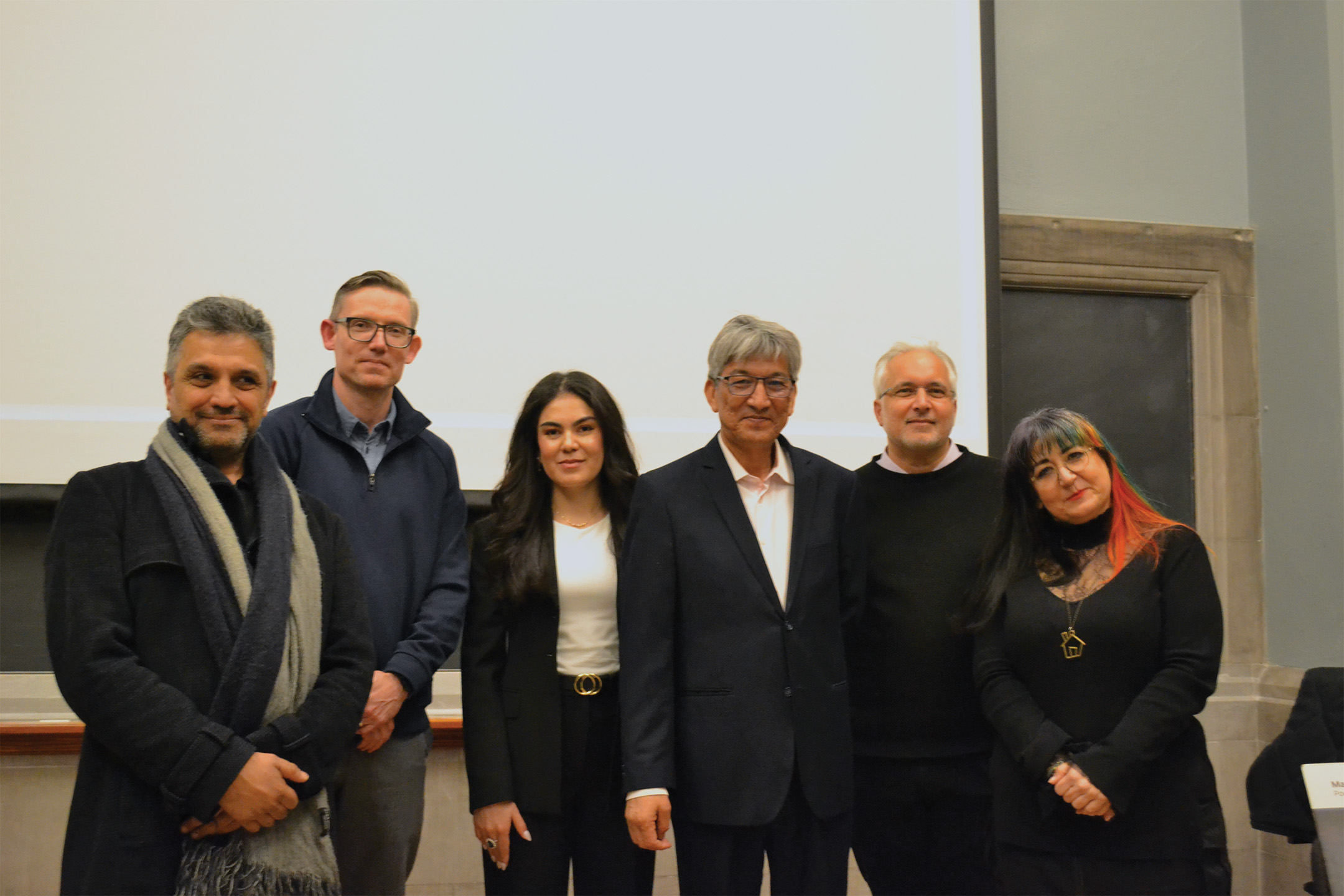
On a dark, stormy evening on March 18, readers and writers from across the GTA gathered at U of T’s Emmanuel College for Poets, Playwrights, Editors, Essayists, and Novelists (PEN) Canada’s Voices of Freedom reading. The event, which was the 11th edition of a reading series established in June 2022, platforms the work of its Writers in Exile community.
Writers in Exile is an advocacy program organized by PEN Canada, the Canadian chapter of an international nonprofit organization that advocates for persecuted writers and journalists facing censorship around the world. Writers in Exile provides refugee authors with opportunities to develop their professional skills through workshops, residencies, and public readings. They also assist with refugee claims, provide professional documentation to help start their careers in Canada, and help writers raise public awareness about their exile and experiences.
Brendan de Caires, executive director at PEN Canada, said to The Varsity in an interview that in the last year, the organization chose to branch out and host their events in more public places like U of T. Their goal was to bring in newer and wider audiences for their authors, because “too often they’re reading to the same room of people.” de Caires was delighted that he couldn’t recognize three quarters of the people who had gathered that night for the reading.
The readers
Theresa Johnson, director of operations for the organization, started off the event by introducing the audience to the symbolic empty chair. The Empty Chair is a tradition of PEN centres worldwide. At all public events and literary festivals, PEN Canada keeps an empty chair that represents a writer or journalist who is currently imprisoned for peaceful dissent or resisting censorship.
This event’s empty chair belonged to María Cristina Garrido Rodríguez, an award-winning Cuban poet who is currently serving a seven-year prison sentence for participating in Cuba’s July 11 protests in 2021 — a mass demonstration demanding improved living conditions in the country.
Jinoos Taghizadeh, a multidisciplinary Iranian artist, writer, and activist, was the reading’s MC. She brought her unique insight into conversations with the night’s Farsi literary panellists from Iran and Afghanistan.
The first reader of the night was Rukhshana Ahmadi, an Afghan-Canadian writer, journalist, and education activist, who is currently finishing her journalism degree at Toronto Metropolitan University (TMU). Ahmadi read a haunting stream-of-consciousness short story titled The Forgotten Roof, about the banality of student life on the TMU campus. While education on campuses like TMU appears ordinary, it is a luxury denied to girls in Afghanistan, who are subjected to a regime of gender apartheid because of policies from the Taliban-led government.
The next reader was Ali Sobati, an Iranian poet, translator, and literary activist. Sobati read an essay titled “In a Time of Drought” that examined the desolate state of the literary practice in an age of mass distraction and destruction. Invoking the words of philosophers like Guy Debord, Jean Baudrillard, and Cornel West, Sobati deftly interrogated the idea and purpose of writing in these particularly trying modern times.
Sobati expanded on his essay about the role of the poet in times of crisis, and the macabre spectacle of exile that necessitates writing. For Sobati, the act of writing is a response to the ‘abyss’ of living in exile. Exile causes one to lose touch with one’s native tongue and distorts the memory that the artistic practice helps address.
The event’s last reader was Hazrat Wahriz, an Afghan Hazara former diplomat and university instructor, and current leader of a network of schools for girls in Afghanistan. Wahriz read from a piece entitled, From Where I Orbit the Sun.
Wahriz described his writing style as taking after the Russian poet Bulat Okudzhava’s maxim: one writes the way one breathes. Wahriz told Taghizadeh that he took great pains to avoid unnecessary sentimentality. He feels that oversentimentality can crowd out the natural emotion of his writing, which should be left for the reader to decipher. This thought and decisiveness were reflected in his writing.
Panel discussion
After each of the writers had read their pieces, they all gathered onstage for a question-and-answer session moderated by Taghizadeh. The matter of audience, language, and the public perception of the exiled writer dominated the discussion.
Sobati compared being in exile to not recognizing the changing figure in the mirror. He strongly condemned the imperialist callousness of Western philosophers like Theodor Adorno, Max Horkheimer, and Jürgen Habermas of the Frankfurt School, and their Zionism. He also condemned the current wars of aggression that the West is imposing on Iran and other countries in the Middle East.
Wahriz criticized the expectation that writers from countries of “the so-called ‘third world’ ” should have all the answers about their country’s problems as a sign of Western ignorance. The average Western citizen is often unaware of the role their country may have played in bringing about the problems faced by countries in the global south in the modern day. They instead place the onus on the shoulders of refugee writers for explanation.
In an interview with The Varsity after the panel, Wahriz expanded on his point. He emphasized the need for countries in the West to take responsibility for their actions and their obligation to provide material support to countries like Afghanistan in the Global South. He warned against primitive characterizations of Afghans as only being backwards or conservative, and shared how many parents in Afghanistan approach him eagerly about educating girls in rural Afghanistan.
He emphasized how important it was for countries in the West to provide empowerment for education initiatives in Afghanistan. Wahriz also mentioned UK Home Minister Shabana Mahmood’s surprise announcement on March 5 that suspended education visas for students from Afghanistan, Cameroon, Myanmar, and Sudan, calling it “a crime against humanity.”
He said, “To shut down the doors of university for these girls that were not lucky enough to be born somewhere else, I don’t think it’s a human act. Everyone should condemn that.”
The Voices of Freedom reading brought new voices and perspectives to the literary community at U of T. Taghizadeh remarked, “Every generation feels that its moment is urgent, that something important is happening that can’t wait.” The reading and PEN Canada brought this urgency and stories to the student writers and community members of the university. This urgency is sorely needed in an environment that can sometimes feel insular and self-centred.

No comments to display.