
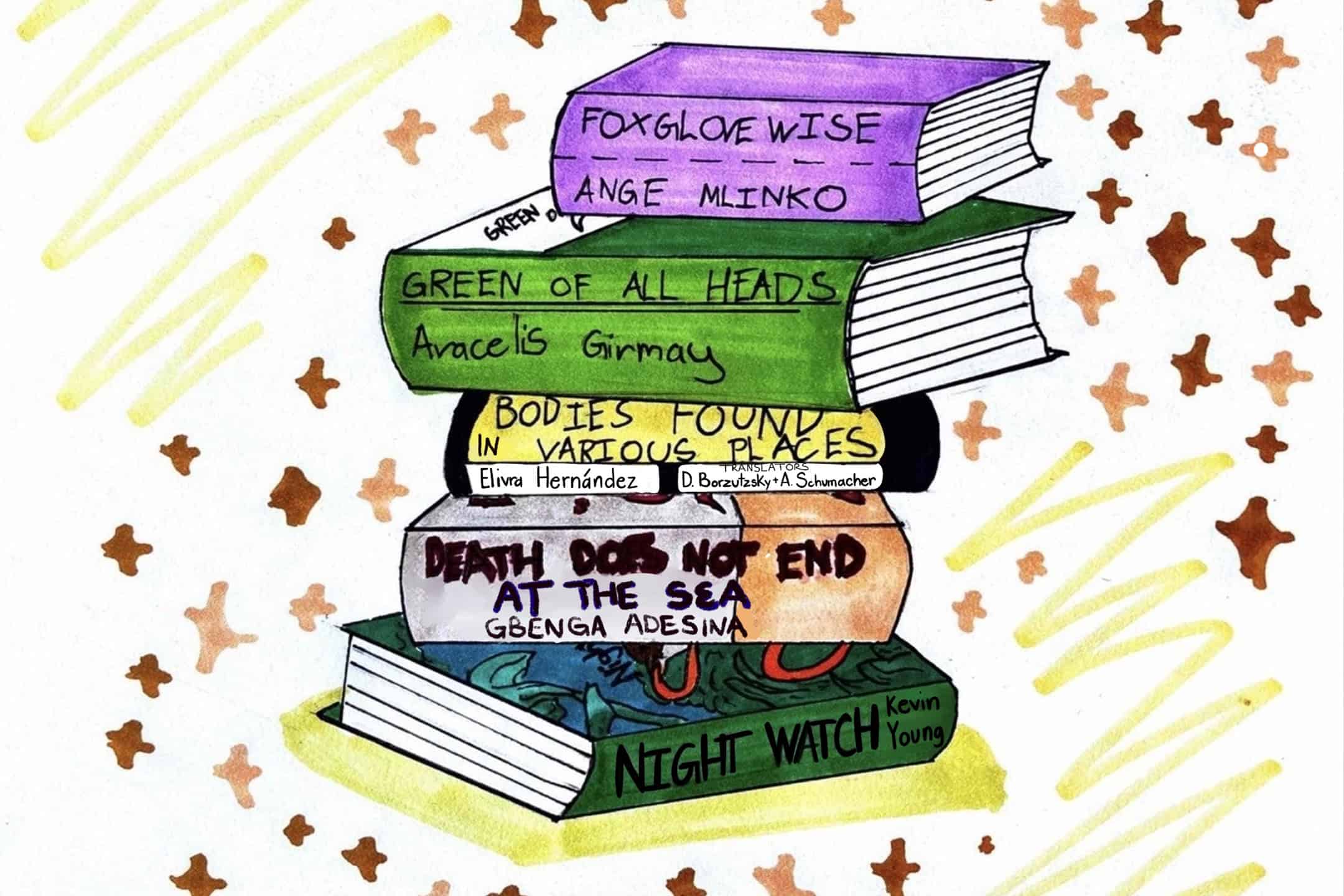
The 2026 Griffin Poetry Prize is almost upon us. The Canadian prize — the world’s largest monetary prize for a single book of poetry — will announce its winner on June 3 at Koerner Hall. Established by businessman and philanthropist Scott Griffin, the prize is now in its 26th year. The winning poet and their book will receive $130,000, and the other four shortlisted authors will each receive $10,000.
This year’s judges, Colombian poet and professor Andrea Cote Botero, Canadian trans poet, professor, and theatre-maker Luke Hathaway, and American poet and professor Major Jackson, read 461 poetry books each to arrive at their shortlist selection. These books included 34 translations into English from other languages, and submissions from 219 publishers from 42 countries.
The shortlist includes Gbenga Adesina’s Death Does Not End at the Sea, Daniel Borzutzky and Alec Schumacher’s translation of Elvira Hernández’s Bodies Found in Various Places, Aracelis Girmay’s Green of All Heads, Ange Mlinko’s Foxglovewise, and Kevin Young’s Night Watch.
Gbenga Adesina’s Death Does Not End at the Sea

Photo of Gbenga Adesina and cover of Death Does Not End at the Sea (Courtesy of Griffin Poetry Prize).
This debut book of poetry by Nigerian poet and essayist Gbenga Adesina is a strong contender that has already won the 2024 Raz/Shumaker Prairie Schooner Book Prize in Poetry, and the 2026 Anisfield-Wolf Book Award. The book is an intense exploration of fatherhood as a generational relationship, the concept of a journey, grief, and the lives claimed by the sea in service of imperialism and neo-imperialism. There is not one bad poem in this book. Every poem is woven into the overarching narrative of the book, and even though the volume is only 114 pages long, I found myself spending hours thinking about the references, phrases, and declarations Adesina makes.
Three long poems titled “In Search of James Baldwin in Paris (I-IV),” “In Search of James Baldwin in Istanbul (I-III),” and “In Search of James Baldwin in Senegal (I-II),” are the masterpieces in a collection of masterpieces. The father-narrator travels with his young son in the footsteps of James Baldwin. The poems explore the fragility of a new father in awe of the life he has helped create while still confronting the loss of his own father.
Adesina’s poems about the migrants who are forced to escape their dire situations by boat to safer countries in Europe humanizes them in a culture that holds no sympathy for their plight. He also contextualizes the connection of the tragedy of these migrants to other atrocities of the colonial past through an artistic internationalism–– an artistic practice that does not seem to appeal to writers’ anymore.
This is my pick for the winner, and an absolute must-read.
Daniel Borzutzky and Alec Schumacher’s translation of Elvira Hernandez’s Bodies Found in Various Places
This translated collection of poems from Chilean poet Elvira Hernández — the pseudonym of María Teresa Adriasola — is nothing short of revolutionary. Spanning from 1981 to the present, the book presents six of Hernández’s poetry collections to an English-reading audience. I often complain about how most modern Canadian poems are not willing to confront the political outside the realm of abstract language. This book is a beautiful example of actual political courage for Canadian poets to follow in the footsteps of.
Hernández, who was briefly imprisoned by the military dictatorship of Augusto Pinochet, had to use a pseudonym between 1973 and 1990 to avoid further political persecution. Her powerful poetry confronts the violence of the Pinochet state and the poverty imposed on regular people by the corrupt nature of neoliberal politics.

Headshots of Daniel Borzutzky, Alec Schumacher, and Elvira Hernández (Courtesy of Sebastian Utreras) and cover of Bodies Found in Various Places (Courtesy of Griffin Poetry Prize).
Each poem in this book is presented to readers in Spanish and in English. I found “The Chilean Flag” to be awkwardly translated, but Borzutzky and Schumacher manage to give us an eloquent English version of the five other poetry collections without sanitizing Hernández’s revolutionary anger and pain for a foreign audience.
I will be thinking about “They say it was like a decapitated head appearing / and never wanting to disappear,” used to describe the appearance of Halley’s Comet in 1986, for a very long time.
Aracelis Girmay’s Green of All Heads
Aracelis Girmay’s fourth full-length poetry collection is another shortlisted title that meditates on the death of a parent. Unlike Adesina’s Odyssean collection, however, Green of All Heads takes the reader through grieving as a ritual and a eulogistic commemoration of the immigrant parent’s personhood and history.
Girmay is most skillful in this collection when she is narrating family histories and their interpersonal connections. The haunting second section of a long poem, “Siblings,” is about the life of her father’s older brother, Abraham, who was so gentle that, as a child, he wouldn’t even join his siblings in playhunting birds with slingshots.
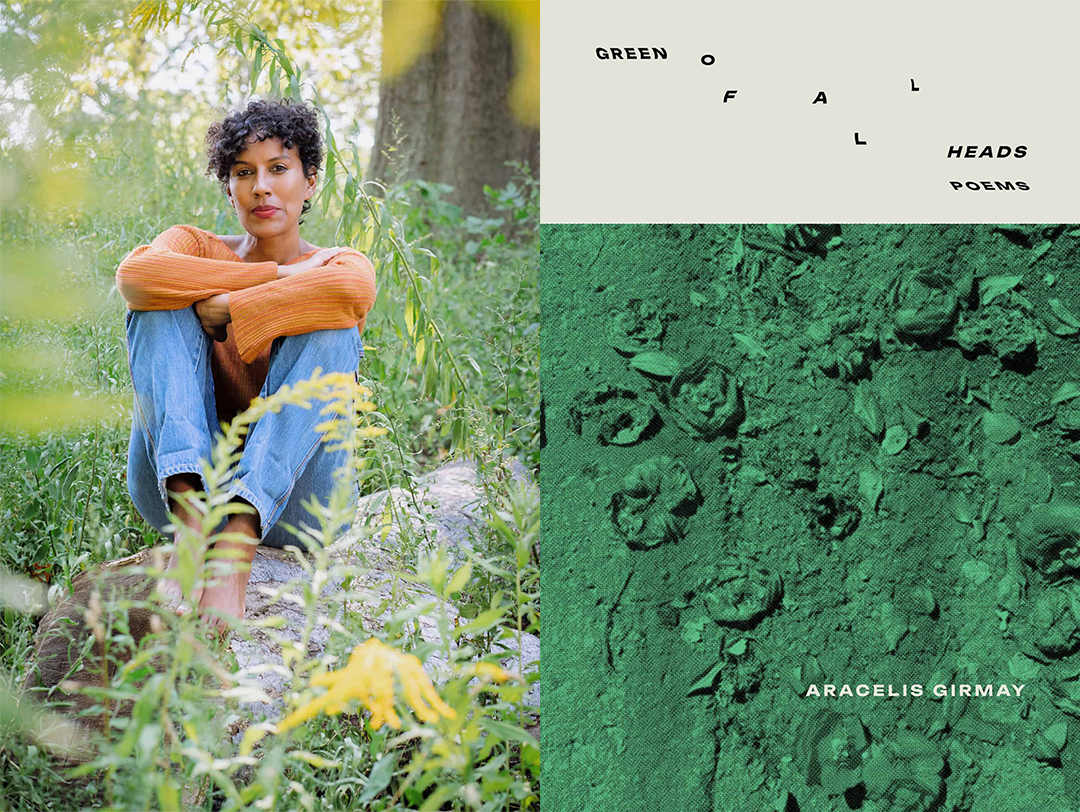
Photo of Aracelis Girmay (Courtesy of Yekaterina Gyadu/Griffin Poetry Prize) and cover of Green of All Heads.
Girmay uses the poem to tell the reader how Abraham watched his friends be gunned down by the Ethiopian military. Abraham then joins the Eritrean War of Independence as a soldier and is eventually killed in the effort. Girmay relays this haunting memory of her father’s through the lines:
“We were in the car, I think,
one of the times my father told the story in that way
as though just realizing it for the first time. How Abraham
would not kill the bird.”
Green of All Heads is a very strong contender for the prize, with the book’s weaving of the personal with the historical in its exploration of grief and mourning.
Ange Mlinko’s Foxglovewise
The professor, critic, and writer’s seventh full-length poetry collection is a lyrical collection mired in nostalgia — both for the personal and the linguistic. The collection begins with the impressionable line, “Maria Callas came to our banal climate, age five,” in “Tarpon Springs, Epiphany,” a poem about the loss of names to time and generations.
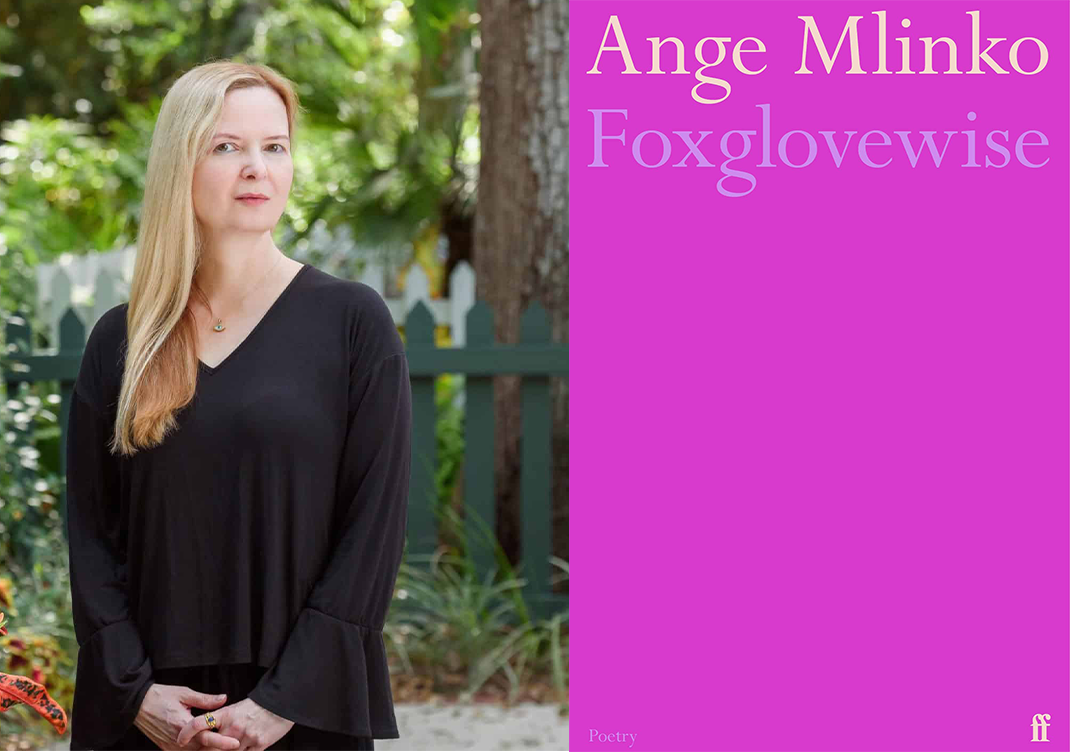
Photo of Ange Mlinko (Courtesy of Jimmy Ho/Griffin Poetry Prize) and cover of Foxglovewise.
“The Iliad in a Scottish Cemetery,” “Madonna of Oranges,” and “The Cemetery of Pseudonyms” are other standouts from the collection.
A perfectly good collection that unfortunately comes up short due to the strong competition present this year.
Kevin Young’s Night Watch
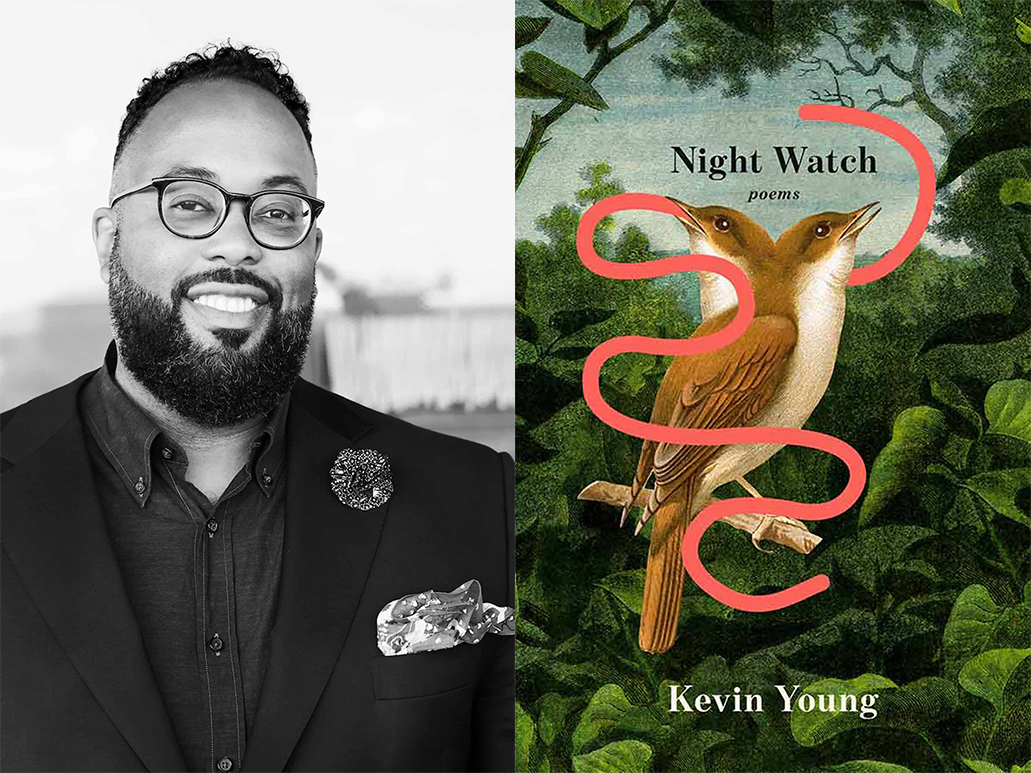
Photo of Kevin Young (Courtesy of Melanie Dunea/Griffin Poetry Prize) and cover of Night Watch.
Award-winning poet and writer Kevin Young’s 16th book is a delight for poetry readers who prefer the abstract but do not discount narrative.
Death and the mourning of the living are the leading themes among this year’s Griffin Prize shortlist. Young’s Night Watch delivers historical mournings in his poems about enslaved conjoined twins, Millie and Christine McKoy, who were made to perform in fairs and “freak shows” due to their biological differences.
An 18-part long poem, “Resurrection City,” is also a mourning of faith, love, and hope. Young writes, “My body came/ to bury me— / All the papers/ were in order” and the reader is filled with sadness.
A wealth of poetry
This year’s shortlist for the Griffin Prize are strong titles that are clear in their purpose, creating art that explores both the vastness of the human condition and its limitations. Every Canadian reader and student of poetry will be deeply enriched by picking up any of these five titles.

No comments to display.