
TAGS
ON CAMPUS
STUDENT LIFE
OFF CAMPUS
EDUCATION

GOVERNMENT
MONEY
COOL
VARSITY BLUES
UTSU
ADMINISTRATION
BIOLOGY
ART
MUSIC
FOOD & DRINK
ELECTIONS
IN THE LAB
FACULTY
TECHNOLOGY
HEALTH
FILM
PROFILE
NUMBERS
INTERVIEW
LITERATURE
PSYCH
BRIEFS
THEATRE
LOVE & SEX
DESIGN
ENVIRONMENT
GENDER
LONG FORM
POP CULTURE
THE VARSITY
PRO SPORTS
SIMCOE HALL
SPACE
LAW
MISSISSAUGA
TORONTO
UTSU DEFEDERATION
HUMAN RIGHTS
FROSH
SCARBOROUGH
PHOTOGRAPHY
INFOGRAPHICS
FAITH
BEST OF 2012
GUIDES
LGBTQ
FASHION
RACE
ALUMNI
EUREKA
DRUGS
EDITORIAL
SGRT
DANCE
RELIGION
JOURNALISM
INTRAMURALS
JOB MARKET
COMMUTE
INVESTIGATIVE
PODCAST
University of Toronto's Student Newspaper Since 1880

Hundreds gather for provincial assembly

CFS-organized conference seeks to strengthen bonds between student activists

By Rida Ali
Published: 2:58 am, 15 October 2012
Vol CXXXIII, No. 06 under
PHOTO COURTESY SEAN CARSON

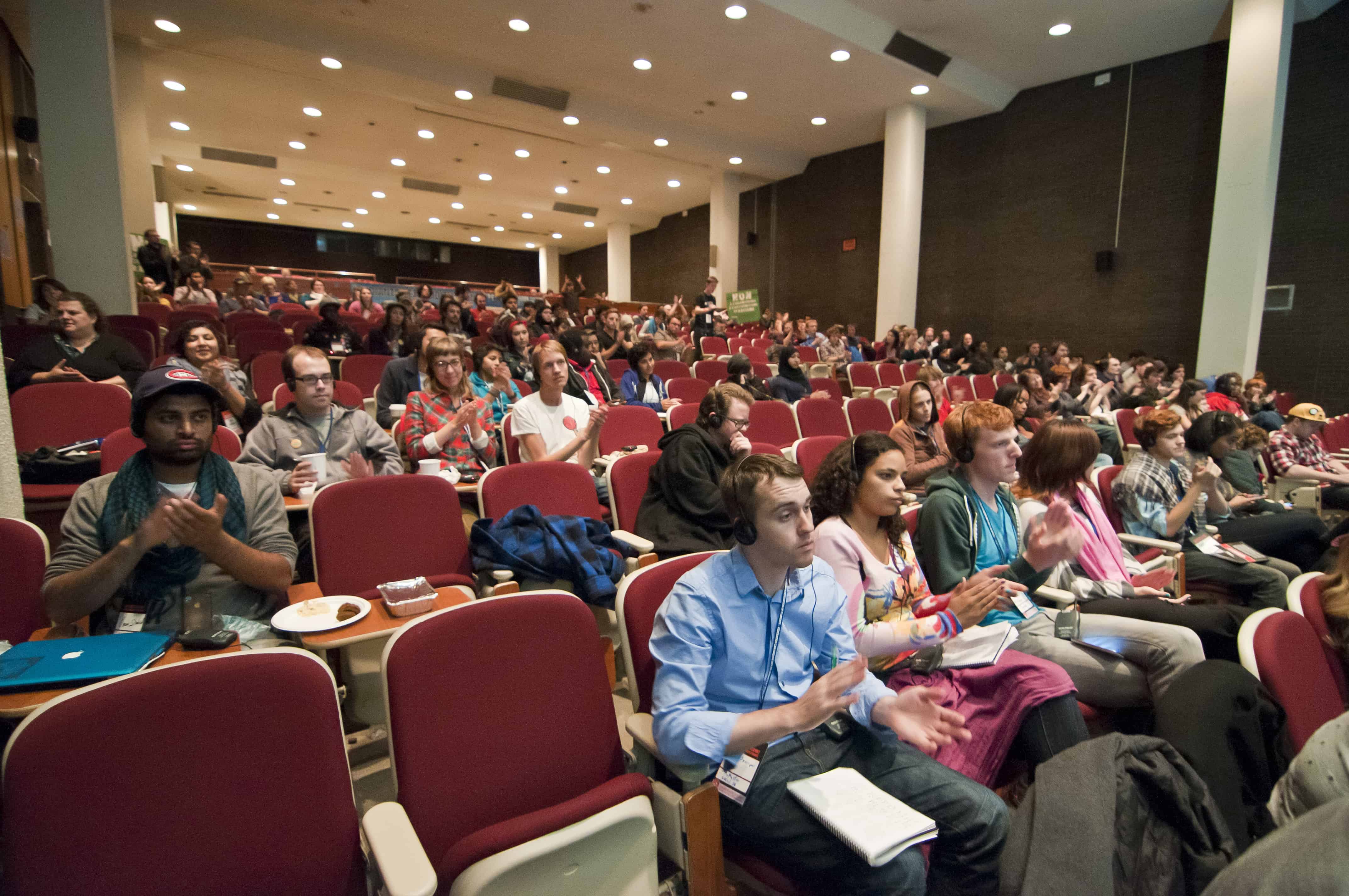
This weekend, OISE played host to a student activist assembly convened by the Canadian Federation of Students Ontario (CFS-O). Over 450 students from universities and colleges across the province registered for the event, which sought to foster conversation about topics ranging from the state of education to poverty and environmental issues.

“The activist assembly brings together students from across the province to participate in both information- and skills-based workshops,” said Sarah Jane King, chairperson of the CFS-O.

The assembly was attended by students from Toronto-area schools including York, Ryerson, and U of T, as well as Guelph, Lakehead, Laurentian, Carleton, and the University of Ottawa. College students were also in attendance from across the province.

Attendants participated in workshops ranging from “Education Inc.: The Rise of Corporate Interest on Campus” to “Building a Radical Disability Movement” to “Who’s Turning the Screws? Understanding Who’s Who in Post-Secondary Education.”

Campus media outlets were not permitted to attend the sessions. “We ask media not to be recording the sessions or taking notes, simply because we wanted to create space where everyone felt comfortable participating fully, where people can say whatever they wanted without fear of seeing something in the newspaper that they didn’t want recorded,” explained King.

Corey Scott, vice-president, internal and services at University of Toronto Students‘ Union, explained, “One of the strengths of having conversations with people from the different universities and colleges is that you get to hear about some of the things that have happened on their campus and you see it translated back onto your own campus.

“By having these conversations, we find out about these things in advance and we prepare ourselves as best as possible.”

Scott pointed to flat fees, a system already in place at U of T (in spite of intensive lobbying efforts by student government), now under consideration at other universities such as Carleton.

Scott also discussed the value of learning from the recent experience at Lakehead University, where, as Scott explains, the governing council “disallowed students from voting on tuition fee increases, because they said that it was a conflict of interest. We heard about how they challenged that, how they filed an injunction, how they were able to overrule that decision, so that students could eventually vote.”

Scott also explained that the assembly was a chance not only to prepare against moves from university administrators, but also from other student groups.

“There are anti-choice groups that are travelling around the country, and are talking about limiting women’s rights to choose,” said Scott. “We get to hear about what is happening on different campuses who have those organizations popping up and doing a lot of really sexist work on campus, and we’re able to think about how to ensure that we are creating safe spaces.”

King explained that the assembly was very timely. “We’re at an important time right now, because the government is trying to make a lot of really significant changes to our education system,” she said. “It’s extremely important to bring people together to talk about these issues and to make a plan for how we move forward and to really find out how we should be addressing the problems we face as students right now.”

Overall, the students in attendance had positive things to say about their experience.

“It’s been pretty cool to learn about what’s going on at Carleton, what’s going on at UTM, what’s going on at Scarborough and other universities across Ontario,” said Yolen Bollo-Kamara, vice-president, campus life for the UTSU.

The assembly also had a panel of student activists from around the world in attendance; on Saturday Ana Garcia from Spain, Panagiotis Louvros from Greece, Rodrigo Echecopar from Chile and Marianne Brenton Fontaine from Quebec gave keynote speeches in which they shared their stories and their countries’ experiences with student activism. The panelists also spoke about the differences and similarities between their struggles and the struggles that Ontario students are facing.

“All of the things we talk about here are interconnected,” reflected David Eaton, an international development major from the University of Ottawa. “One person’s struggle or movement can be directly related to someone else’s. You may not think that they’re related but in fact the struggles that we face are not that different.”

  • Hardy Weinberg

    Sure looks like 450 people showed up

    • Hulk Brogan

      people left in between sessions but there legit were 400-500 people.

      • Hardy Weinberg

        Oh ok, thanks for the info. What happened? Was there an emergency election at York federation of Students?

  • Anon

    ““There are anti-choice groups that are travelling around the country,
    and are talking about limiting women’s rights to choose,” said Scott.
    “We get to hear about what is happening on different campuses who have
    those organizations popping up and doing a lot of really sexist work on
    campus, and we’re able to think about how to ensure that we are creating
    safe spaces.””

    Being pro-choice is sexist and creating unsafe spaces? How so?

    • Hardy Weinberg

      This above comment is confusing. Scott said anti choice, anon says pro-choice. WTF?

      • anon

        I meant anti-choice. good eye.

        • http://www.facebook.com/rida.fatema.ali Rida Ali

          Of course being anti-choice is sexist. You’re advocating to limit a woman’s right to choose what she wants to do with/to her body.

          • anon

            They would say you’re limiting a fetuses right to choose. The answer is not silencing. The answer is open discourse and argumentation. Anything is is evil on your part.

            To paraphrase Nietzsche, we must be careful when fighting monsters lest we ourselves become monsters.

          • anon

            Also, “of course” is not an argument,

          • Hardy Weinberg

            I believe “You’re advocating to limit a woman’s right to choose what she wants to do with/to her body.” is an argument

          • Anon

            No, that’s an assertion without argumentative support.

            Also, advocating for something is okay according to our Charter. Indeed, it’s our duty to defend people who do so.

            This is about free speech. Just because you disagree with someone does not mean you have the right to silence them. As John Stuart Mill writes:

            “We can never be sure that the opinion
            we are endeavoring to stifle is a false opinion; and if we were sure,
            stifling it would be an evil still.”

          • http://www.facebook.com/rida.fatema.ali Rida Ali

            Firstly, you said anti-choice not pro-life.

            Second, the fetuses argument depends on when you believe that a fetus becomes, either scientifically, a person, or philosophically, a moral patient. If you believe that its at birth then the argument doesn’t work. Until this issue can be resolved, the “rights of the fetus” argument doesn’t suffice. A fetus has no rights, a person does.

            Third, I’m not saying you can’t advocate whatever you want, I’m saying that advocating “anti-choice” is sexist and creates unsafe spaces. Just as insulting judaism is anti-semitic.

            And I’m glad you brought up Mill. He also said “the sole end for which mankind are warranted, individually or collectively, in interfering with the liberty of action of any of their number, is self-protection. That the only purpose for which power can be rightfully exercised over any member of a civilized community, against his will, is to prevent harm to others. His own good, either physical or moral, is not sufficient warrant.”

            So, since the woman is committing no harm to others, whatever her choice, no one has the right to interfere in her affairs.

          • Anon

            I agree. I am pro-choice.

            Insulting Judaism is anti-semitic, but legal. Insulting women is impolite, but legal. It’s not creating ‘unsafe spaces’. That’s non-sense. No more than expressing any other biomedical view creates unsafe spaces. You’re just trying to cover up the fact that you think people who disagree with should not be allowed to speak.

            Mill was pro-choice and pro-freedom of expression. As am I. You., clearly are not.

            Being pro-life is a morally repulsive position to take in my view, but legal and is legal because of our Charter (quoted earlier).

          • Hardy Weinberg

            I think the issue is not about charter but about utsu positions and policy. So by that definition the pro lifers can protest and do what they want, but should they get union funding?

          • http://www.facebook.com/rida.fatema.ali Rida Ali

            Forget about which is the “right” view. People have differing opinions on that. Free speech has its limits. Its limited by Mill’s harm principle that I quoted earlier. If it is harming someone then you’re not allowed to say it. And whether you agree that it creates unsafe spaces or not is not the issue. If people feel unsafe because of it then it creates unsafe spaces.

            Free speech is also limited by the offence principle but being that it is more complex than the harm principle, I can’t explain it to you over a comment. Look it up.

          • Michael

            Harm and offence are to a certain extent socially constructed. They are subjectively determined within society in the context of free expression from relatively well-defined instances such as fraud, libel and slander to relatively less well-defined such as hate speech. We need some more or less impartial measure of the limitations of free speech. I fear saying that speech should be limited because someone feels subjectively unsafe or offended is unsatisfactory. If this were the case I fear we would move back towards the era of vigorously enforced obscenity laws and free speech would be “chilled” as a direct result.

            As a further note, using argumentation which I reject wholeheartedly, these limits could theoretically be reversed to condone an anti-choice position. If society determined that there was some harm to itself they could prohibit (most) abortions (in much the same way as suicide is prohibited). In fact, the Canadian Charter would permit a much more restrictive abortion law and only political opposition prevents the enactment of such a law.

          • Hardy Weinberg

            I am not trying to stop you for advocating something. I am just saying the student government has the right to not support you too.
            How would you feel about having a plebicite? Should the UTSU support prolife groups?

          • Anon

            They have to support student clubs or not on an equal basis. Not based on whether they agree with them or not, but based on whether there are enough student who wish to participate, etc. To make that decision otherwise is simply wrong.

          • Anon

            Also, that’s simply false. I am not advocating to stop women from having a right to do with their bodies. I think that’s a mistaken thing to do. Nevertheless, I would protect to the death the right of others to make that mistake.

        • Hardy Weinberg

          Limiting anyones choices creates un-safe environments

          • Anon

            Advocating for it does not. Limiting it does not. You have to actually argue points like these, otherwise, I can just deny them.

          • Hardy Weinberg

            i think you’re right. UTSU should recognize Pro-life clubs and fire Shaun Shepphard, cause in the words of fake brett chang “He’s black”

          • Anon

            Arguing for any position, whether Nazism or pro-life, does not create an unsafe environment. There is simply no connection between those two things.

  • Left Winger

    Louvros kai myala sto blender!!

  • Anon

    “Everyone has the following fundamental freedoms:
    (a) freedom of conscience and religion;
    (b) freedom of thought, belief, opinion and expression, including freedom
    of the press and other media of communication;
    (c) freedom of peaceful assembly; and
    (d) freedom of association.”

    You were saying about not allowing pro-life groups gain club status?

    • Hardy Weinberg

      Charter of rights of freedoms determines indinvidual rights to assemble. Gaining clubs status requires additional requirements. either way Are you a supporter of Israel Apartheid week?

      • Anon

        No. Student governments support liberal and conservative clubs. The reason they do not support pro-life clubs is because they do not agree with them. This is not an acceptable reason. It violates those people’s right to think what they want and be offered – equally – a chance to form groups to advocate for their causes.

        • Hardy Weinberg

          So you support pro-life clubs being recognized by student government but not Israel Apartheid Week. How fair of you.

          • Anon

            I support IAW. Sorry, I just don’t see the relation.

          • Hardy Weinberg

            So you also support pro-death clubs. If there is a club that opposes all abortions there should be a club that says everyone should have an abortion. And both should be recognized by UTSU

          • Anon

            Why? Sure. Both should be recognized. One thing is that pro-life is a reasonable position to take. PhD’s in biomedical ethics take it (people who are atheists).

            They’re not Nazis or anything. They take positions on live issues in biomedical ethics and should have every right to do so.

          • Hardy Weinberg

            So? there are PHD students who think we should all be in Children of Men.
            Ok, so lets break it down, there is a UofT for life “pro-life” club on campus, the have protests once a year in front of Robarts where they get in to arguments with students.
            Are they recognized by ULife? Unknown Are they recognized by UTSU? Unknown Engsoc? Unknown College club? Unknown GSU? Unknown Apus? unknown ASSU? Unknown (probably not as it is not a dept. club)
            Do they meet the requirements for any of those mentioned above? Unknown…

          • Hardy Weinberg

            Also to further my above comment there are 100s of clubs on our campus that is not recognized by UTSU (clubs recognized by other entities). So existance or running events on campus is not determined by UTSU recognition.

          • Hardy Weinberg

            Also President Naylor has stated his disgust for IAW and said it is the worst time of the year as university president when IAW is going on.

  • Noam Chomsky

    “Goebbels was in favor of free speech for views he liked. So was Stalin.
    If you’re really in favor of free speech, then you’re in favor of
    freedom of speech for precisely for views you despise. Otherwise, you’re
    not in favor of free speech.”

    • Hardy Weinberg

      Explain that to Anon and the rest of the knuckledraggers who come grill UTSU every year on Israel Apartheid week (Remember UTSU also doesnt participate in this)

      • Anon

        That was Anon (lol). I do support Israeli Apartheid Week. I’m a grad student. I wasn’t aware of the UTSU’s stance on that. Shameful.

        • Hardy Weinberg

          dude, use one account. Here I thought Noam Chomsky was a big fan of The Varsity

      • Michael

        I think one can make a fairly reasonable argument that a student union tasked with representing all students has no business becoming involved in issues like Israeli Apartheid Week (or the Tamil protests) as the UTSU has done in the past. Although at present, it is my understanding that the UTSU does not directly support Israeli Apartheid Week, a number of other student levy organizations do (APUS, GSU Social Justice Commission, OPIRG, Centre for Women and Trans People). I think that organizations which are paid for by all students and do not have it in their mandate to take on such positions should not. Even those that have a mandate, should have a mechanism to obtain the affirmation of the position by at least a majority of the levy-paying students before they take on such a contentious position.

        • Hardy Weinberg

          So you’re also opposed to the student unions stance in the 80s opposing South African Apartheid.

  • Anon

    They can’t punish, denounce, discipline a group who, in a very civil way
    … try to persuade people not to have abortions. It isn’t as though
    the entire Western world has settled all these bioethical questions
    about the beginning of life and end of life — they’re live issues.

  • big black boner

    solid turnout… NOT

  • Anonymous

    Hundreds of students gathered for this… and yet you didn’t get a single student to comment?

    This is U of T…. you guys practically coordinated Occupy Bay Street…. I want to hear from a student activist, not chairpersons and VPs.