
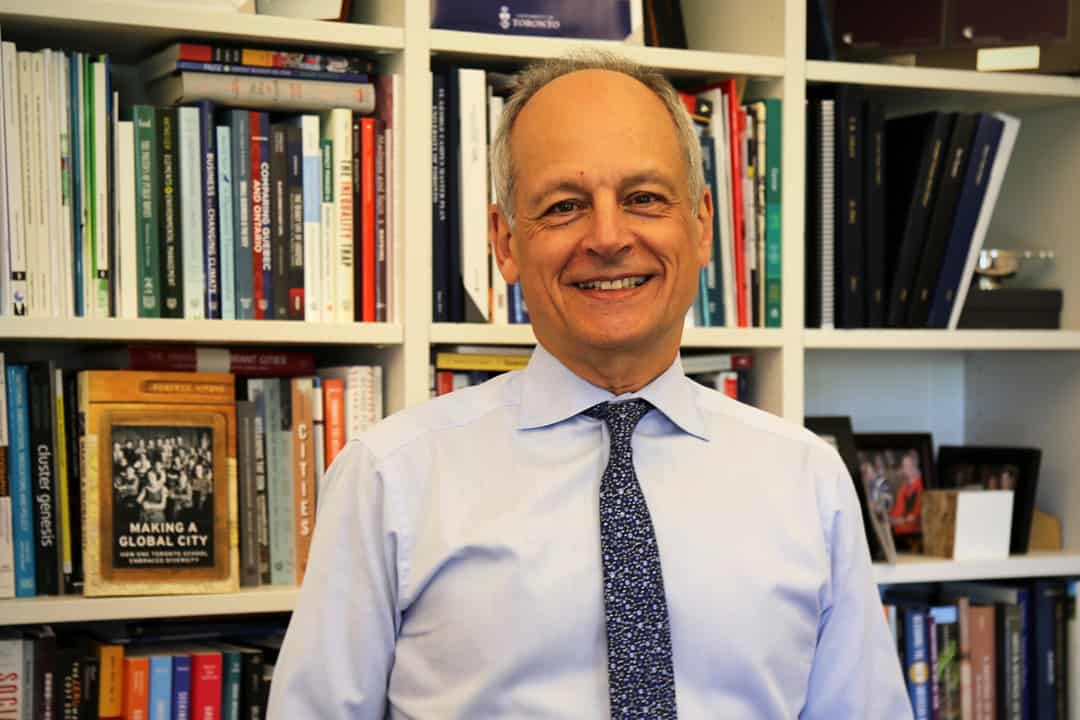
Meric Gertler’s office is clean and stylish, perhaps hinting at his roots as a city planner and urban academic. The sweeping view of Front Campus, however — which almost feels omniscient out of the large, clear, sturdy windows in Simcoe Hall — cannot belie that this is a seat of power. U of T’s President since 2013, Gertler is the steward of the university’s progress, as well as its public image. “Get the branding in,” he joked to our photographer about his logo-emblazoned coffee mug. “They won’t let me drink from anything else around here.”
Gertler granted The Varsity an interview in early July. The President and I touched on a range of topics, from the university’s offshore investments to the slow but ongoing practice of reconciliation on campus. This interview is an excerpt from our discussion about mental health and the controversial university-mandated leave of absence policy.
The Varsity: In the last year, there was an uproar from students about the university-mandated leave of absence policy. I think that it’s fair to say that this uproar revealed a desire among students for mental health reform. This was punctuated by a public suicide on our campus in June. Do you think that U of T has a mental health crisis?
Meric Gertler: I think that all of higher education is dealing with a much, much bigger challenge around mental health than it has ever had to face before, and we’re not immune from that. If you simply look at the kind of demand that we have for mental health services across all three of our campuses, it has continued to grow at a very high rate. We have continued to invest over quite a number of years in expanding the capacity of our mental health services, both centrally and within divisions. There has been a multi-year effort to expand our capacity, and that’s certainly been an important part of the university’s response. So too, of course, has been the recently approved policy on the university-mandated leave, which was one of the flashpoints for the discussion around these issues recently.
TV: Do you think that these issues are unique to U of T?
MG: I don’t think they are unique to U of T at all. No, if you ask any university president across the continent, they will tell you that they are facing similar development where it seems that the stresses that our students are under and the conditions that they experience have led to growing challenges in the area of mental health and growing demands on our institutions to provide support. One thing I will say is that, at least in this jurisdiction, it has been hard for us to get the provincial government to recognize that universities are primary sites of care for mental health. We haven’t been funded in a way that is, I think, commensurate with the demand that we’re experiencing, and that has been a challenge for us.
TV: Do you think it was problematic that the university-mandated leave policy was approved despite widespread dissent from students?
MG: We had to do something — the Ombudsperson made it very clear and she spoke again at Governing Council to reaffirm her support for a policy like this one. We already have the power to place students on leave, but it was through a punitive mechanism, which I think everyone agreed was far from appropriate, particularly for instances where students were facing serious challenges related to their mental health. How do we make sure that when our students are facing these really significant difficulties, we allow them to sort of hit the pause button in ways that will not hurt them in the future? That will not become a blight or a mark against them in terms of their academic record, and also — more importantly — in ways that provide them with support and a pathway back to return to study? I think the policy that was approved by Governing Council in June meets all of those needs.
TV: Except students aren’t the ones pressing the pause button — it’s the university doing it for them.
MG: Let’s be careful here. Students can press the pause button. The mandatory leave is the last step in a multi-step process, and it’s a last resort. The policy does include voluntary leave options, but it also has many checkpoints along the way where there’s plenty of opportunity for corrective intervention to take place that is based on mutual consent and cooperation between students and caregivers. However, if all of that fails and nothing else works, it really is important to have the ability in a very, very, very small number of cases — we’re probably talking about three to five cases a year out of 90,000 students — to be able to take a step, which we believe to be in the student’s best interest, in order to change their status, give them time to seek help, and to recover.
Is it a perfect policy? Probably not. There’s really no such thing as a perfect policy. Is it subject to future improvement? Absolutely. I think, ultimately, the passion that was expressed around this policy underscored how significant and challenging these issues are. It underscored what I said earlier, that there is tremendous demand for some kind of new approaches and new support. It also raised some questions about the extent to which students trust the university to make the right call in the moment, and I recognize that that’s a bit of a leap of faith. So really what I’m saying to students is: let’s try this out. We are committed to reporting annually on its application. We are committed to reviewing the policy again in three years’ time. Let’s see how it works.
This interview has been edited for length and clarity.
