
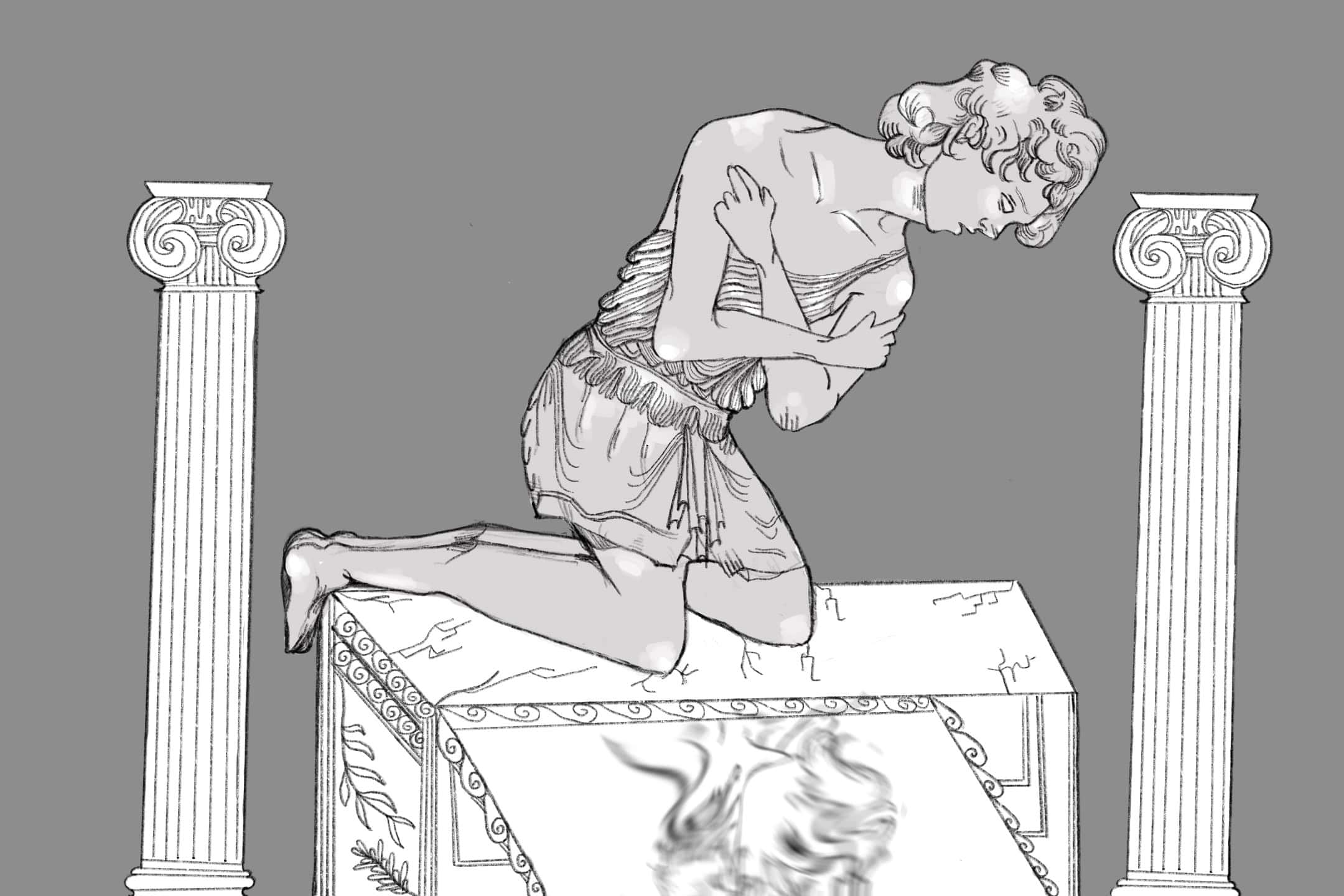
The twink. You’ve likely seen him around campus. While I wouldn’t necessarily identify with that label, it’s been notably used on me in the classroom. Who exactly is the ‘twink?’ What does he want from me? From you?
The twink as myth and mirror
In 2018, online discourse about the twink proliferated after the New York Times published an article by Nick Haramis, the Ontario-born former editor-in-chief of Interview Magazine. “Five inches shorter, naturally smooth, with a pronounced clavicle and a concave torso,” Haramis wrote, “twinks are young, attractive, hairless, slim men.”
Many queer writers responded to this, critiquing Haramis for his ahistorical viewpoint, lack of discussion of race, and unquestioning inclusion of straight celebrities as models of the twink. While I am not particularly interested in naming off so-called celebrity twinks, I am sure you can picture a few who stand in proximity to Haramis’ constructed idea.
Brian O’Flynn — a freelance writer at The Guardian — responded to Haramis, arguing that the twink is an afterlife of pederasty, an imaginary that allows for the continued reproduction of an adolescent, youthful innocence, always waiting to be deflowered.
Kadji Amin — an associate professor of women’s, gender, and sexuality studies at Emory University — defines pederasty as “any male same-sex relation… built around an eroticized differential of age or generation,” tracing its origins to ancient Greece. In his 2017 book, Disturbing Attachments, Amin explores pederasty’s willed detachment from age-differentiated gay relations, which create figures like “the daddy” and the twink for the political purpose of shaping a coherent “modern homosexuality.”
A friend of mine who plays in a gay volleyball league frequently recounts being called a twink by his older teammates. Is it a mix of desire and bitterness, fuelled by their own anxieties about a ‘lost’ adolescence in a gay culture that valorizes youth above all else? Perhaps this saturated feeling of both envy and erotic longing is what gives meaning to the modified term “demon twink.” His beauty adorns him, but also taints him.
Such assumptions may lie in psychoanalytic narratives of homosexuality as inherently narcissistic — a search for the self in the other. Following one of Sigmund Freud’s delightful 1905 footnotes, the twink is seen to take “themselves as their sexual object… they proceed from a narcissistic basis and look for a young man who resembles themselves and whom they may love as their mother loved them.” Here, Freud theorizes on the origins of homosexuality — from self-affirming object choice and men’s effeminacy — as arising due to an overbearing mother and absent father. Take that as you please.
As to whether alleged twinks are just looking to love each other, Jack Slater’s erotica novels may have an answer. In a 2023 article examining the work of queer thinker Leo Bersani, Slater explains that as the homo-narcissist subject searches for the self in others, he “necessitates an identification of some parts of the world as too dangerous for the maintenance of the self.” This process perpetuates the othering that pervades contemporary cultural discourse, as seen in phenomena like racial bias on dating apps and the proliferation of clone-like queer men aesthetics.
The twink as racialized ideal
As standard and norm, the ideal of the twink is always already racialized, even as he swishes his little bum down Church street or Ossington avenue.
Mikelle Street — former digital editorial director of PrideMedia — critiques Haramis’ failure to address the racialization of the twink, explaining that it is a “type of nuanced identity that Black men have historically been denied.” Street also points out that tropes of Black men as hypermasculine have hindered them from inhabiting the twink as an “alternative [effeminate] form of masculinity.”
Applying British-Australian writer and scholar Sara Ahmed’s seminal 2007 article, “The phenomenology of whiteness,” the figure of the twink, imbued with whiteness, can be seen as the “unmarked… centre against which others appear only as deviant, or points of deviation.” Queer men are conditioned to seek and valorize the twink, to find him in glances on the subway or reflections of a torso in a Grindr tile — above all, to place greater value on his body than others.
The figure of the twink, and his unmarked place as a central ideal of queer men culture, must be understood historically. My so-called Hinge ‘standouts’ are insistently those who most closely approximate him.
The twink is relentlessly at work, attempting to hierarchize queer men’s bodies through racialized, gendered, physical, and classed demands. He beckons you to become him. If I may rephrase the words of eminent queer American writer Edmund White: “[his] beauty [stands] between us like an enemy.”

No comments to display.