
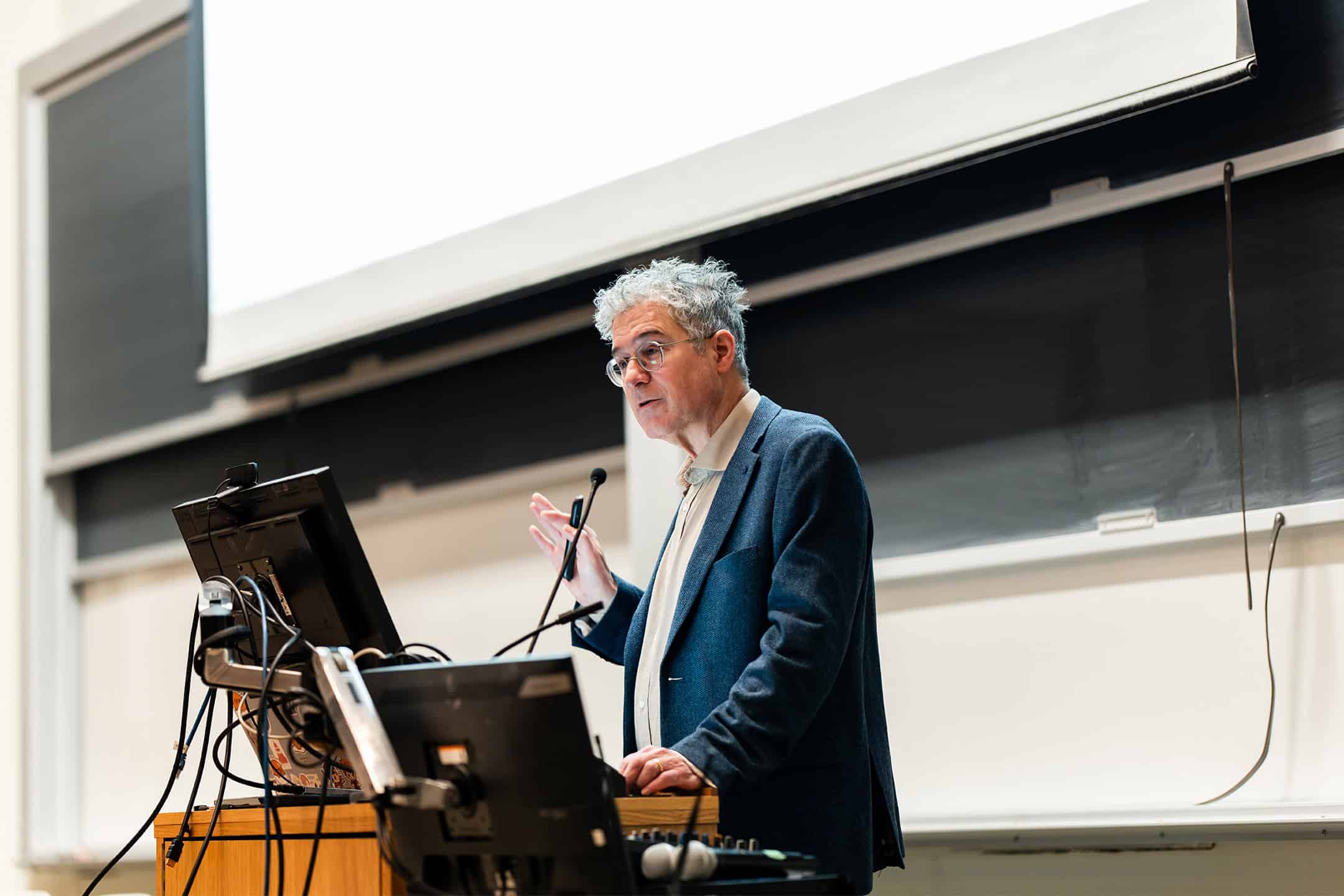
On February 1, the U of T Undergraduate Research Student’s Association held its first conference, Synergy. The day featured talks on current cancer research, presented by both professionals in the field and undergraduate researchers.
The first keynote was given by Dr. Lincoln Stein, acting scientific director and head of adaptive oncology at the Ontario Institute for Cancer Research. During his talk, he shared three anecdotes, all of which centred around how artificial intelligence (AI) is improving the study and diagnosis of cancer.
Cancers of unknown primary: solving the origin story
The first story discussed cancers of unknown primary origin, which are tumours that spread from another part of the body whose original locations are unknown. Without this information, doctors cannot effectively treat the cancer.
To address this issue, Stein and his team developed Deep Tumour, a system that could predict the original type of cancer with inputted data. They fed cancerous DNA data into neural networks, which were able to generate predictions based on prior connections in the inputted data.
Neural networks are a form of AI inspired by the brain’s structure, used to process complex information and problems like how we would. The accuracy of Stein’s network ranged from 100 per cent in identifying kidney cancer to 60 per cent in diagnosing stomach cancer.
Synthesizing cancerous DNA with neural networks
Stein continued to explain how AI is being used to create synthetic cancerous DNA, which contains mutations, or variations from what the ‘healthy’ DNA pattern should be. These synthetic DNA sequences allow researchers to avoid relying on actual human genomes to learn more about various cancers. Human genomes contain confidential health information, which must be collected solely for the purpose of benchmarking — that is, comparing analysis techniques.
Two different programs were required for this: one model that generates fake genomes, and another that evaluates them. The goal was to fool the evaluating model as many times as possible. By testing their results on Deep Tumour, they were able to conclude that the simulated genomes were accurate.
Reactome, the ‘smarter’ chatbot
The final story was about Stein’s chatbot, Reactome — another language model that aims to replicate conversation that functions like ChatGPT.
However, Reactome relies on accurate scientific sources rather than vague or sometimes unreliable sites. This chatbot is capable of stating when it doesn’t know the answer, ensuring that it provides accurate data. This stands in stark contrast to some traditional chatbots, like Google’s “AI overview” tool, which once recommended that people eat rocks for their “mineral content.”
This is just the beginning of AI applications in the biomedical field. Stein is working on new projects, including one focused on detecting tumours before they even form. In his closing remarks, he encouraged the audience to experiment and have fun, emphasizing that advanced computer science knowledge wasn’t necessary to create any of these projects.

No comments to display.