
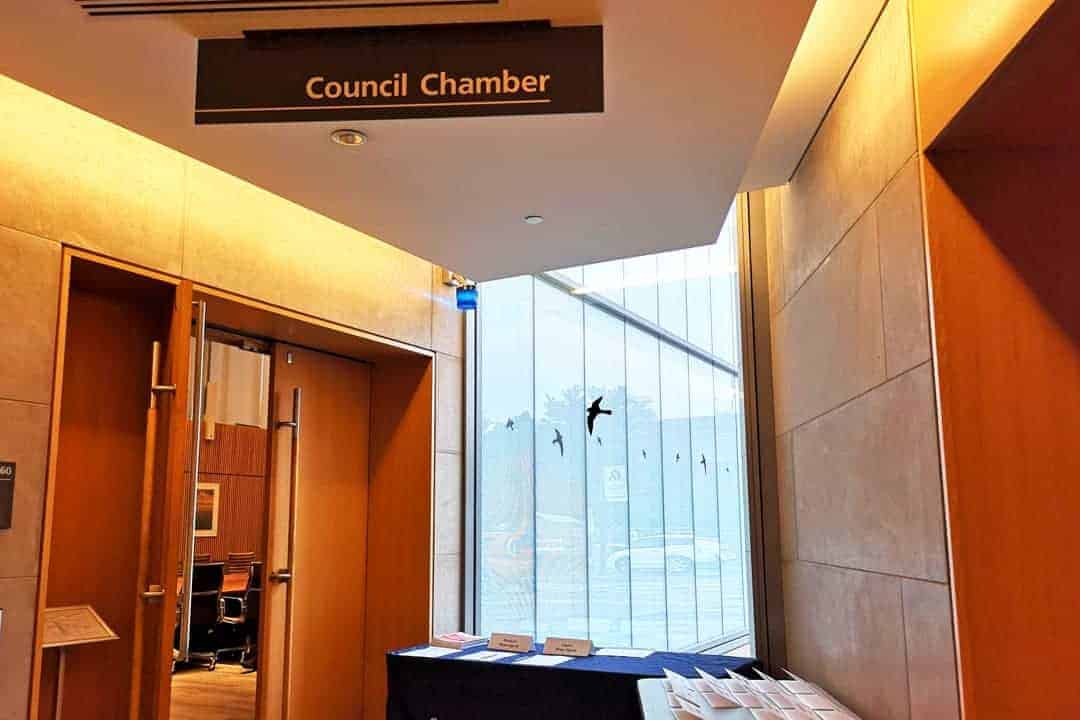
On May 22, U of T’s Governing Council (GC) met to discuss the opening of Indigenous House at UTSC in September and approved the establishment of an Institute of Forensic Sciences (IFS) at UTM. The council further voted to create a Department of Italian, Spanish, Portuguese, and Latin American Studies, combining the Department of Italian Studies and the Department of Spanish and Portuguese.
Institute of Forensic Sciences at UTM
At the meeting, the GC approved the establishment of a new IFS, in effect on July 1. The IFS is a category B extra-departmental unit, or EDU:B. An EDU:B is a multidisciplinary unit designed to promote scholarship in specialized fields.
Since its inception in 1995, UTM’s Forensic Science program has been housed in the Department of Anthropology. However, this structure has made it difficult for students and faculty to navigate program planning and research, as the program has grown to include Forensic Anthropology, Biology, Chemistry, and Psychology Specialists.
The proposal to create the IFS follows the 2018 review of the Forensic Science program. It “recommended the establishment of a separate administrative home for the program to support a strong vision and long-term stability for Forensic Science at UTM,” as stated in a report provided to the council.
This recommendation has received extensive support from faculty and staff in the Forensic Science program and Department of Anthropology, as well as those in the associated Departments of Biology, Chemical & Physical Sciences, and Psychology.
Departmental restructuring
The GC carried the motion to form a Department of Italian, Spanish, Portuguese, and Latin American Studies, consolidating the Department of Italian Studies and the Department of Spanish and Portuguese. This change is effective July 1 and extends to the associated graduate units, now combined as the new Department of Italian and Spanish Studies.
A council report notes that the new department addresses the overlap between Italian, Spanish, and Portuguese Studies, giving students more program flexibility and new course options.
The report also states that the consolidation of the departments will attract graduate students “who would benefit from enriched and diversified courses and research opportunities, as well as a more dynamic academic environment with greater cross-disciplinary collaboration.”
Indigenous House at UTSC
After seven years, Indigenous House is finally set to open at UTSC in September.
While presenting an overview of the project at the GC meeting, Andrew Arifuzzaman, Chief Administrative and Strategy Officer at UTSC, said, “Our objective… was to symbolize the University of Toronto, Scarborough’s recognition of its responsibility to strengthen and rehabilitate its relationship with the Indigenous peoples.”
The complex design of the 12,000 square foot, $21 million project incorporates “numerology [and] symbols of significance [to the] Indigenous community,” Arifuzzaman reflected.
Mike DeGagné, Special Advisor to the Vice-President and Principal (UTSC) on Indigenous Initiatives, emphasized that Indigenous House needs “a sense of place… that is resonant of the Indigenous heritage and outreach that we’d like to do here.”
Turning to educational programming, DeGagné stressed the opportunity to “do some teaching in this space and learning through some of the elements that have long been used as forms of Indigenous expression.”

No comments to display.