
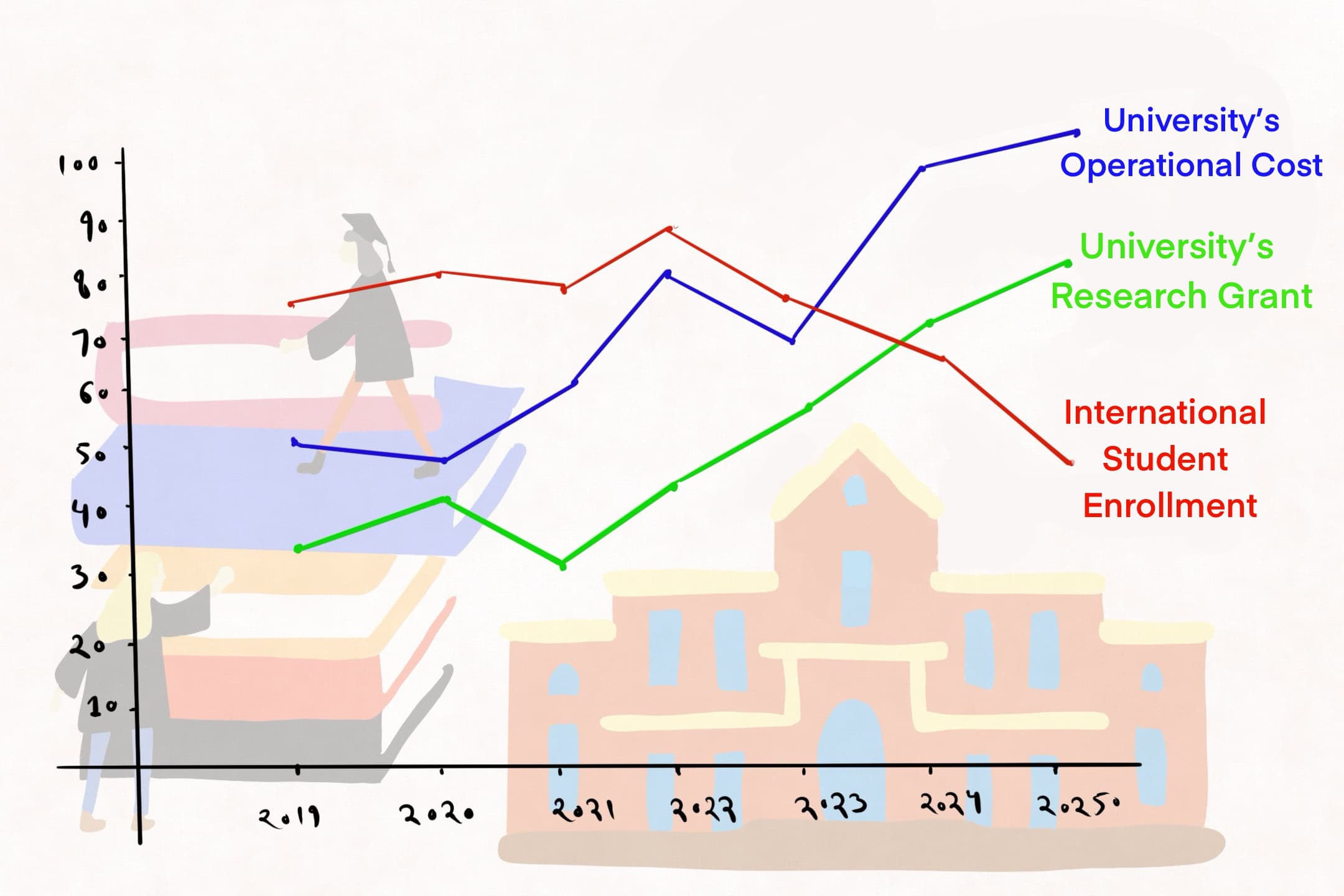
U of T’s revenue is predicted to be $50 million less than projections due to underperforming international student enrolment. While it was revealed at the Business Board meeting on June 17 that other sources of income are exceeding expectations, international student tuition significantly helps fund university activities.
The university is still in good financial health, however, with revenue growing by 5.1 per cent, partially due to strong investments. Yet, Scott Mabury, vice-president of operations and real-estate partnerships, believes that U of T cannot rely on this and must focus on improving efficiency for financial stability.
Decreased international student enrolment
Mabury revealed that international enrolment fell $73 million short of projections.
At the meeting, he described the university’s approach as “a terrible experiment,” referencing the mandated $3,000 deposit for international admits introduced this year. The initiative was designed to reduce the ‘melt rate’ — the number of students who accept offers in the spring but never enrol in the fall. While enrolment still lagged expectations, Mabury noted that the policy did succeed in securing stronger commitments from those who did pay.
To offset the shortfall, all academic divisions kept late admissions open. Expectations remain modest, but Mabury suggested that Trump-era changes — such as restrictions on foreign student visas — could encourage more international students to choose a Canadian university over an American university.
U of T had budgeted 2.8 per cent year-over-year revenue growth, but without a rebound in international student enrolment, growth could slow to just 1.1 per cent annually.
Summer courses, domestic demand, and grants
Summer enrolment exceeded predictions, generating $19 million more than projected. For the 2025–2026 academic year, U of T forecasted total revenue of $2.4 billion.
While administrators assumed summer business would taper off this year, students have continued to be interested in summer classes, which is “more of a real trend and a change as opposed to something temporary,” Mabury said. Although overall revenue remains below projections, the additional summer enrolment income has helped offset losses from lower international students.
Domestic demand is also surging, especially for engineering and health programs. Overall, student enrolment increased by 2.9 per cent to reach 91,245 full-time enrolments. At UTSC, new health programs and targeted recruitment efforts have been especially successful in attracting students.
However, Mabury cautioned that the university faces a “challenging situation” financially. He believes that U of T cannot rely on strong returns from future investments to help its finances. He noted that “The solutions for any new initiatives… [will] come from cost-savings rather than [finding] new revenue.”
U of T is spending more on operations than its peers
The university embarked on an initiative to improve its operational efficiency, drawing on data from Uniforum — a service that benchmarks U of T against 36 other universities worldwide. The data presented at the meeting covered the 2022–2023 fiscal year.
This project revealed that U of T’s spending on operations grew by four per cent compared to the previous year and is 15 per cent higher than the average among Uniforum participants.
Transactional work — bureaucratic and administrative activities — accounts for 45 per cent of the university’s operational costs. “Highly transactional activities are not well thought of as error rates tend to be higher,” states Mabury. Referencing this inefficiency, he later said, “We spend about $200 million more than we need to [on transactional work].”
Mabury also points to many U of T’s employees being generalists — those who do a wide variety of activities instead of being focused on a few — rather than specialists. With 39 per cent of U of T’s operational employees being in generalist roles, the university could be operating less efficiently when specific jobs require more expertise.
U of T hopes to use the data from the Uniforum survey to improve the quality and efficiency of its service delivery. Mabury pointed to the University of Melbourne digitizing much of its transactional work to increase efficiency. The university is also hoping to use similar technology to decrease costs.
They are hoping to use many of the university’s existing resources to do so — for example, Mabury said they will consult academic divisions, but will also recruit students to help with these projects, such as the Faculty of Engineering’s student design teams.
When asked how the university will measure success in the initiative, Mabury says that they will observe whether they can “generate opportunity out of [the] saving of expenses, as opposed to… [raising] more money.”

No comments to display.