
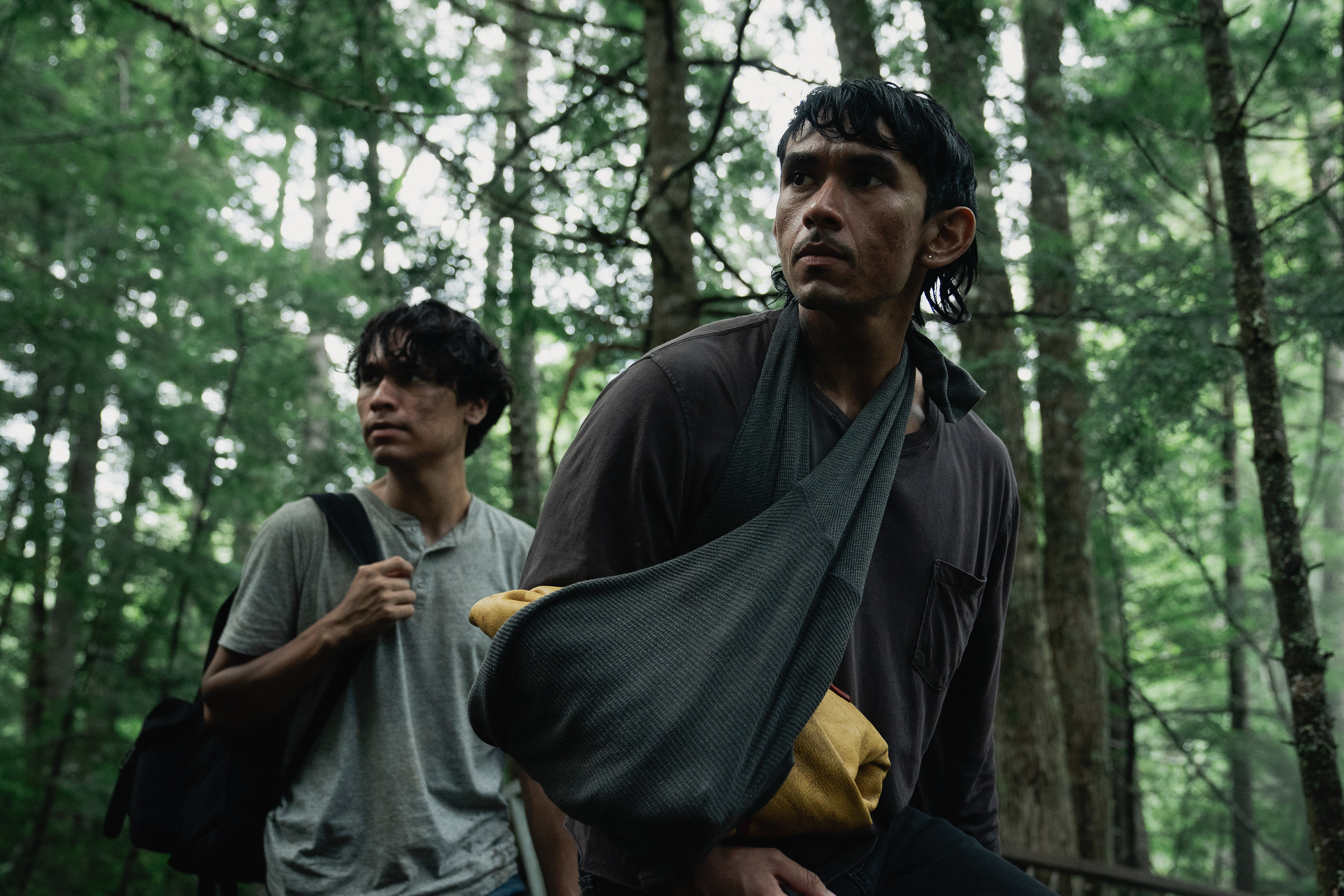
Bretten Hannam’s Sk+te’kmujue’katik (At the Place of Ghosts) is an emotional masterpiece that left me yearning for a DVD copy to take home and rewatch, rewind, pause, and bask in. From the immersive sound production, which Hannam was directly involved in, to the incredible performance of lead actors Blake Alec Miranda and Forrest Goodluck, Sk+te’kmujue’katik is one to add to your watchlist.
Having moved to Canada for university, my time in Toronto has led to my first introduction to Indigenous history, stories, and culture. It was incredible to see, for my second year in a row, Indigenous cinema and stories being showcased at the Toronto International Film Festival (TIFF).
Sk+te’kmujue’katik was a movie I knew I had to watch from the moment the TIFF schedule came out in August, and it was worth the wait. The film is in English, French and Mi’kmaw. Hannam’s storytelling is multilayered, about Canada’s colonial history and Mi’kmaw culture and teachings, making Sk+te’kmujue’katik a true gem at the festival.
Sk+te’kmujue’katik works in decolonial, non-linear time, and follows siblings Mise’l (Miranda) and Antle (Goodluck) as they face a haunting presence from their past. To depict trauma allegorically, the film uses elements of horror, such as the appearance of spirits from the characters’ individual and collective pasts — including spirits of their abusive father and of colonized ancestors. Some are benevolent, offering food and shelter, while others terrify both characters and audience.
It isn’t long into the movie before one of these spirits from their past appears, and corrupts the very air it touches, with dead leaves flurrying off it. The spirit presents a visual representation of the trauma eating away at Mise’l, Antle, and their more-than-human kin — a concept introduced by Indigenous scholars which emphasizes the recognition of nature not only as a resource, but as something that lives alongside us, that we are connected to.
Mise’l convinces Antle to go into the forest, and the two embark on a journey surrounded by humanoid tree trunks and mossy groves. They are aided by spirits of their past and future, and their more-than-human kin in the forest. Added to the eerie atmosphere the forest creates is the striking artistry of the makeup department, showing the impact of trauma on the body through dark, veiny marks on Mise’l and Antle’s bodies.
In this forest of temporal uncertainty, where time follows a winding path, a collective healing takes place as elders, great-grandfathers, grand warriors, and future children aid the heroes on their journey.
Sk+te’kmujue’katik reads as a story of decolonial healing together, through community. While the significance of the spirits is up to interpretation, to me, they represent the lasting effect of mass suffering that was left with the Indigenous peoples in Canada due to colonization, and how important community and togetherness are in a healing process.
The ending is hauntingly beautiful, with their father’s body returned to the lake and the two siblings lying on their canoe — one of their more-than-human kin, and a vessel of healing as they float in the lake. Their journey is over; they have reckoned with their traumatic past, their family’s past, and are prepared for whatever the future might hold.

No comments to display.