
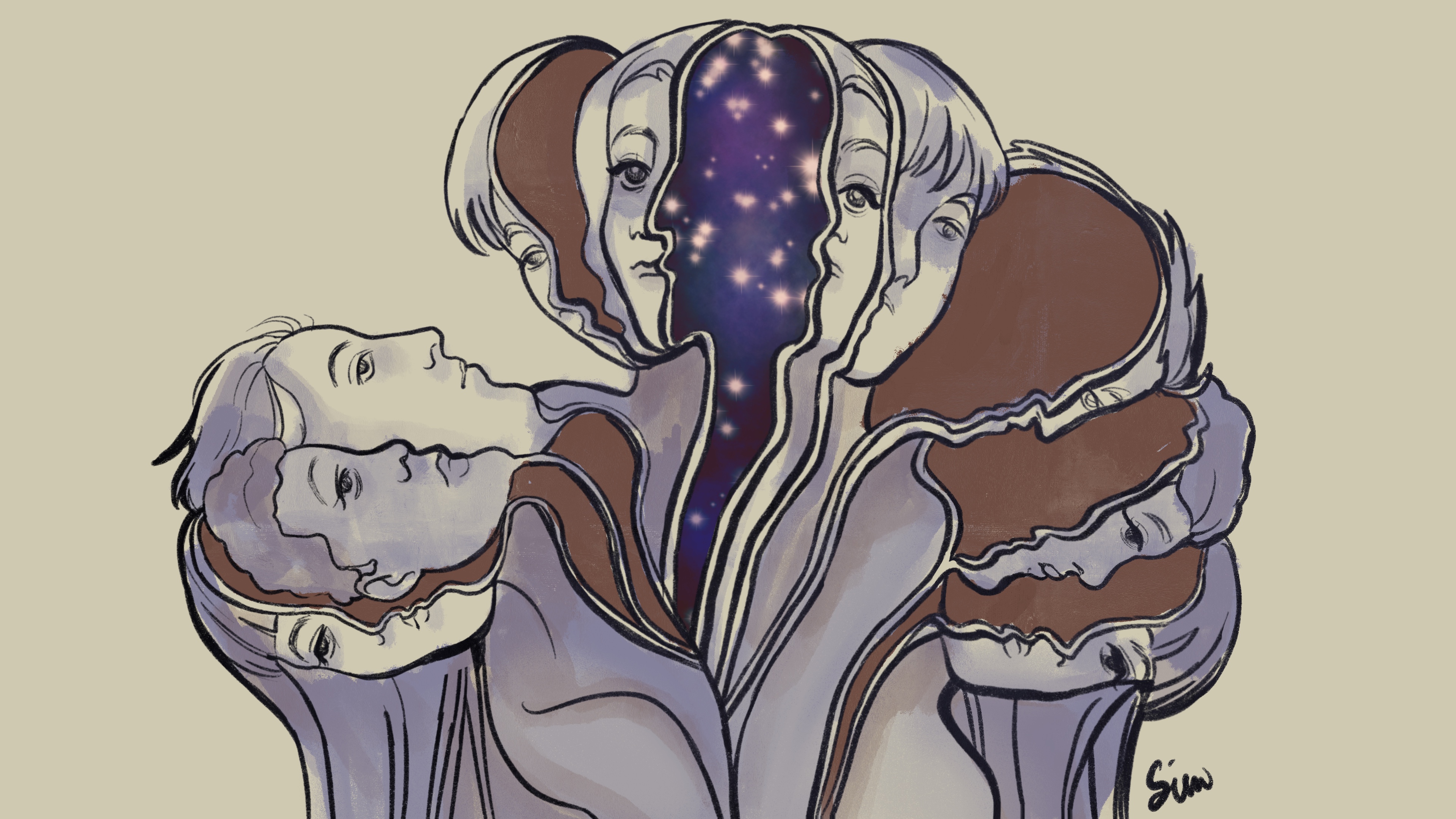
I often avoid voicing my opinion in heated discussions with friends and family. A long-gone Instagram post I once saw pointed out that an aversion to conflict is common among youngest siblings who may have often felt ignored or unimportant in their childhood.
While I no longer remember which self-proclaimed Instagram therapist made this insightful post, it lurks in my mind, providing me with explanations I’ve long searched for to justify my behaviours.
I see an increasing number of social media posts talking about similar theories for why people develop certain personalities or behaviours. For young people who are trying to discover their identities or who struggle with their mental health, easy access to mental health information on social media might seem like a good thing. But I think it’s leading to an onslaught of ineffectiveness and inaccuracy when it comes to actually trying to understand ourselves and our mental health.
Internet theories and internet therapy
‘Birth Order Theory’ — the school of thought behind that Instagram post about conflict avoidance and being the youngest sibling — suggests that family birth order — whether you’re an oldest, middle, youngest, or only child — can influence personality traits and behavioural patterns, based on differing treatment of siblings by their parents and by each other.
While people can develop various traits independent of family dynamics, I, along with many others, find that theories like this one retain some validity in uncovering how interpersonal relationships in childhood influence adult behavioural patterns.
In this way, some of those social media posts about developmental theories can be comforting, validating, and provide insightful explanations for our bad habits and struggles today. Birth order theory was revolutionary for understanding the root cause of my tendency to shut down when trying to express myself in group conversations.
However, I remember getting caught in a train of thought where I was contextualizing the idea of myself purely within family dynamics, letting that dominate my view of myself. I recognized that I share some traits and habits with other younger siblings, but what does this mere acknowledgment really do for me if I’m treating it as a way to actively avoid correcting my harmful habits?
Surface-level self-improvement
While some online mental health theories serve an educational purpose, the way they proliferate can be damaging. Not only do they simplify complex topics into short-form content, but they also lack the intimacy that comes with seeing a mental health professional one-on-one. Having a surface-level understanding of mental health gained from social media does not mean you have diagnostic authority, and this kind of thinking leads to practices like therapy-speak.
Therapy-speak refers to the casual usage of psychological terminology used by mental health professionals. Jargon regarding mental health is widely used on social media and has found its way into everyday conversations. Friends acknowledge their ‘quirky’ avoidant-attachment styles in relationships, but continually cry when their failed relationships leave them feeling burnt out or undervalued.
What a lot of people seem to forget is that these attachment styles are rooted in one’s childhood development. Attachment styles aren’t merely an indicator of how we act in romantic relationships, but extend to how the particularities of our childhoods influence how we connect with others throughout our adult lives.
While therapy-speak can be a way to take the first step toward understanding ourselves and improving our mental health, it is up to us to take the next, often harder, steps toward tangible self-improvement.
Many of us who yearn to feel seen or recognized might go online to learn more about ourselves and connect with others like us. For young people, the internet and social media are like our natural domains. Therefore, it only makes sense that that’s where we’d forge our identities through all the personality and behaviour theories, and mental health content. But the theories that Instagram and TikTok provide miss the nuances that define us as individuals, and place them under labels they don’t adequately belong to.
I’ve been reduced to tears by posts that have forced me to come to uncomfortable realizations about myself. How can I differentiate between the trend of identifying with experiences popularized on social media — which I thought were unique to me — from the desire to know who I am? I feel further from knowing ‘myself’ than ever.
Acknowledging and uncovering my mental health
When I was 13, a friend was telling me about Attention Deficit Hyperactivity Disorder (ADHD). She suggested that my patterns of forgetfulness and procrastination might be signs of ADHD. I promptly fell down a rabbit hole of Google searches about ADHD — each symptom I identified with felt increasingly validating.
All my favourite social media sites seemed to indicate that I have ADHD, from informational posts on Pinterest about Executive Dysfunction to reels on Instagram explaining different types of hyperactivity. I thought if I had a tangible reason for why I am the way I am, maybe I could finally be understood, as someone who simply had ADHD, and not someone who constantly made mistakes or misbehaved.
I thought that having a clinical diagnosis that explained my habits would make me feel less like I was functioning differently from my peers. But beyond feeling like I belong to the category of people with ADHD, no diagnosis would change what I knew for certain: that I was ultimately an imperfect, mistake-making being, and merely coming to terms with my mental health status would not suddenly end my quest to work on myself.
The stigmatization of ADHD and other mental health disorders has prevented me from contacting a professional and getting a formal diagnosis. For years, I’ve been anxious to have confirmation of what was ‘wrong’ with me, yet fearful of how I and others would feel if I knew. The massive amount of content online discussing ADHD propelled my desire to know. In the midst of all this information about who I might be, I found it difficult to truly understand and recognize myself.
Over the years, I’ve grown to have a deeper understanding of mental health as a whole, and have learned what it means for me to struggle with my mental health. Coming to know what my bad habits were came with the temporary relief of emotional validation. But it’s not enough to be able to identify the root of your emotional or behavioural issues — you have to take actionable steps toward working on them.
Generational cluelessness and criticism
I know that I’m not alone in my desire to truly explore and understand myself. Many other young people whose lives are entangled with social media experience the same digital distortion of things like their mental health and interpersonal relationships.
For centuries, humans have long had a hungry desire to understand themselves — philosophically, emotionally, mentally, you name it. Millennia ago, philosophers heavily debated the question of what the soul is. We have always, and likely will always, ask questions about what, who, and why we are. Almost all of us spend a lifetime searching for the answers to these questions.
The generation gap has always existed. The term refers to what EBSCO Knowledge Advantage terms the “disconnect between different generations” as they grow up in changing cultures. For example, older generations often struggle with constantly evolving technology. Similarly, mental health is a topic that is often misunderstood and undervalued by Generation X and Baby Boomers, because its importance is not often recognized or prioritized.
This is nothing new: generations have long criticized those who precede them. For thousands of years, it seems, younger generations just haven’t been able to convince their elders that the differences between them are not inherently negative.
What might be new with the generation gap is the role that social media plays in widening it. Because our lives are so intertwined with our screens, our parents and grandparents seem exponentially more socially or culturally distant from us than they were from their parents.
If older generations are already less inclined toward valuing therapy, coupling that with their struggles and/or dislike of new technologies and social media makes phenomena like therapy-speak seem like a ‘Gen Z’ issue.
For those of us struggling with understanding ourselves, when we finally find the answers and find comfort in who we want to be, oftentimes our parents, or other elders around us, begin to take up issues with who we’ve decided to be and how we learn about ourselves.
Self-acceptance as the path forward
In short, the struggle doesn’t ever really end — like our parents have and our children will, we all struggle with this overwhelming desire to know and understand ourselves. We might turn to the ever-dominant sphere of social media, which will provide new niches, labels, or categorizations for us to identify with.
To fight this, spirituality and religion serve as a stable respite for me amidst the trend-driven instability of social media. Prayer and faith elevate me above the pains of the past and anxieties about the future, acting as a concentrated moment of reflection in which I focus on something larger than myself altogether.
Whether it’s social media, whatever hot topic of conversation people are discussing, or my everyday life — prayer becomes a break from it all. The nature of prayer for me is such that I enter into a meditative state of mind where I focus solely on God. I entrust my worries to a power much higher than myself. And suddenly, whatever problem I’m facing matters just a bit less. Religion provides a clear purpose for me: to connect with God. And amongst the surrounding conversations, reels, and videos, the clarity is uplifting, and provides peace.
The world is like the train platform at Union Station, each train going in and out is reflective of past, present, and potential future selves. You’re never going to pin down a singular, unmoving ‘self’ — you’ll always find yourself changing and evolving. A social media trend may be part of your journey, but it can’t provide the knowledge, direction, or stability for you to reach your end destination. Self-reflecting on your own terms, understanding your mental health and wellbeing, and taking actionable steps toward self-betterment are the best ways to uncover your true ‘self.’ To me, this realization is the sweetest fruit of introspection.
