
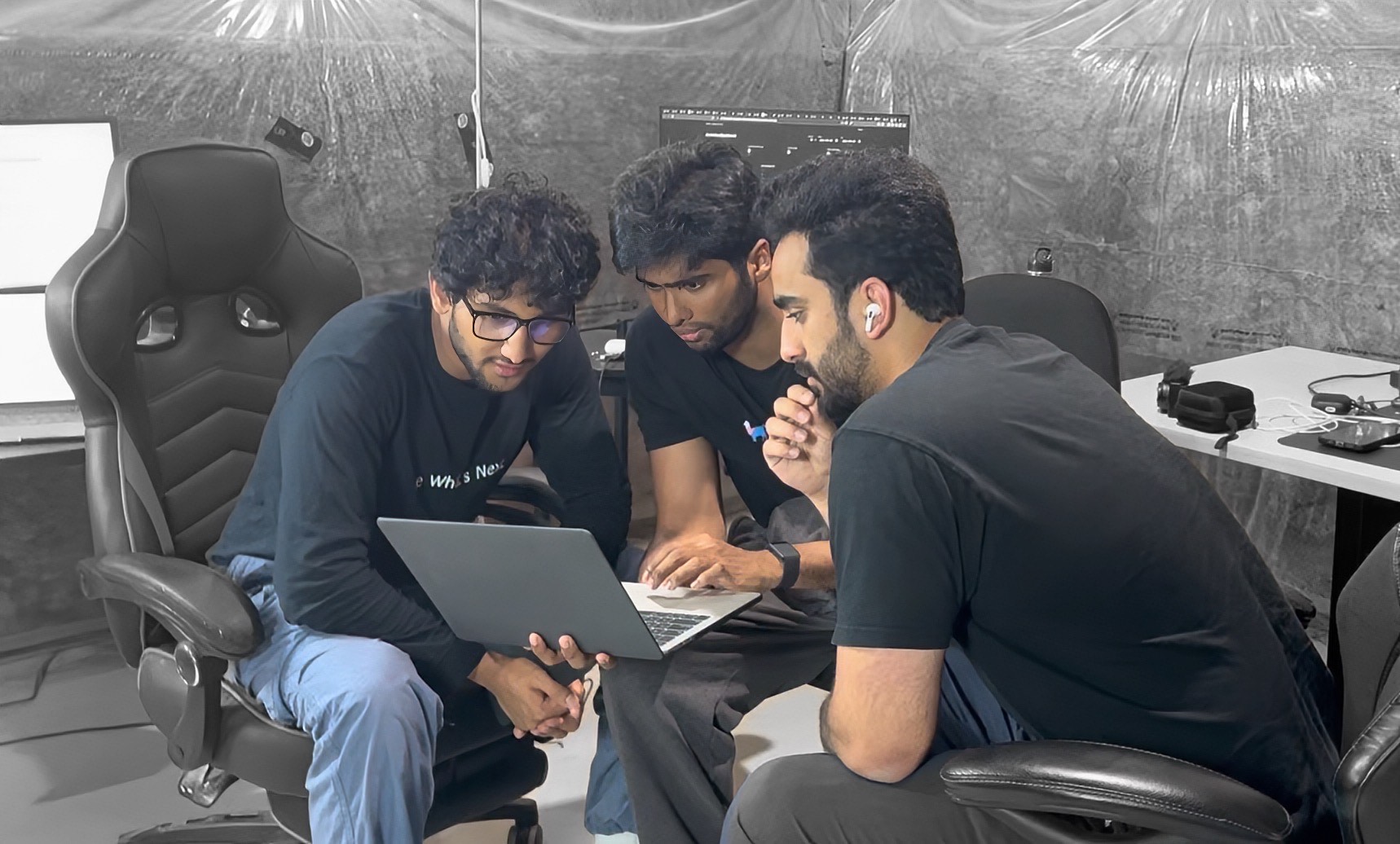
Three U of T students realized an important truth during their summer internships: as technology advances, genuine in-person connections are becoming rare. That insight inspired them to create Offline — an app that matches users based on their proximity, interests, and hobbies.
In an interview with The Varsity, co-founders Vikram Narra, Syed Asad Hussain, and Haris Malik — all fourth-year computer science students — shared the inspiration and journey behind their startup.
From late-night idea to startup
Offline was born when Narra posed a question: “What if two people walk past each other and they get a notification on their phone, matching them based on compatibility?” Offline offers more than just matching users. Its ‘wave’ feature lets users request a match after viewing someone’s profile — sending a wave that the other user can choose to accept.
Following the beta release, Offline added a feature that, as Hussain explained, lets users “read other people’s thoughts in the room.” The feature, inspired by Instagram Notes — where users share their thoughts with followers — limits visibility to people within a certain radius on Offline.
Narra says that the startup aims to build a community at U of T before expanding to other universities. “We’re trying to niche it down to just universities… similar to what Facebook did in its early days, releasing it to Harvard and then all the Ivy Leagues,” he said.
Offline’s privacy features
Building trust and protecting privacy is central to Offline’s strategy. They plan to use Bluetooth Low Energy (BLE) to connect users based on proximity, removing the need for GPS location sharing. BLE functions like regular Bluetooth but consumes less energy while maintaining the same range. Using Bluetooth Low Energy, the app works “without WiFi, without data, without your location sharing, and it will be completely private, ” explained Malik.
Users can customize what they share through in-app filters. “The main thing for us is that we want to give the user as much control as possible — over who they can match with [girls only, men only, or both] and even where they can match,” said Narra.
Advice for aspiring entrepreneurs: Lessons from the founders
The Varsity asked the founders what advice they have for aspiring entrepreneurs, AI enthusiasts, and students hoping to break into the field.
Narra wrote in an email to The Varsity that students should “be delusional.” Adding, “we would have absolutely nothing in terms of a [minimum viable product] (MVP), but we would email investors and talk to them as if we were sitting on a gold mine.” An MVP is a basic version of the final product that users can test out before the official product launch.
When answering how you can grow in your career, Hussain wrote, “being a likable person… goes a long way. Most interns bring roughly the same technical skills, but not the same soft skills. Teaching someone a new programming language is easy; teaching someone to be likable is not. To truly stand out during your [work experiences], you need to develop strong soft skills.”
Malik points to his technical experience, explaining how important it is to build a variety of skills. “Working on everything from drones to humanoid robotics taught me to set a high bar, think deeply about human needs, and navigate complex systems. Each of those experiences pushed me to see challenges from new angles and deliver work that really matters — skills I’m now pouring into building Offline,” he wrote.
