
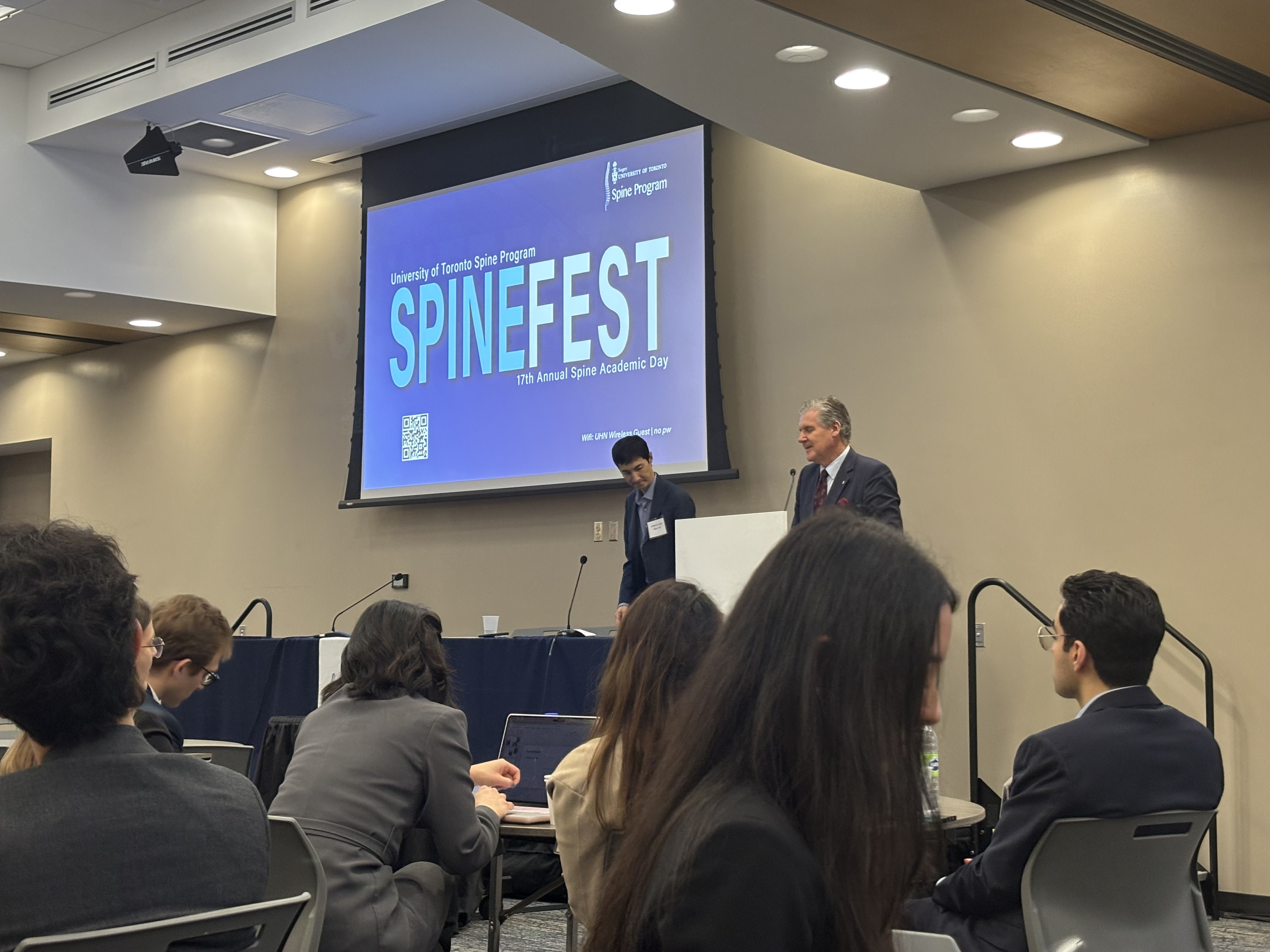
On June 9, clinicians, research trainees, and physician-scientists came together to present research and findings in the field of spine surgery at SpineFEST 2025. Hosted by the U of T Spine Program — a program within U of T’s Department of Spine Surgery — the event brought together leading experts and researchers in the field of spine surgery to the forefront.
The event was opened by Dr. Michael Fehlings, the Co-Director of the U of T Spine Program, Head of the Spinal Program at Toronto Western, and Professor of Neurosurgery. U of T Neurosurgery Resident Dr. Husain Shakil presented an abstract on spine metastases at the conference, titled Home Time and Survival after Surgery for Spinal Metastases: Development and Validation of the Home Time and Overall Survival after Metastatic Spine Surgery Estimator (HOME Score).
Spine metastasis — or spinal metastatic cancer — is a type of spine tumour that occurs when cancer spreads to the spine from elsewhere in the body. It poses significant challenges for treatment and quality of life for the patient.
Dr. Shakil’s presentation spoke about the clinical prediction model he and his team developed to estimate both home time and survival likelihood after spinal metastases surgery.
Predicting patient prognosis — HOME Score
There is a lot of ambiguity on patient outcomes after metastatic surgery, as prognoses tend to fall on a wide spectrum. Some patients may recover well and return home quickly, while others may face significant complications, limited mobility, or shortened survival times. This unpredictability makes it difficult for physicians to guide treatment decisions, and for patients and families to prepare for what lies ahead.
Determining whether patients should undergo metastatic spine surgery is challenging because outcomes can vary widely depending on tumour type, overall health, and expected recovery. This uncertainty often leads to differing opinions between surgeons and primary care providers, leaving patients confused and burdened with difficult decisions.
Dr. Shakil and his team developed a novel clinical prediction model that has the potential to improve decision-making — weighing the risks, benefits, and likely recovery after metastasis surgery. The HOME model, or the Home time and Overall survival after Metastatic spine surgery Estimator model, was the focus of the abstract. The HOME model predicts whether patients with spinal metastases are likely to benefit from surgery based on 17 items that predict home time and 24 items for survival, such as demographics, comorbidities — the presence of other diseases — and presentation of the cancer.
The data from the model will serve as a tool for physicians to support more accurate and efficient patient management decisions, ultimately reducing wait times in trauma centers, optimizing surgical resource use, and ensuring patients receive care more quickly.
Understanding the HOME Score
Researchers conducted a population-based cohort study — a specific category of epidemiology studies that follows a defined group of people over time to examine links between exposures and outcomes. It was conducted in Ontario, Canada, and included 2,348 adult patients who underwent metastatic spine surgery for tumours that had spread, or metastasized, from cancer elsewhere in the body between 2005–2020.
Patient data was divided into two cohorts: a training cohort of people who had surgery from 2005–2018 whose experiences were used to develop the HOME model, and data from people who had surgery from 2019–2020, which was used to assess how well the model performs on more recent patients. These two cohorts ensured the model’s predictions remained accurate and relevant.
In this study, the results confirmed that the HOME model could reliably identify patients most likely to benefit from surgery for metastatic spine disease.
The model focused on predicting two key outcomes: whether patients would spend three months or less at home following surgery — referred to as “home time” — and their overall survival at six months, one year, and one and a half years post-surgery.
Lung and breast cancers were the most common primary malignancies which then spread to the spine. The final model achieved reliable estimations of home time and survival, marking significant advancements in preoperative risk stratification — the process of evaluating a patient’s health before surgery to predict their likelihood of developing complications or experiencing adverse outcomes such as death or infection.
Dr. Shakil’s work demonstrates how computational modelling can be harnessed to support clinical decision-making in complex surgical settings. The HOME model offers a promising tool to enhance patient care while addressing broader system-level challenges related to triage and resource allocation in spine oncology.
