
Toronto’s 2025 summer was particularly notable for the heavy smoke that filled the air, which made the typically hot but manageable season especially unbearable.
Along with the temperatures, the risk of overheating and air pollution in the city also rose. While Toronto might have seemed sheltered from the wildfires that have been plaguing western Canada this year, the smoky city skyline proved otherwise. Seeing the fires edging as close as Ontario’s cottage country was frightening for those of us in eastern Canada, who watched the wildfires spread on the news last summer.
Canada is currently facing its second-worst wildfire crisis of all time, only doing better than the 2023 season. Our world’s warming climate has contributed to larger and more destructive fires, and consequently, more smoke-induced health issues, like reduced lung function, asthma, and cardiovascular disease.
Wildfires, their large-scale damage, as well as the personal health impacts they cause, are just some of the many consequences the world is facing as a result of climate change. In the face of clear effects of the changing climate, people around the world are feeling helpless in the face of an incrementally deteriorating global climate. Increasingly, we are compelled to consider who is responsible for climate action.
Eco-anxiety: climate doom
Eco-anxiety, a feeling of distress or worry over the state of the environment and the future, is common among young people. This stress is often exacerbated by news headlines and information online, reinforcing a sense of helplessness or “point of no return” — a term of the popular Climate Clock, which is a countdown that tracks the time we have to reach zero carbon emissions. The clock also tracks progress for key solutions, like preventing the overexertion of the carbon budget and increasing the agricultural sector’s contribution to food production.
A 2021 study from the University of Bath invited 10,000 people aged 16–25 in 10 countries — Australia, Brazil, Finland, France, India, Nigeria, the Philippines, Portugal, the UK, and the USA — to participate in a survey. The study found that 60 per cent of the participants were immensely worried about climate change, and 75 per cent were scared for the future. 45 per cent reported that eco-anxiety negatively impacted their daily functioning, including eating, concentrating, sleeping, and attending school.
Urgency is often a major variable in the decision-making process, and how we respond to it can determine whether we find the pressure to act to be a motivating force, driving us to adopt meaningful lifestyle changes; or if it is overwhelming, causing us to disengage from the issue of climate action altogether.
With mounting emphasis on making personal choices to do our part in reversing the climate’s catastrophic course, how are U of T students responding?
Campus climate choices
“I definitely feel a sense of urgency,” Mariam Aboalsoud, a second-year peace, conflict and justice major, wrote to The Varsity. “[T]here’s definitely certain things on my mind that I won’t be able to do or won’t be able to see in the future because of climate change.”
Aboalsoud explains that this sense of urgency can sometimes feel immobilizing, while other times it makes her “want to do things almost faster,” such as travelling while she has the chance, before climate change causes further damage.
Aboalsoud is anxious to visit Egypt, where she has family. “I think about that a lot because [climate change] is affecting Egypt in a very, very drastic way.” Egypt is vulnerable to extreme climate events — like depleting agriculture, coastal zones, and fisheries — due to factors like its reliance on the Nile River for water, and its large and dense population.
This eagerness to quicken life plans in response to the rapid effects of climate change can overwhelm students, leaving many like Aboalsoud caught between engaging with climate action, and feeling defeated or unmotivated.
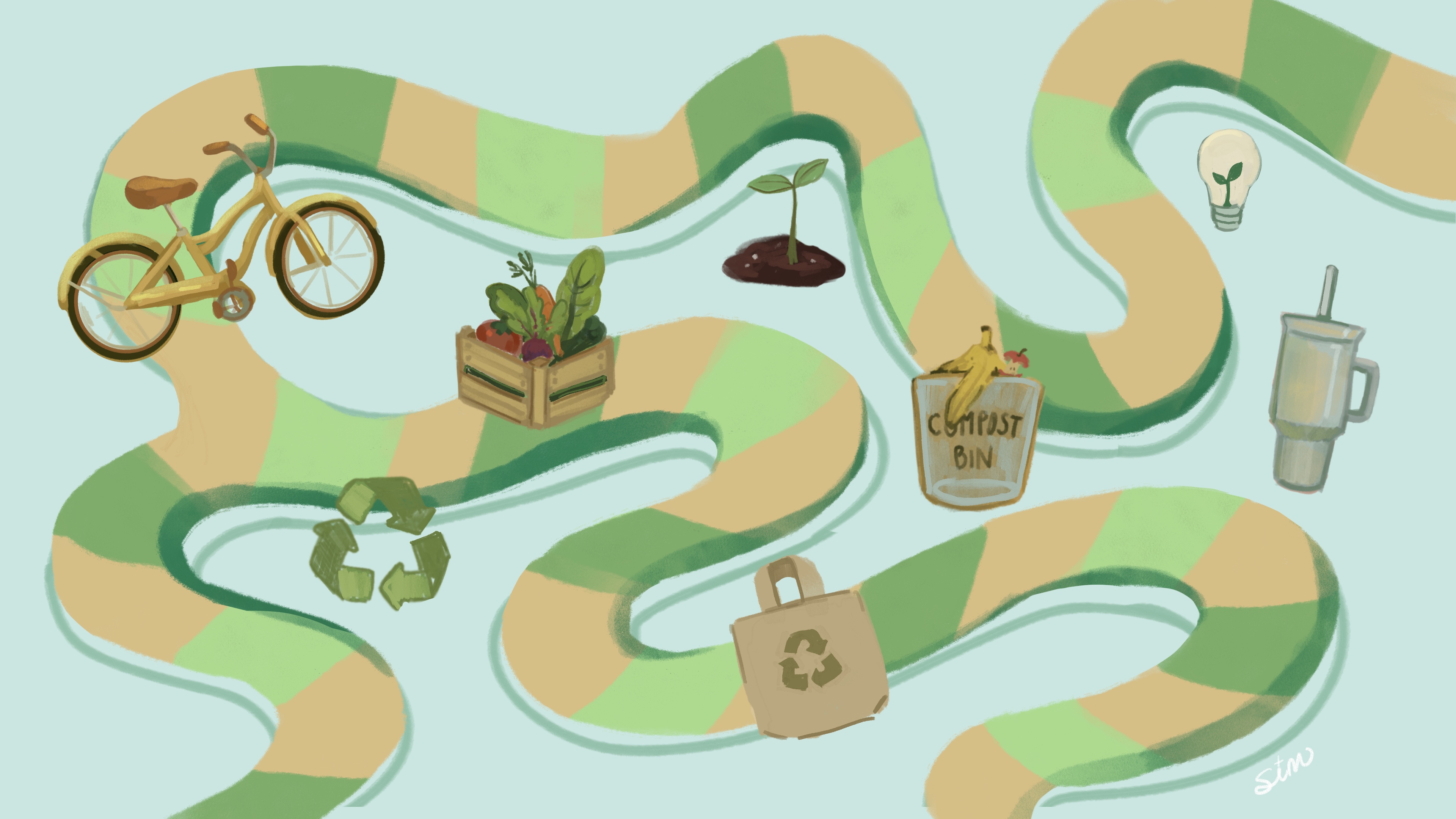
To combat feelings of helplessness, some students and faculty have adopted environmentally-conscious lifestyle choices, like reducing waste and pollution, thrifting and recycling clothing, and opting for alternative forms of transport, including walking and public transport.
This shift in attitudes highlights the link between consumer behaviour and personal values, where clothing, shopping habits, and daily routines reflect a desire to live more responsibly. On campus, I’ve noticed these changes reflected in the prevalence of reusable water bottles, and enthusiasm for thrifting and upcycling.
Many youth are going even farther, extending their sustainability choices beyond the clothes on their back to the food in their bellies.
According to a 2023 survey by GlobeScan — a firm that informs and advises organizations on sustainability — Gen Z is experiencing a significant renewed interest in vegetarianism, veganism, and reducing meat intake as an environmental practice. According to the survey, 27 per cent of Gen Z reported that they eat vegan or vegetarian.
For many, these choices are not only about lowering their carbon footprint but also about cultivating healthier lifestyles, reflecting an intersection between environmentalism and personal well-being. Vegan diets, for example, contain foods that are reported to have health benefits like improving kidney function and decreasing blood sugar.
On university campuses, this food-based transition is often reflected in the popularity of plant-based dining options, student-led initiatives promoting “meatless” meals, and the overarching social media discourse — often led by students — around sustainable eating. Currently, plant-based options are available at dining halls in UTM and UTSG.
Aboalsoud attested to this. “I actively think about consumption and food waste — I hate throwing food out. Also, I’m very aware of how much meat I’m buying; I don’t need to be eating five different types of meat.”
For many young people, food choices have breached the political sphere, acting as a statement of climate-conscious values. By integrating sustainability into something as intimate as their daily diet, young people demonstrate a willingness to embrace change in ways that affect both their individual health and the broader wellbeing of the environment.
Sending global warming away by subway?
Commuting plays a major role in student life at U of T, especially at UTSG, which is located in the public transit-centric hub of downtown Toronto. In turn, many UTSG students utilize options like the subway, streetcars, and buses. “[E]ver since I [began] living in Toronto… I just [take the] TTC or walk everywhere,” Aboalsoud concurred.
While students may choose these more sustainable forms of transportation for convenience or cost effectiveness, rather than environmentalism, public transit is nonetheless a more efficient and environmentally conscious way to get people to their destinations than cars.
In addition to being more efficient and sustainable, urban cityscapes like Toronto benefit from public transit because it creates jobs, reduces traffic, increases walkability, and makes moving around the city more accessible.
While commuting is evidently an integral aspect of living and studying in Toronto, there might be a hidden climate cost to this seemingly climate-friendly mode of transportation.
Second-year commuter and history specialist Svetlana Sobolevskaia wrote to The Varsity that while she often prepares food for the day at home, “it can be pretty difficult when it comes to places like cafés or when eating out,” to reduce her use of plastic. However, buying food on the go is sometimes inevitable for commuters. Their early wake-ups, long travel times, and far distances eat into the time they have to plan and make meals for their long study days.
Sobolevskaia’s experience interestingly contrasts the fact that the availability of single-use plastic is decreasing. This supports the idea that for commuters, who often eat on the go, it’s harder to make climate-conscious eating choices.
Hotter takes
One of the more ‘controversial’ choices some young people are making to be more environmentally conscious is to go child-free. Unlike ‘personal’ lifestyle changes, like thrifting and reducing food waste, this choice elicits heavy debate about issues like individual autonomy versus collective survival and the ethics of reproduction in a warming world.
A 2022 Statistics Canada report showed that over a third of Canadians aged 15–49 don’t intend to have children. Similarly, “the average number of children desired was higher among older people.” While this report illustrates that financial stability compels many young people to go child-free, finances are often coupled with climate fears in Gen Z’s reasoning for not wanting children.
While critics worry about the implications of a population decline on the labour force and the economy, advocates argue that going childfree significantly reduces one’s own carbon footprint and prevents subjecting more people to exponentially worsening climate conditions, like extreme food scarcity and mass uninhabitability.
When asked, Aboalsoud said that family planning wasn’t something she’d really thought about, while Sobolevskaia wrote that although she “understands the need to continue having children,” she doesn’t think that having kids is a climate-friendly option.
Alternatively, Immy Okeefe, a second-year humanities student, wrote to The Varsity that she “personally would not take such drastic steps as not having a child.” The fact that, from only interviewing three people, I was able to get three different views on wanting children in this climate, shows how nuanced debates about this subject are.
Urban infrastructure changes, like pedestrianization projects and car bans, also tend to stir debates. Supporters of these initiatives argue that redesigning streets to prioritize pedestrians, cyclists, and public transit can reduce traffic congestion and emissions, improve air quality, and create safer, more livable cities.
Critics, on the other hand, raise issues of accessibility, economic impact on businesses, and the feasibility of implementing such large-scale changes in a city shaped by car culture.
In Toronto, debates about projects like transforming Yonge Street with wider sidewalks and more benches, or increasing bike lanes, illustrate the division between car-centric road designs and a more sustainable, people-centric city.
Sobolevskaia weighed in on the issue, and supports “creating walkable [cities] to reduce reliance on cars.” She points out that such city planning has already proven “effective in reducing CO2 emissions” in European cities. For example, in Vienna, 44 per cent of people choose to walk as their main mode of transportation; or the CityWalk project, with the goal of increasing walkability across 10 major European countries.
Grassroots or C-Suite, students are stepping up
While the smoke of the environmental crisis is on the horizon, U of T students are curating their daily lives with a consciousness and care that previous generations may not have found necessary. For us, the climate crisis has been a much bigger threat not only to our livelihoods, but to the future generations that some of us want to produce.
But is the fate of the world really in the hands of the people? Or should it rest as a responsibility of major corporations? What about government leaders? Who really has the power and resources to reverse our current climate trajectory?
“Even though I may not see the effects that my small actions have, I believe I’m doing something positive,” wrote Sobolevskaia. “But for there to be an effective solution in mitigating climate change, I believe that there needs to be a systemic and institutional change, and I think that starts with the people electing individuals who believe in the effects that climate change is having.”
Debates about ‘who’ is responsible for climate action are commonplace within climate change discourse. Blame-shifting, accountability, and public image are just a few factors that influence whether people want to claim responsibility for changing the current climate course.
“I do think that systematic and institutional changes [are] necessary to fix this problem,” Aboalsoud wrote. “But I do believe that [at] an individual level, if you don’t care, you will never make it to the systematic and institutional level, so you have to care.”
Whether or not we will all finally come to an agreement about whose responsibility it is to create and follow through on climate solutions, students and youth are making curated choices in their lives, seeing themselves as the starting point to a safer future.
While these curated choices may not solve every climate issue alone, they’re emblematic not only of a growing awareness of climate change, but also of a careful, conscious decision to take actionable steps in our personal lives to help mitigate the climate crisis.
For U of T students, youth in Toronto, and many others around the world, these everyday eco-friendly acts become both survival strategies and symbolic gestures, evidence that even in a time of uncertainty, we’re still trying to choose a better future, one decision at a time.

No comments to display.