
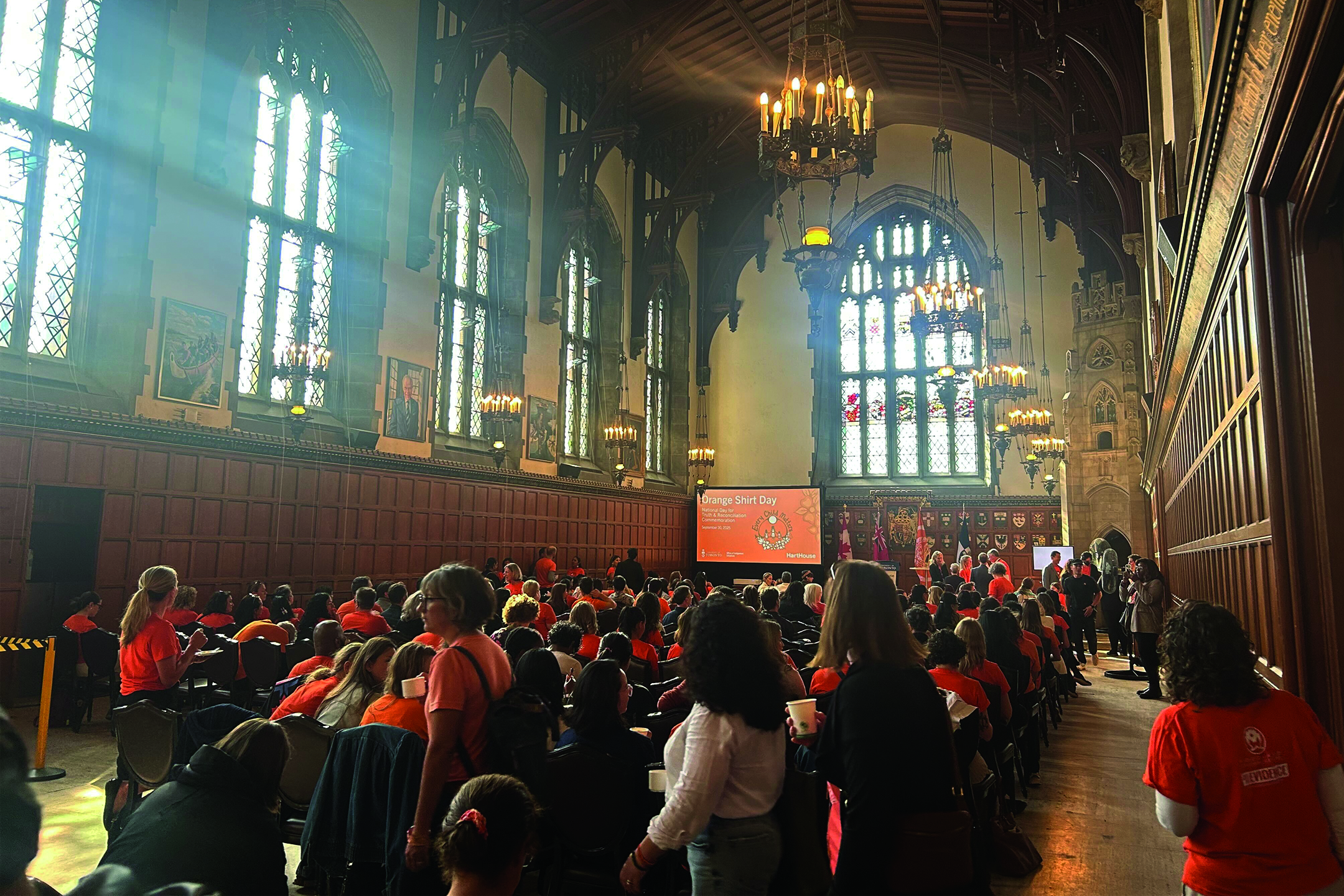
On September 30, the University of Toronto marked the National Day for Truth and Reconciliation (TRC) with a university-wide address and an All-Nations Powwow at UTM, which also honoured Sisters in Spirit Day.
University-wide address on National Day for Truth and Reconciliation
Hosted by the Offices of Indigenous Initiatives, First Nations House Indigenous Student Services, and Hart House, the tri-campus commemoration acknowledged the legacy of the Canadian residential school system. President Melanie Woodin and U of T Vice-President and UTSC Principal Linda Johnston delivered remarks alongside keynote speaker Carey Newman.
In her opening remarks, Woodin noted that the university is “guided by the priorities of [the university’s] Truth and Reconciliation Steering Committee.”
The committee’s 34 Calls to Action are organized into six categories: creating Indigenous spaces on campus, recruiting Indigenous faculty and staff, integrating Indigenous knowledge into the curriculum, prioritizing Indigenous research, providing Indigenous students with co-curricular support, and implementing institutional leadership.
“We’re increasing the presence of Indigenous students, staff, faculty, and librarians. We’re embedding Indigenous knowledge and perspectives into our curriculum. We’re supporting Indigenous-led research and scholarship, and we’re creating spaces that honour Indigenous histories, cultures, and traditions,” said Woodin.
She highlighted the opening of Ziibing — an Indigenous landscape project at Hart House — which responds to the Steering Committee’s call for Indigenous spaces on campus. She also cited the university’s Indigenous Tuition Grant, which covers tuition for students from nine First Nations communities in Ontario.
Vice-President and Principal of UTSC Linda Johnston pointed to the opening of UTSC Indigenous House and added that Indigenous knowledge should not “be treated as a box to be checked.”
Keynote speaker and multidisciplinary artist Carey Newman expressed mixed feelings about inclusion on university campuses.
“When you’re recounting how equity, diversity, and inclusion works in your world, don’t tell me about the number of Indigenous people who work with you, don’t tell me about the number of Indigenous students who are there — tell me about the way that their presence has… transformed the way that we measure success because that’s when I feel included,” said Newman.
In its 2024 Annual Progress Report, the Office of Indigenous Initiatives noted the university’s commitment to “the ongoing hiring of Indigenous faculty, staff, and librarians [and] recruiting Indigenous students.” The Student Equity Census from fall 2023 and fall 2024 reveal that only 0.7 per cent of students identified as Indigenous. According to the 2024 Employment Equity Survey, Indigenous representation among employees increased slightly to 1.4 per cent — a 0.1 per cent rise from 2023.
The report also highlighted challenges faced by Indigenous students, staff, faculty, and librarians at U of T. Respondents pointed to a lack of Indigenous presence compared to the high demand for Indigenous expertise in upcoming initiatives. They also expressed concerns over limited Indigenous input in carrying out TRC goals.
All-Nations Powwow on Sisters in Spirit Day
On Saturday, October 4, UTM celebrated its third annual All-Nations Powwow, coinciding with Sisters in Spirit Day, which honours the lives of missing and murdered Indigenous women, girls, and two-spirit people.
The event featured drumming circles, traditional dances, and a sacred fire where attendees could burn medicinal herbs in a spiritual tradition known as Smudging. The Fire Keeper, responsible for tending the fire, guided participants and explained its cultural significance.
People of all ages and backgrounds were invited to join in song, dance, and prayer. Crowds packed the UTM Recreation, Athletics, and Wellness Centre and explored the market showcasing Indigenous-owned businesses.
Vice-President and UTM Principal Alexandra Gillespie said that she hopes the powwow “takes another step along [the] path [of Truth and Reconciliation.]”
In an interview with The Varsity, third-year digital enterprise management student Blakely Thompson, who volunteers as an Assistant to the Powwow Fire Keeper, discussed the importance of Indigenous positivity on campus. “We love to talk about Indigenous people only in the context of our pain and not in the context of what actually makes us valuable. Being identified only by suffering is restricting [and] focusing on more positive things is really nice. I enjoy it, and that’s what the powwow helps a lot with.”
Thompson expressed hope for change within the university: “My culture allows me to persist in an idea that we actually can, in fact, change these systems. The greatest tool of these systems is convincing you that you cannot change it.”

No comments to display.